Screenshots
See it in action
A modern, intuitive interface designed for productivity.
Warning: May cause sudden urges to containerize everything.
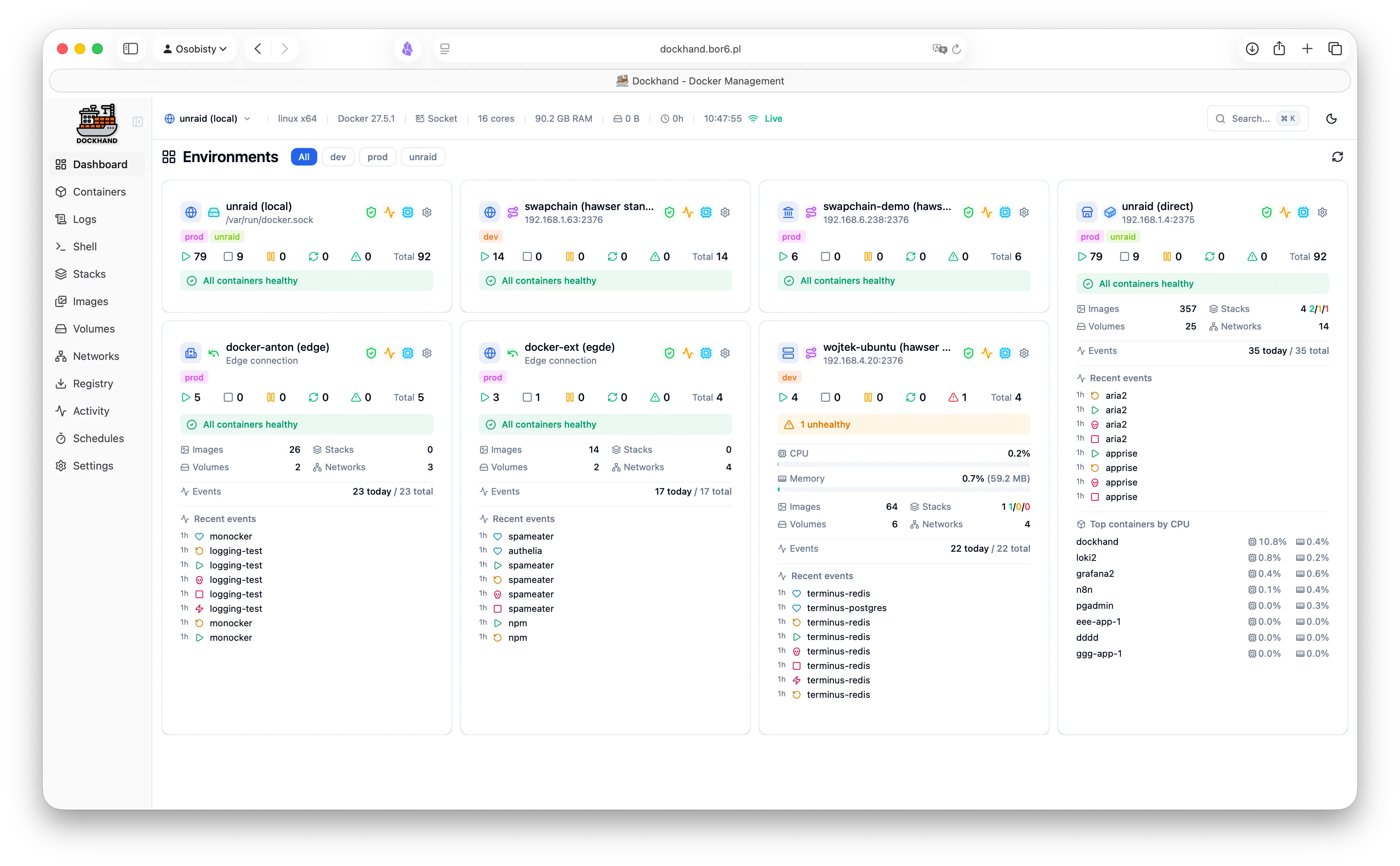
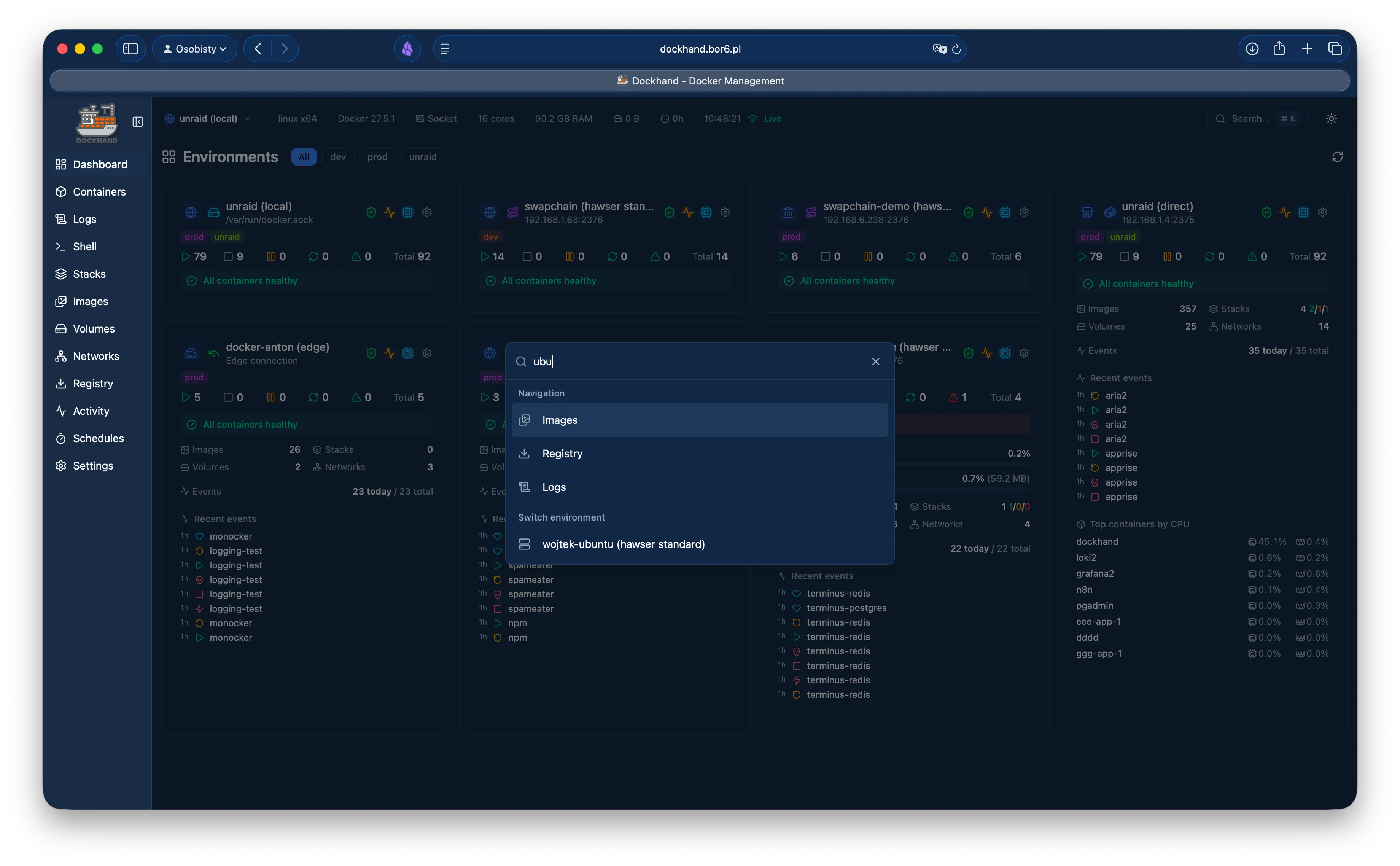
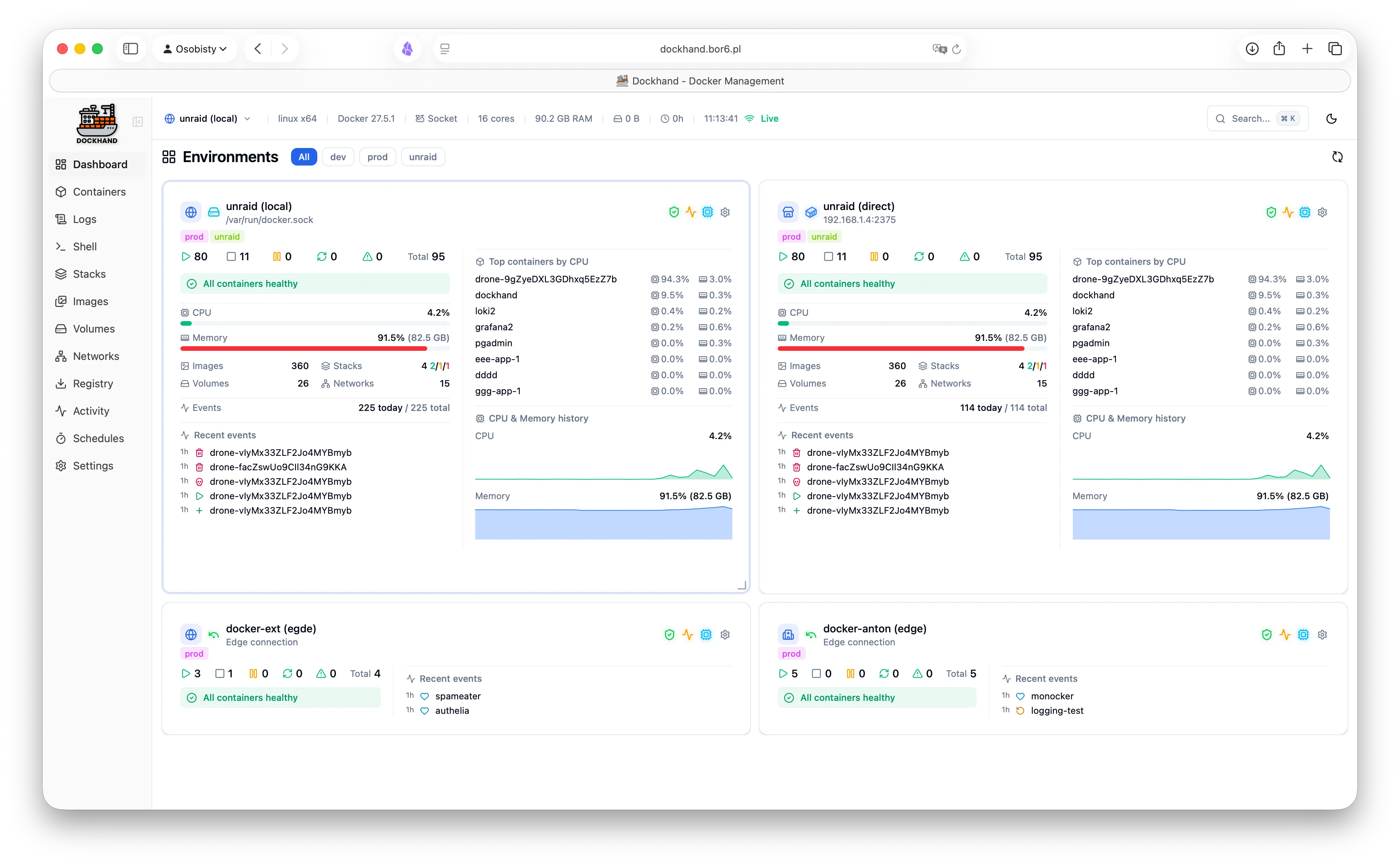
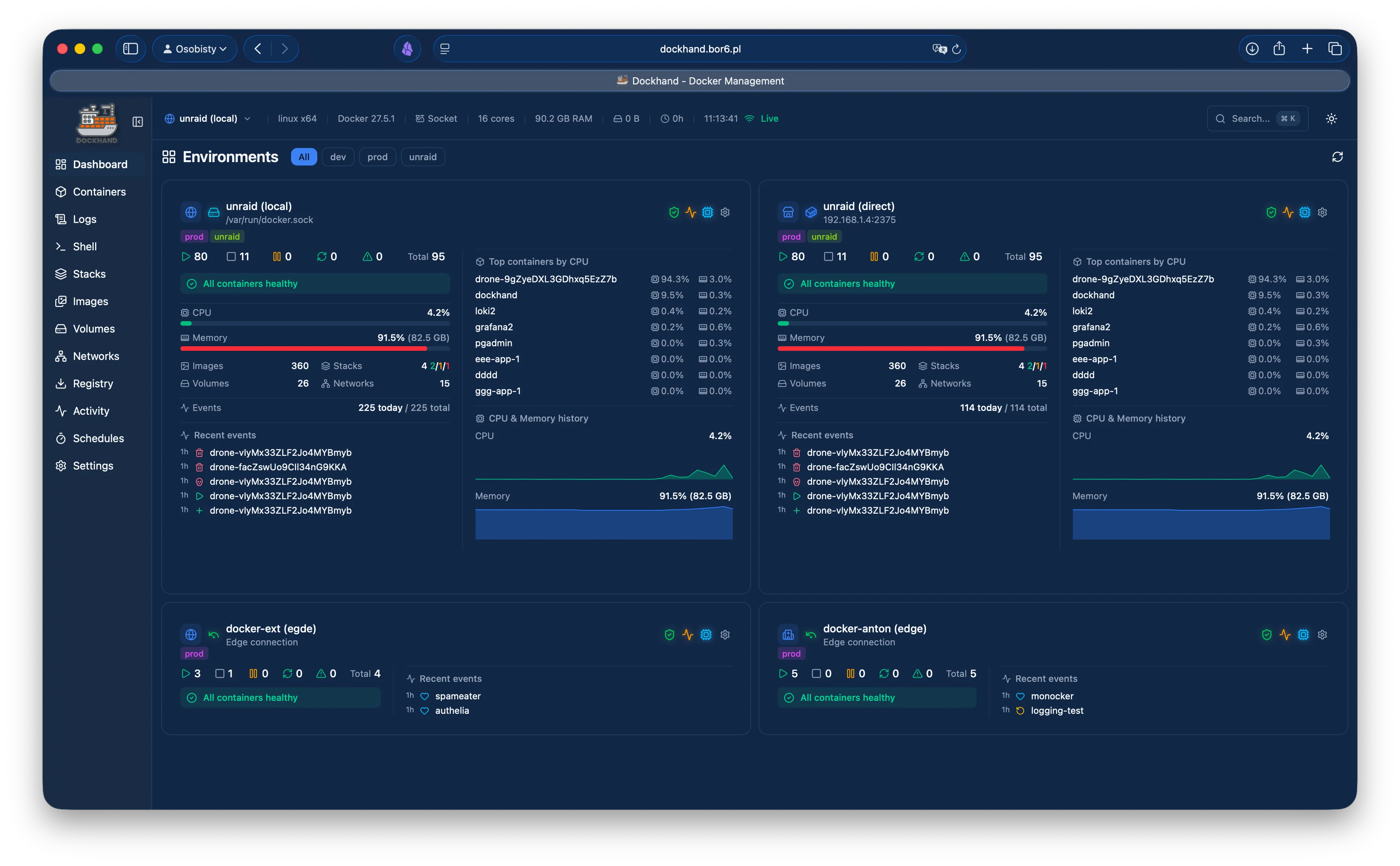
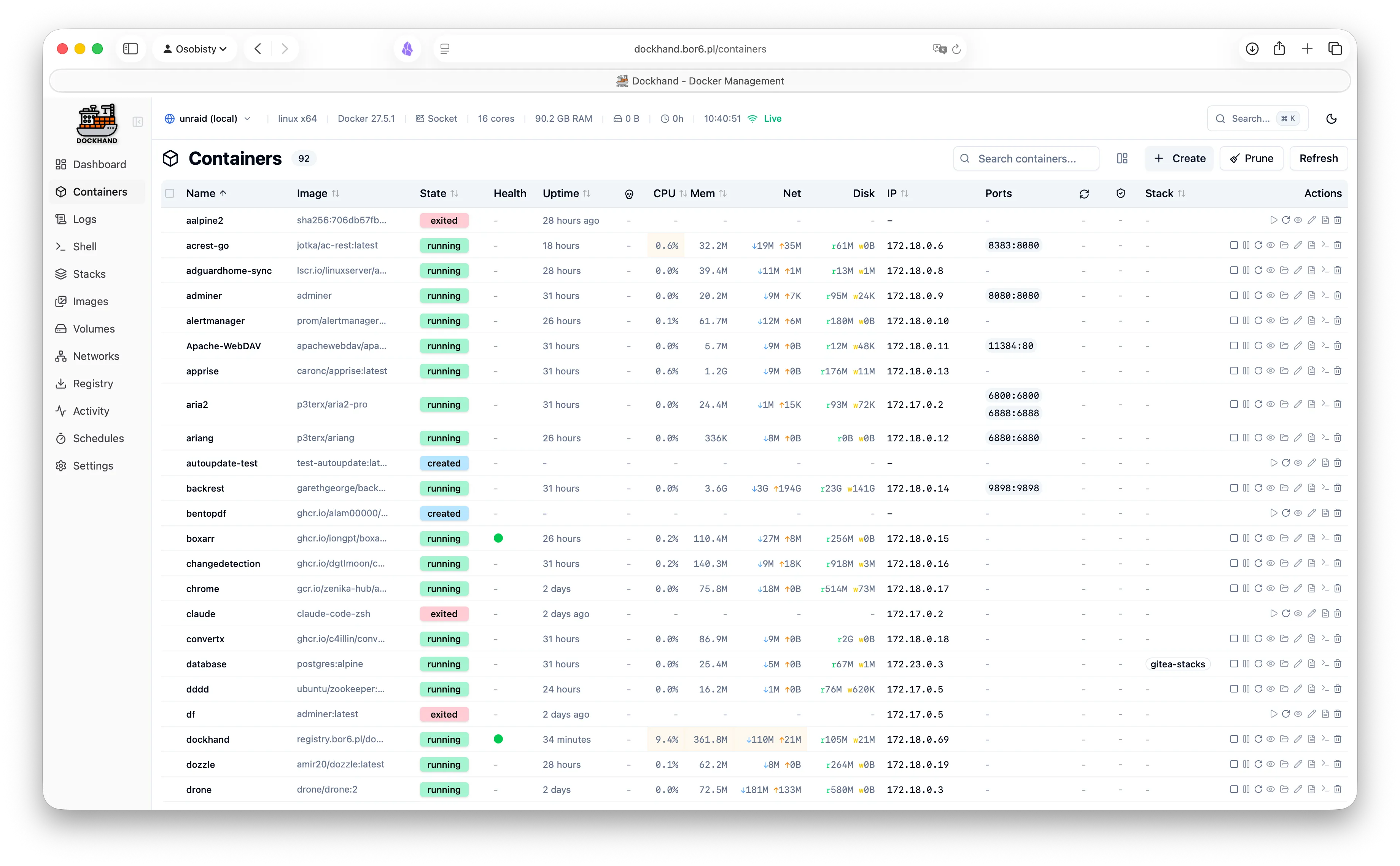
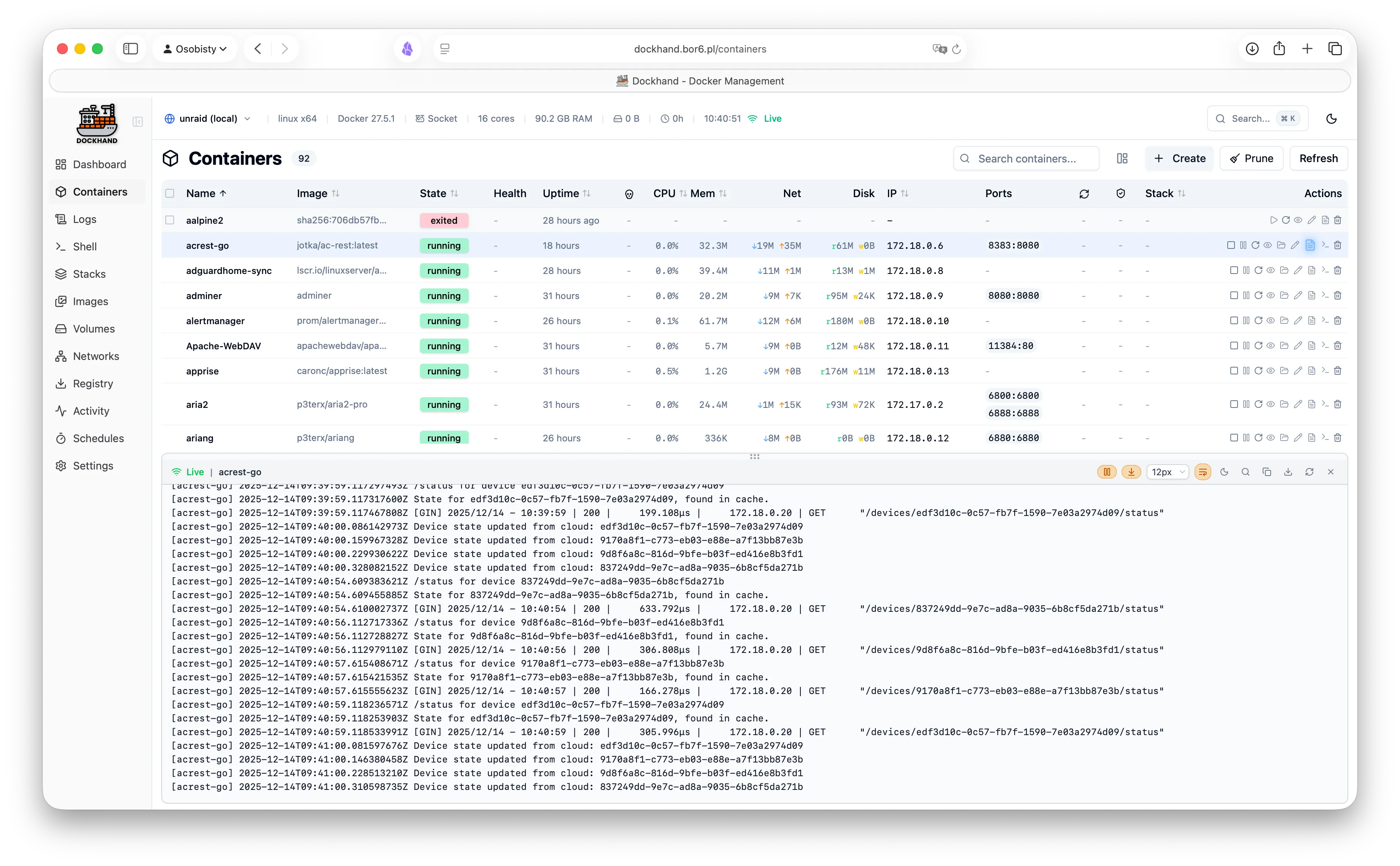
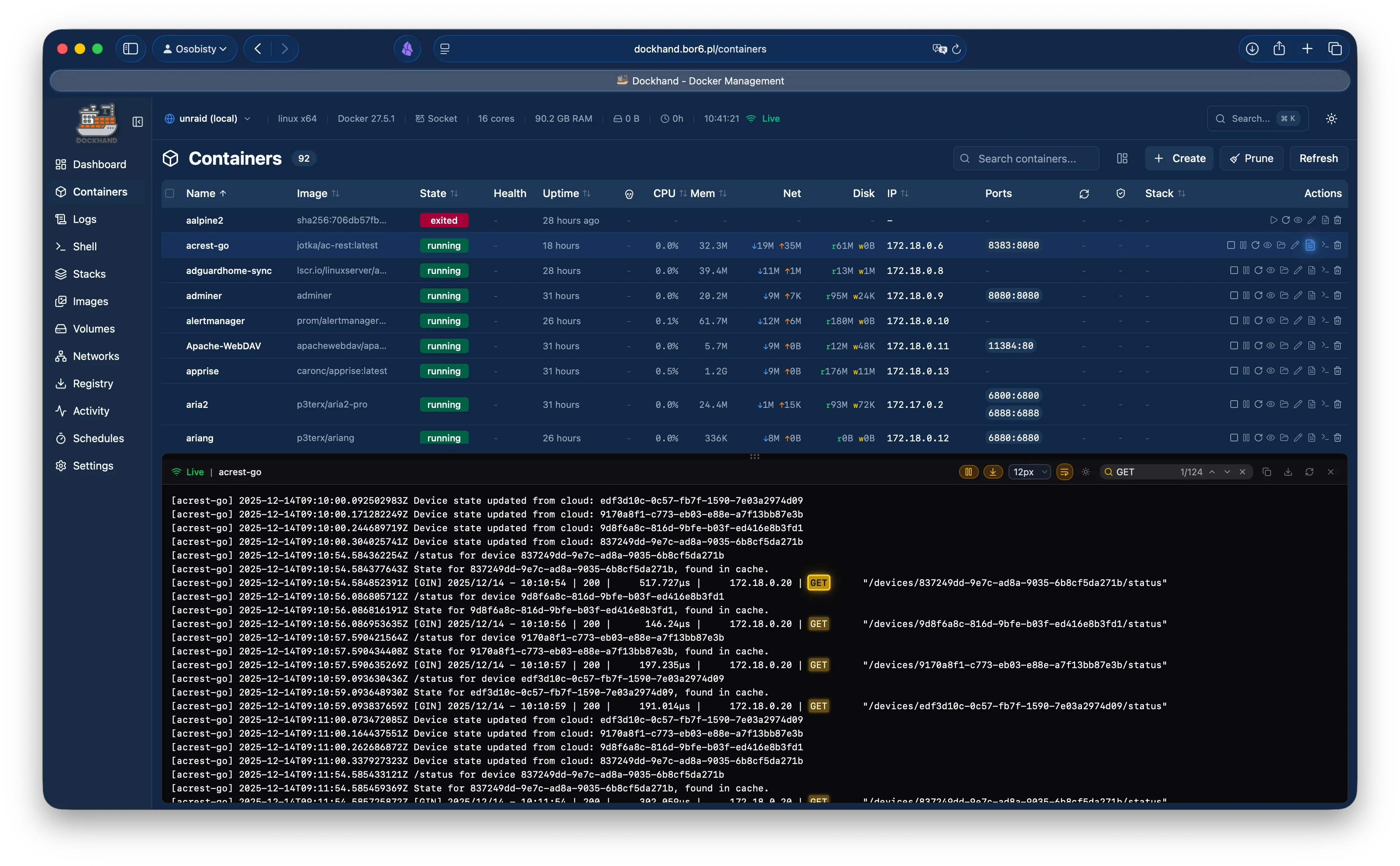
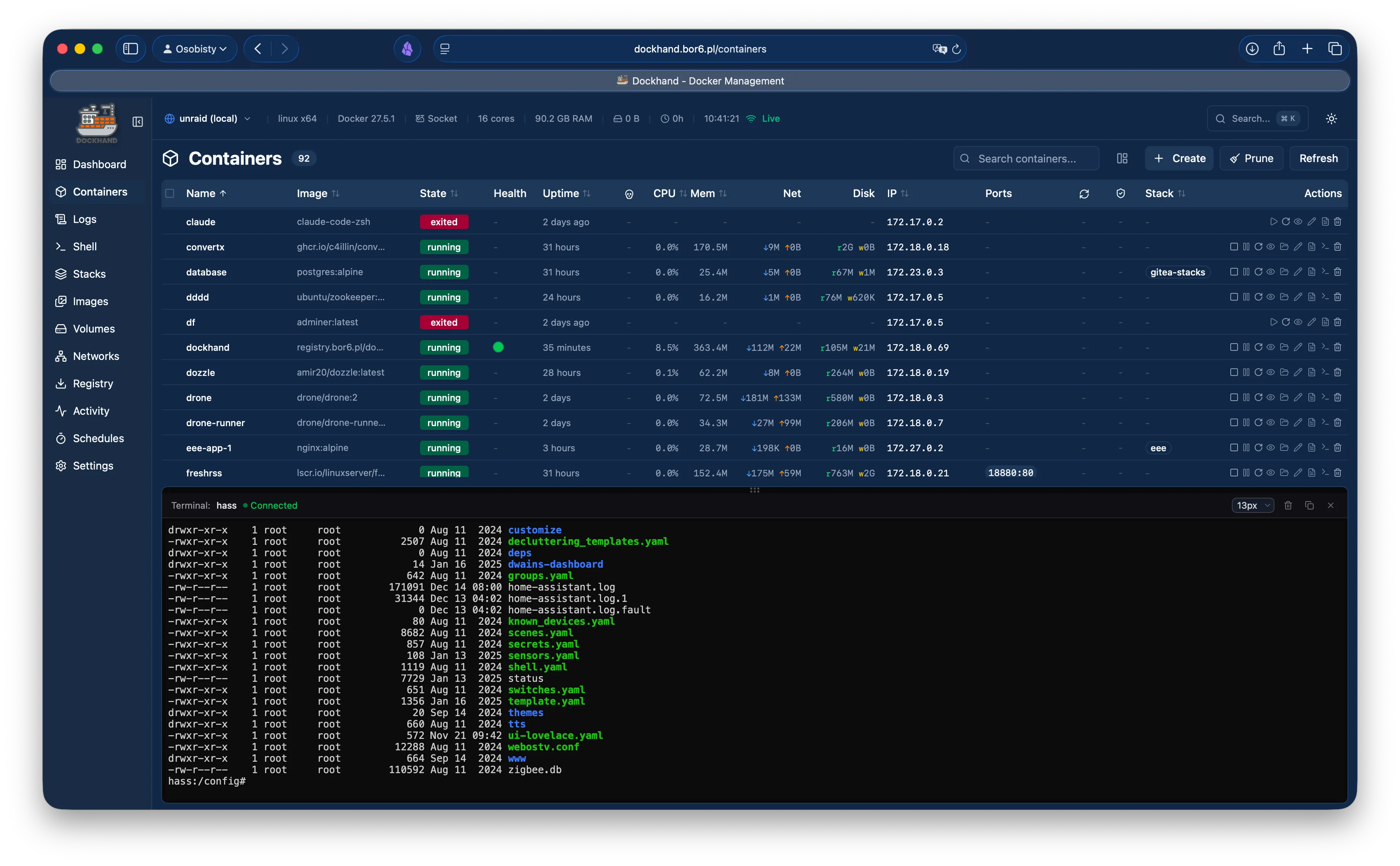
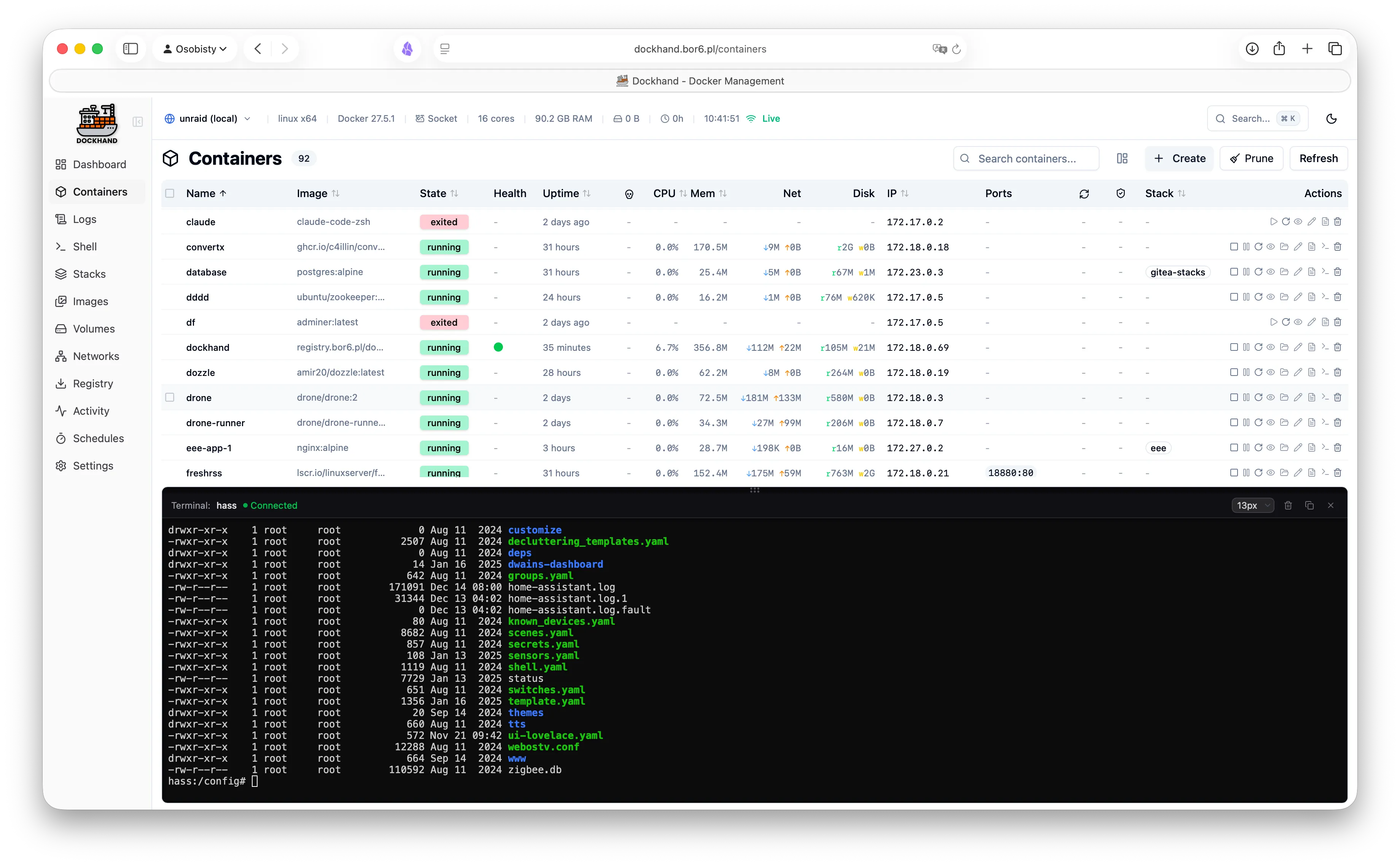
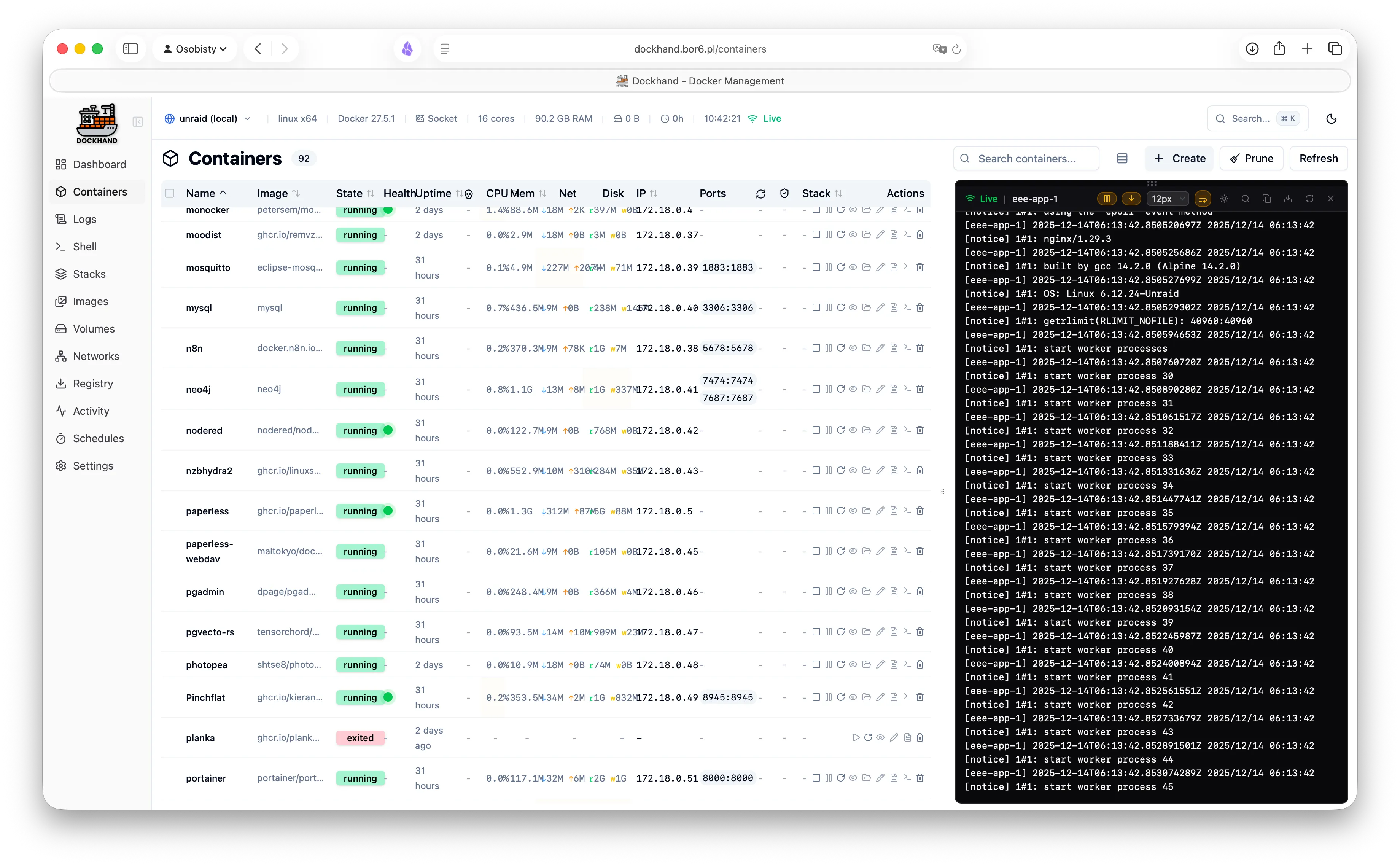
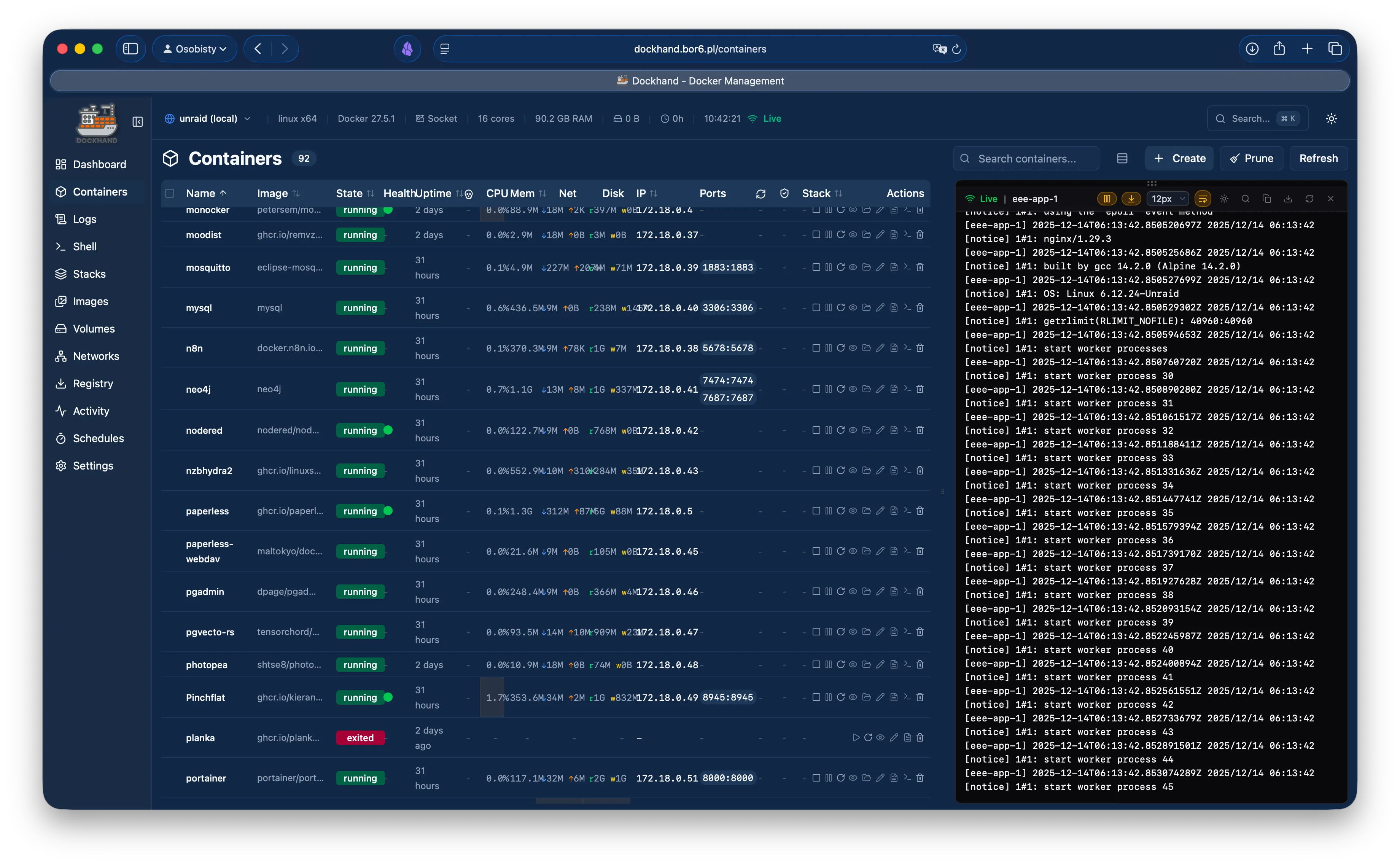
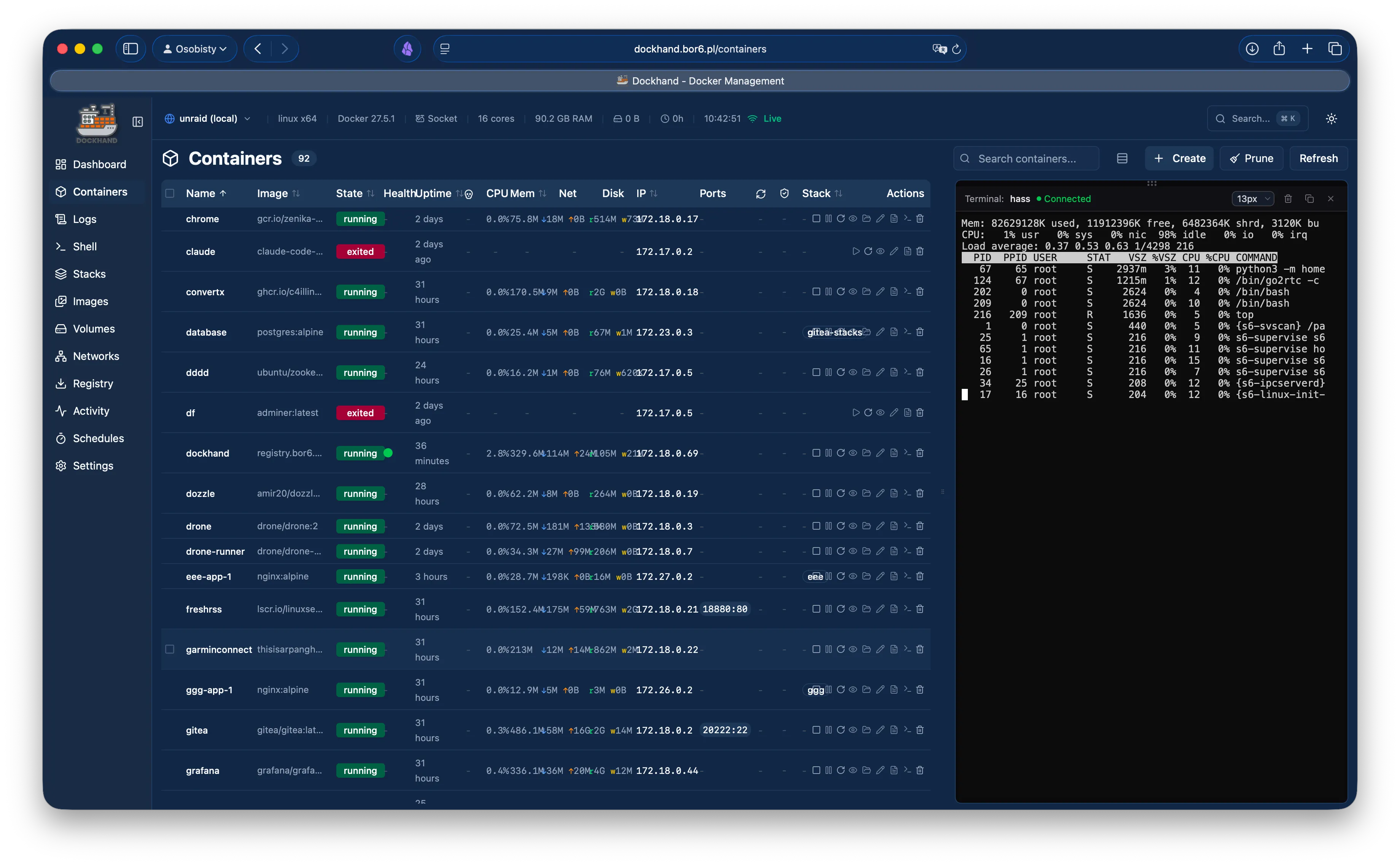
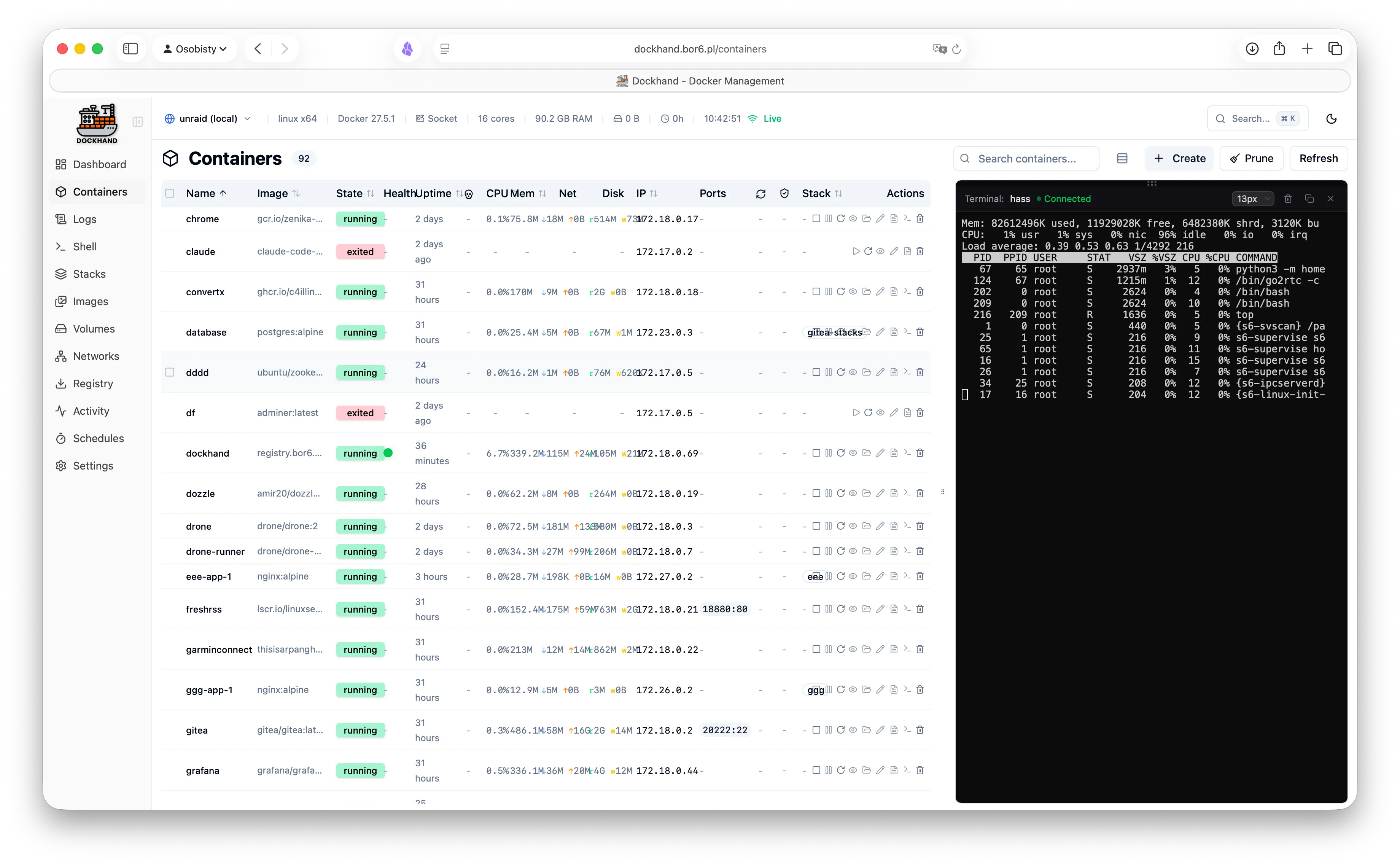
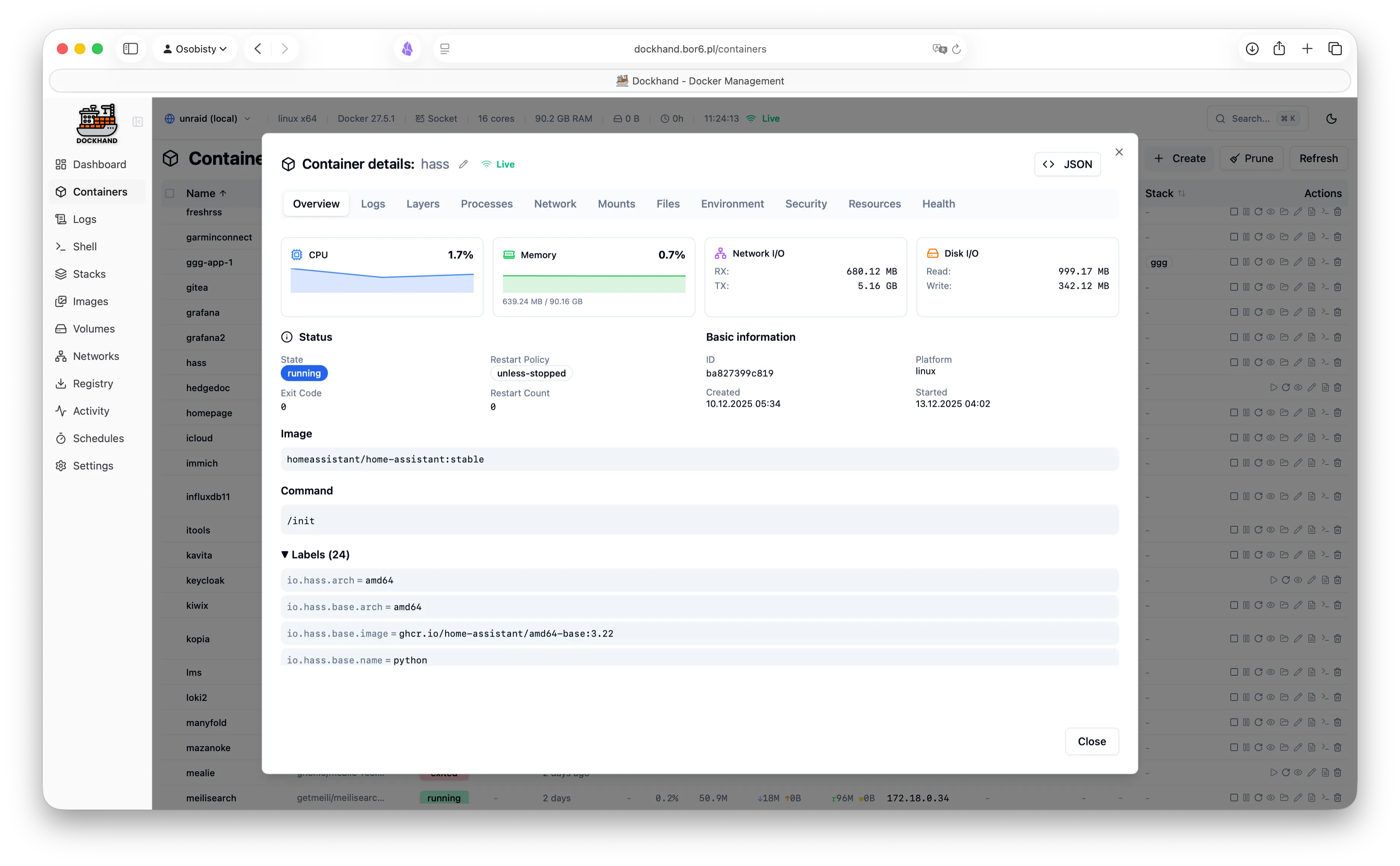
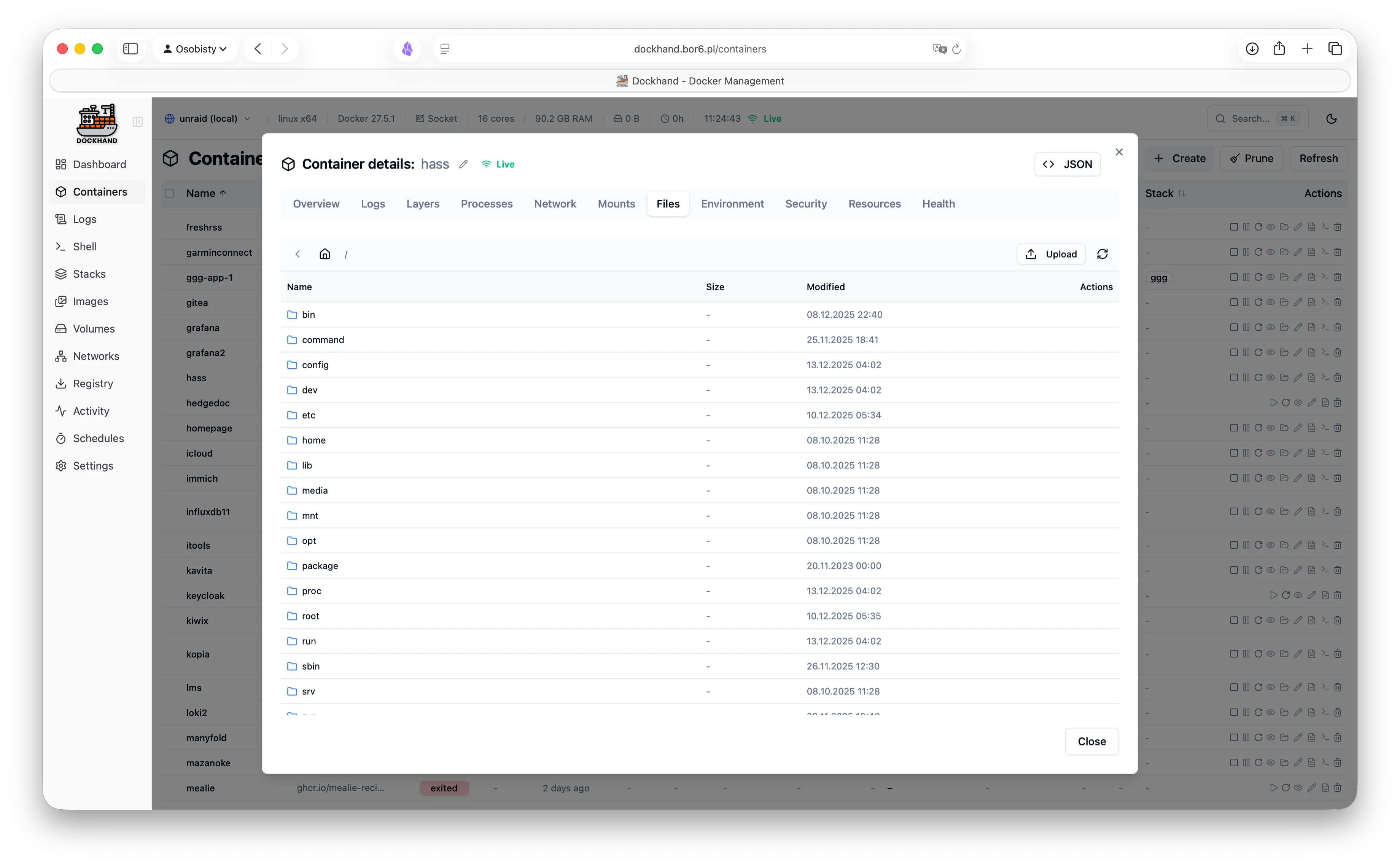
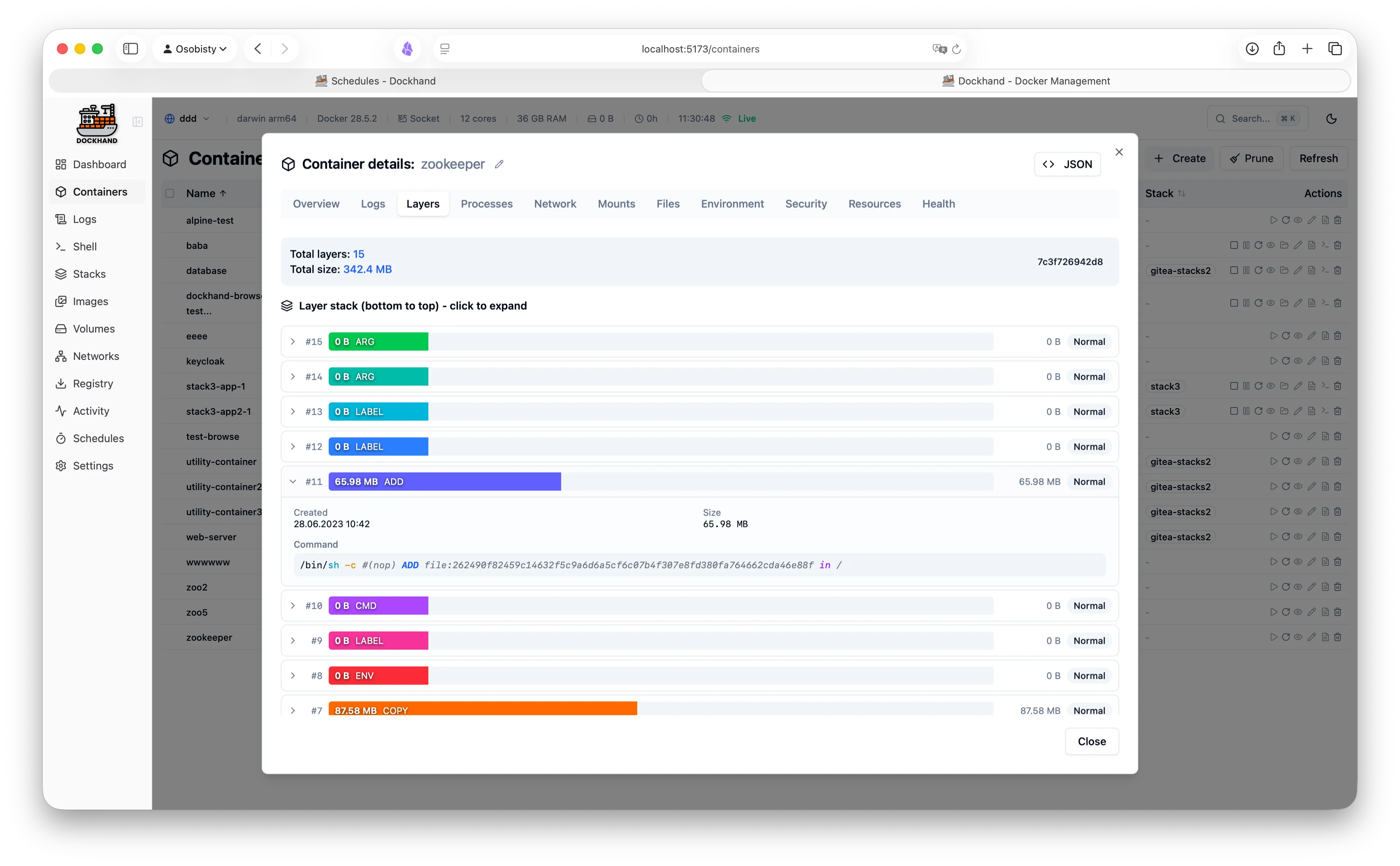
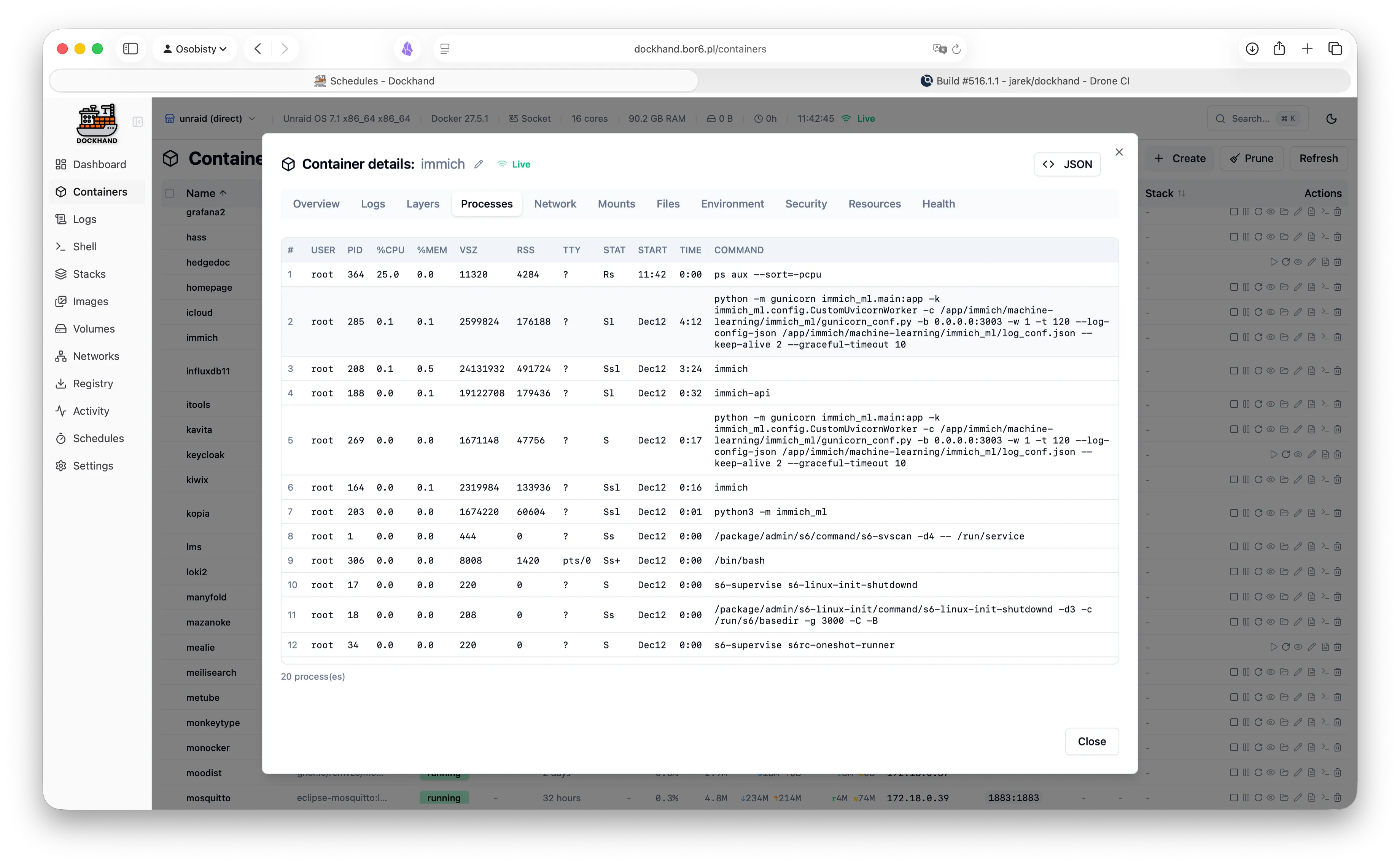
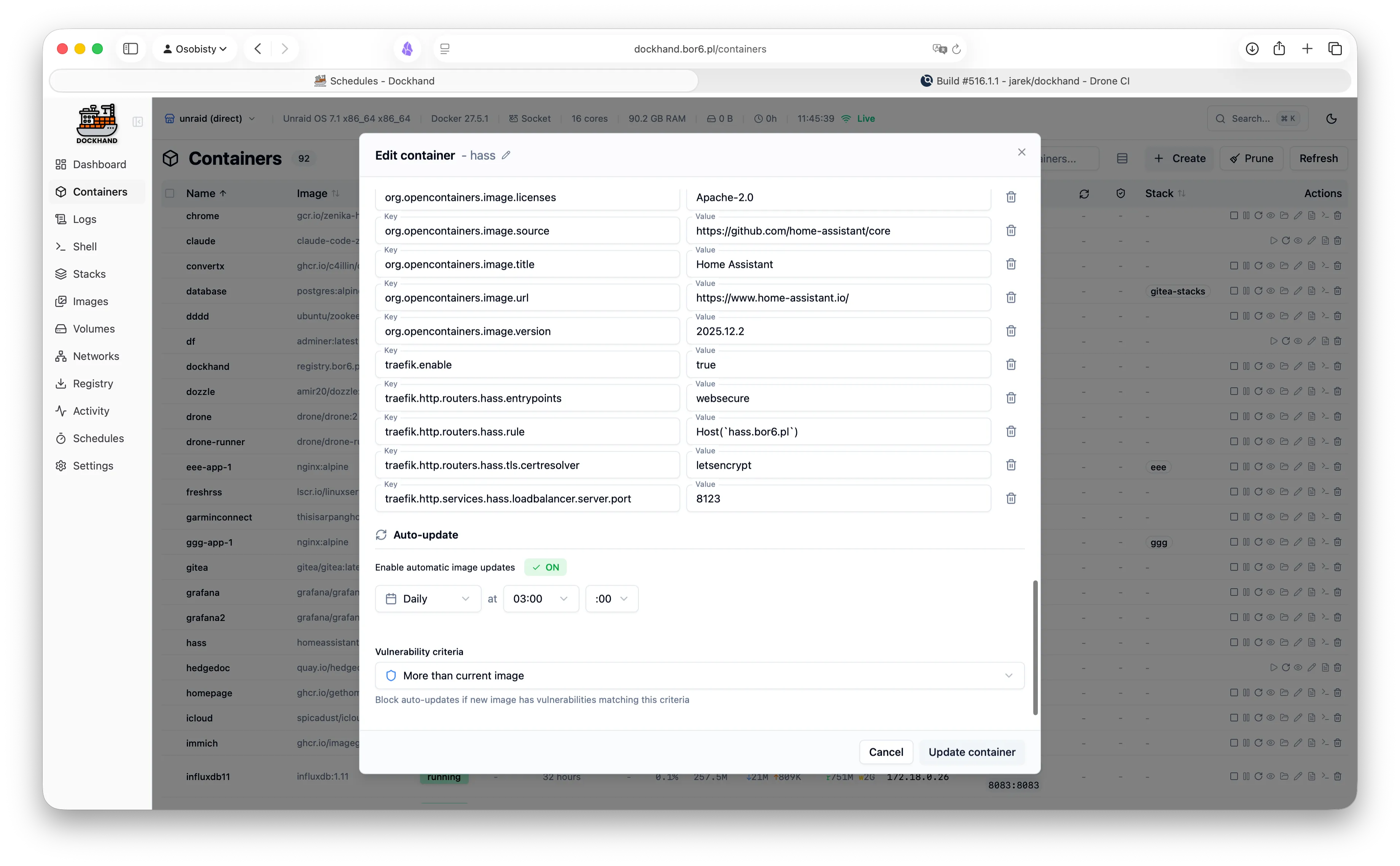
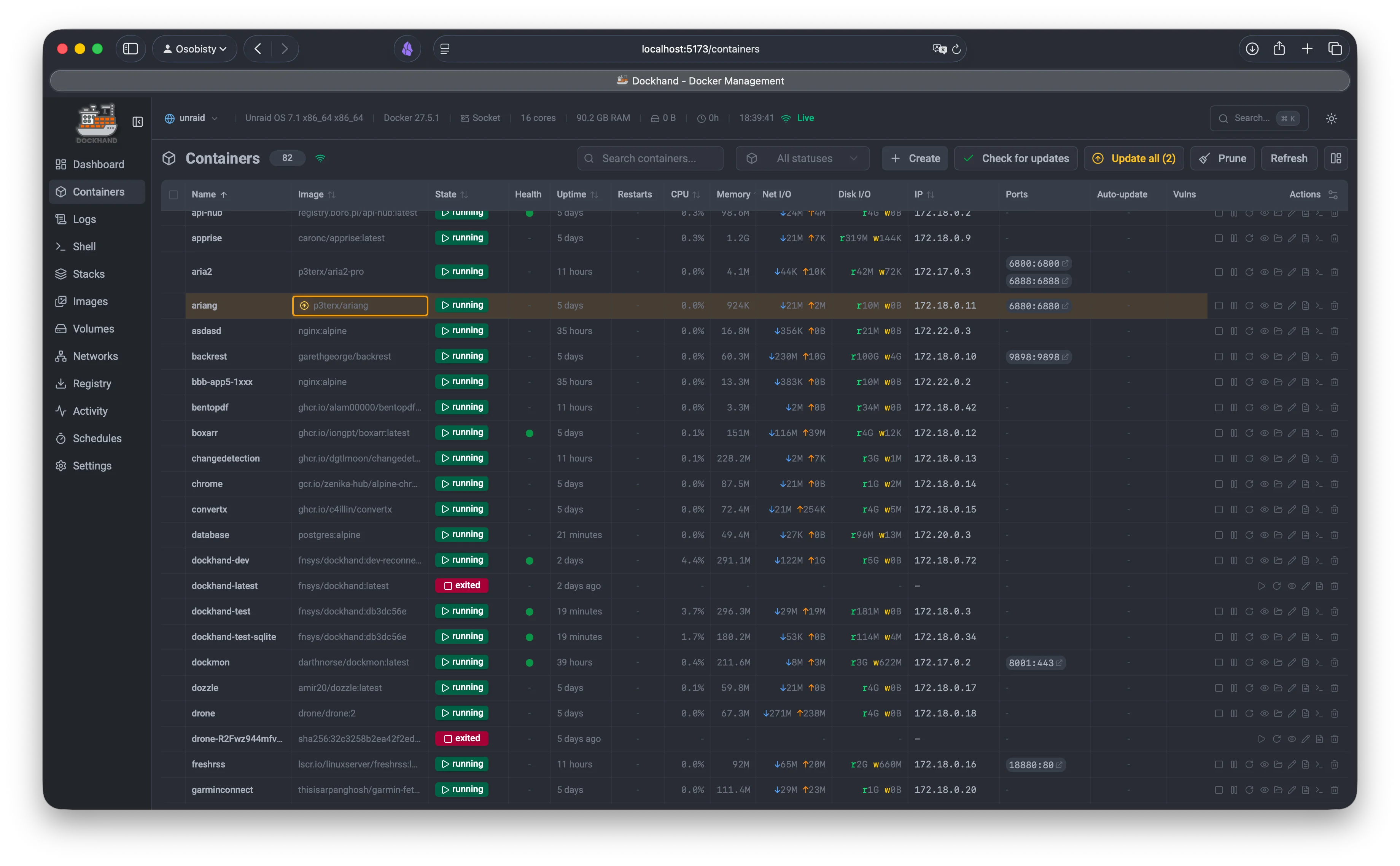
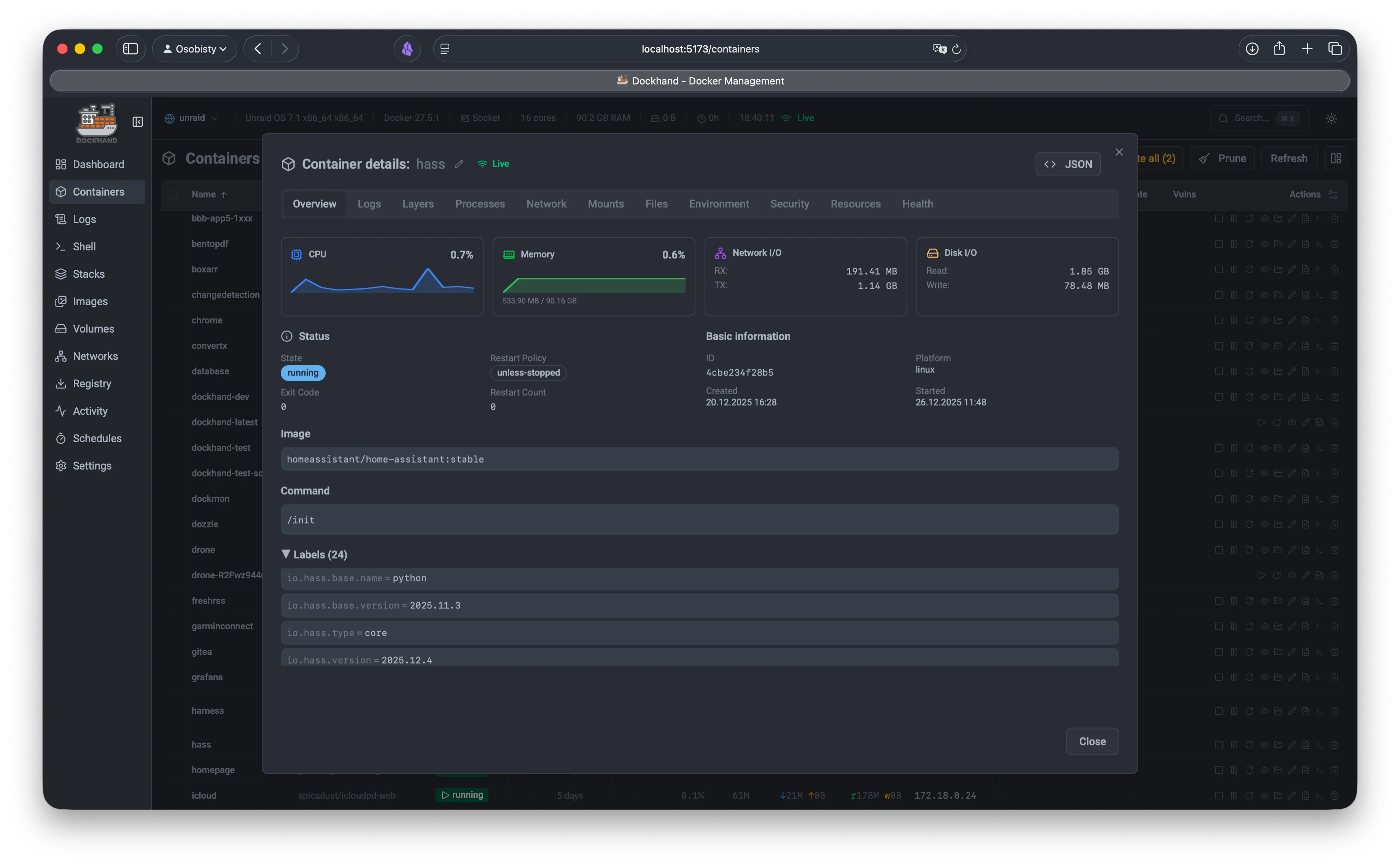
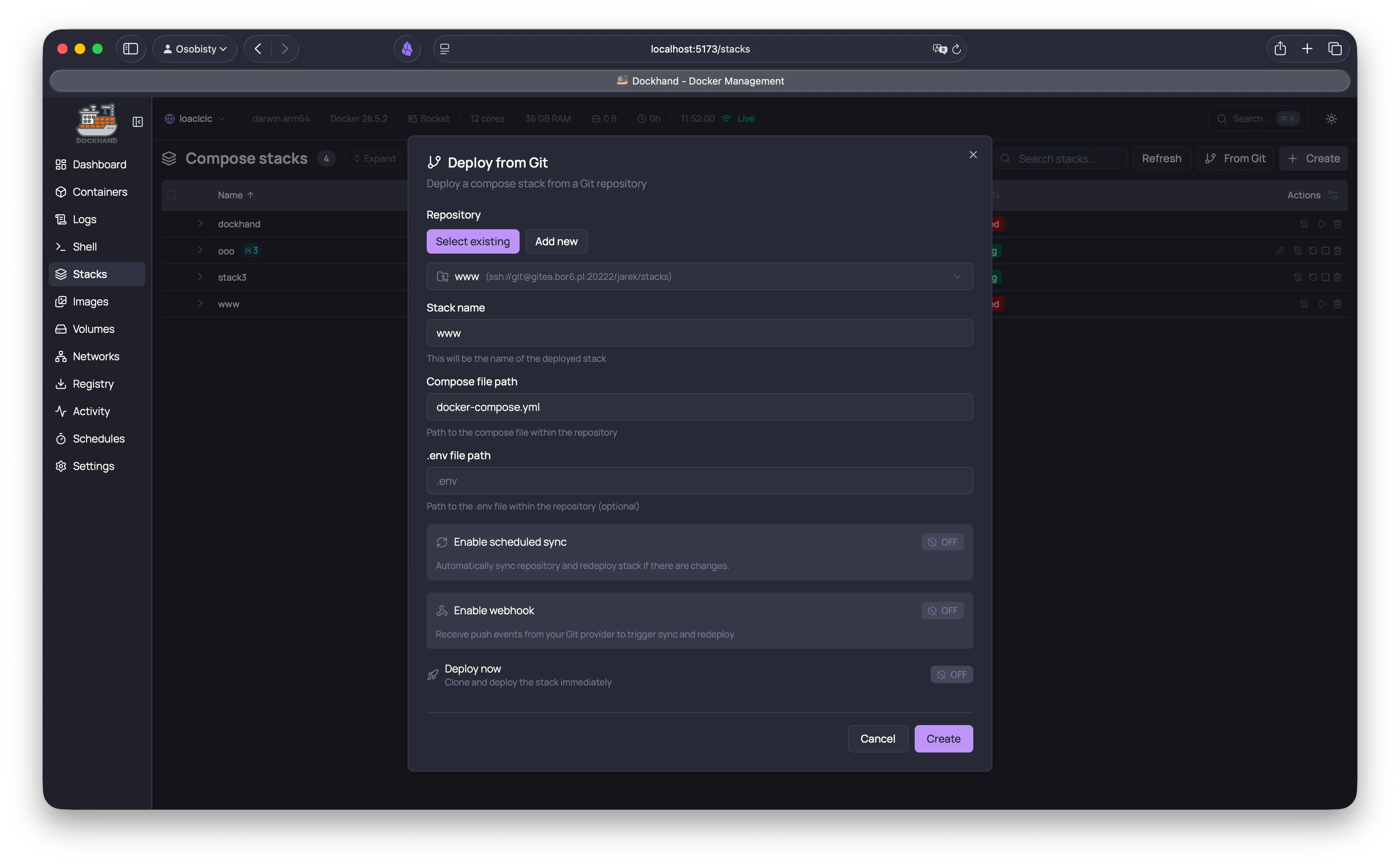
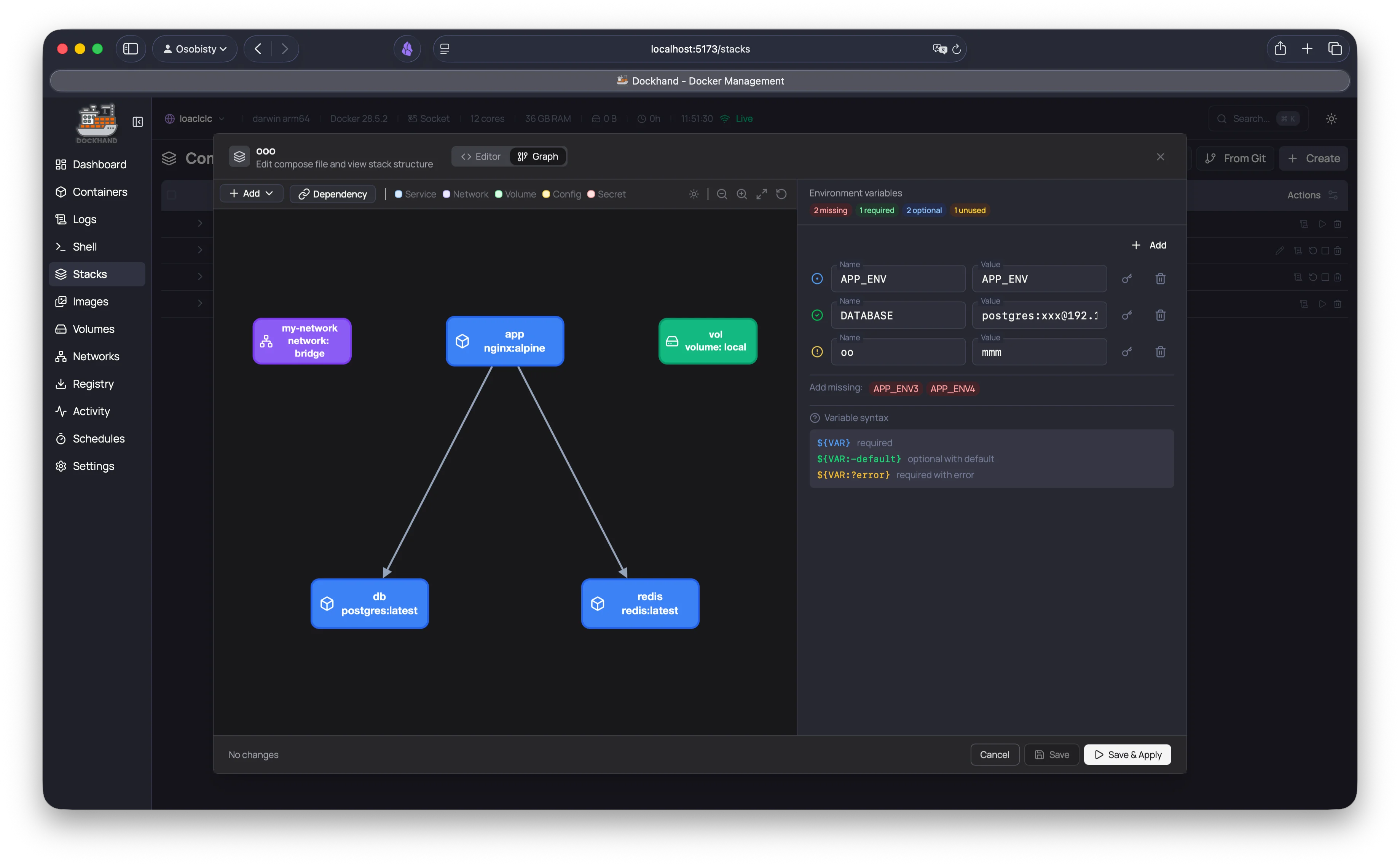
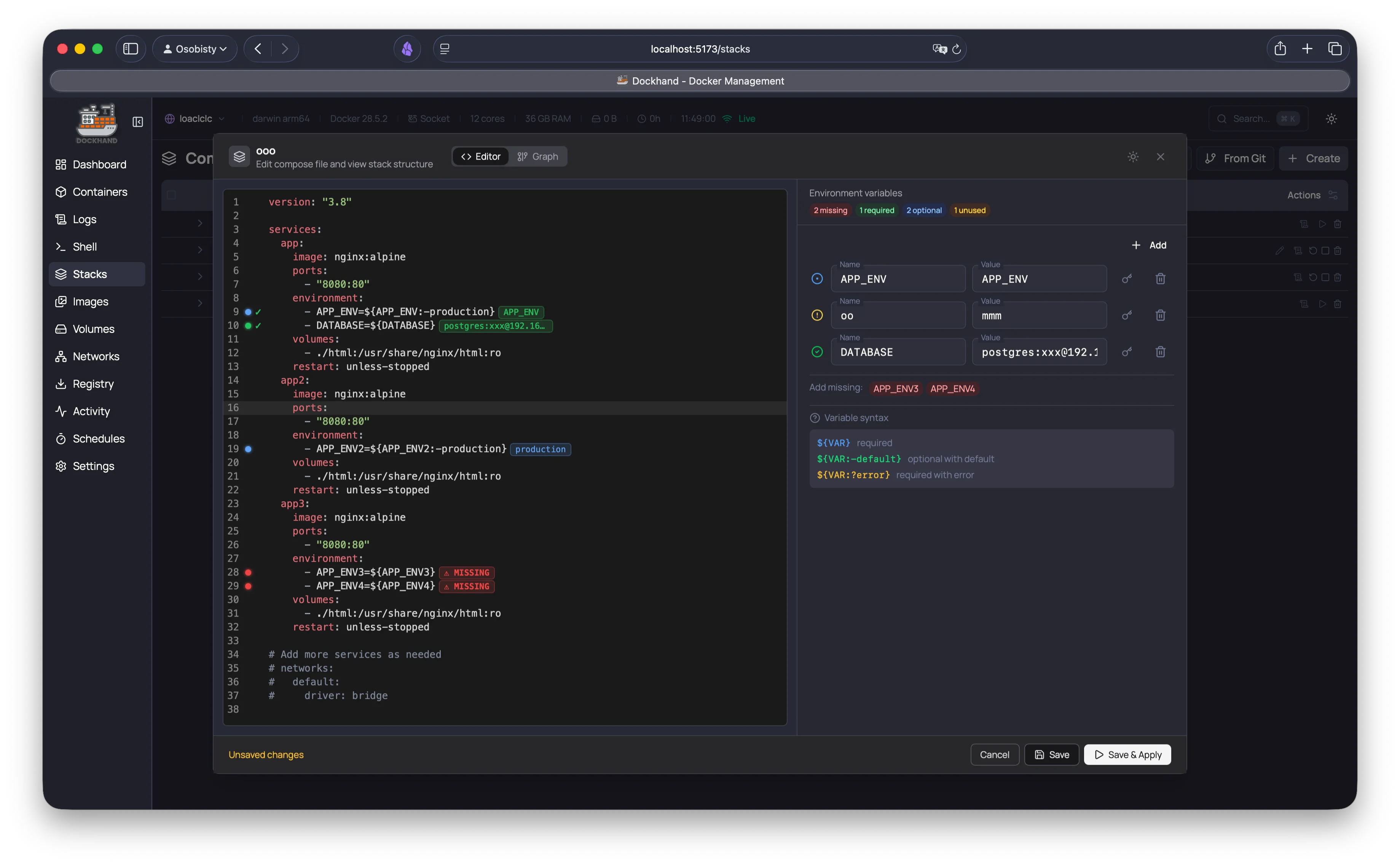
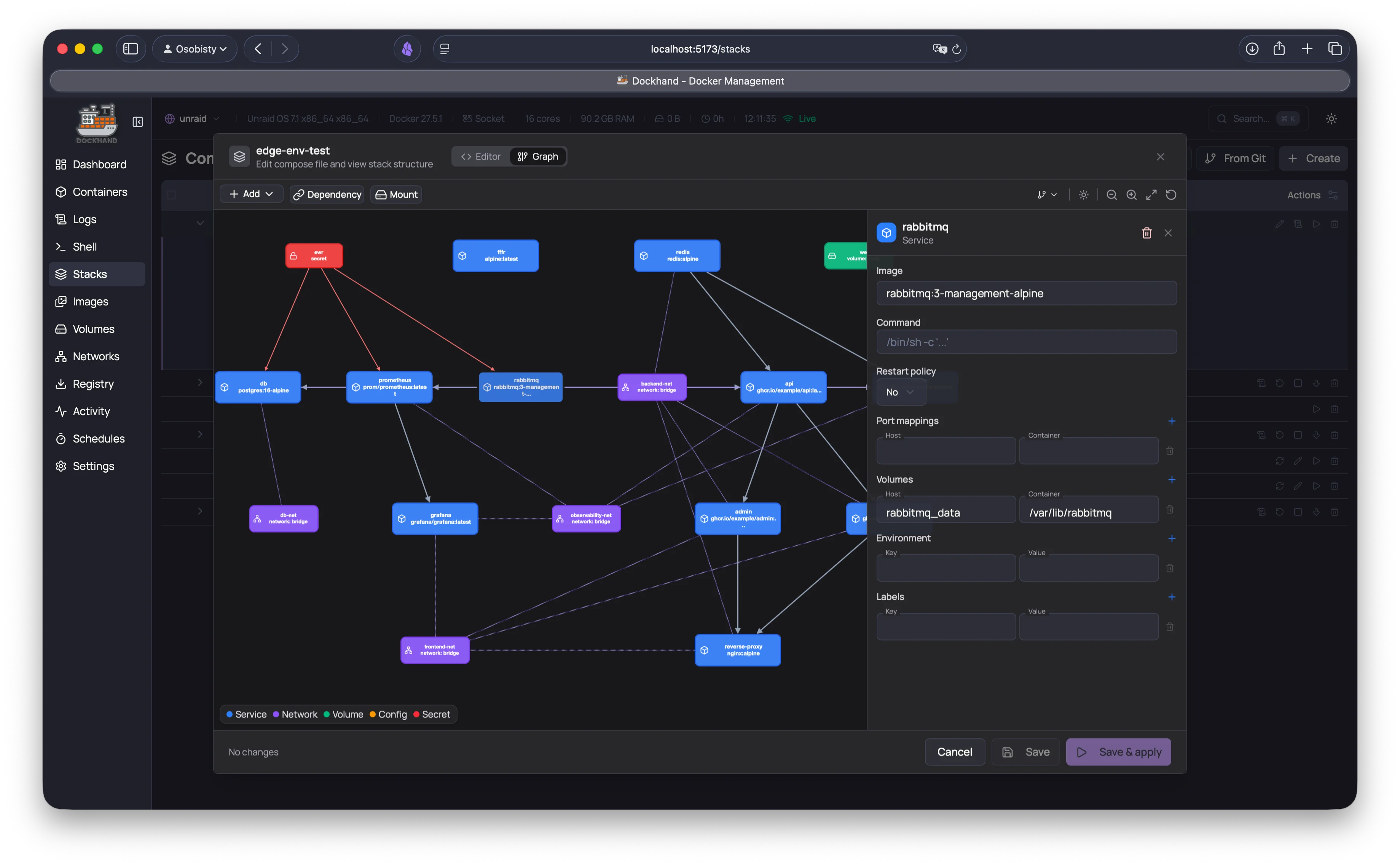
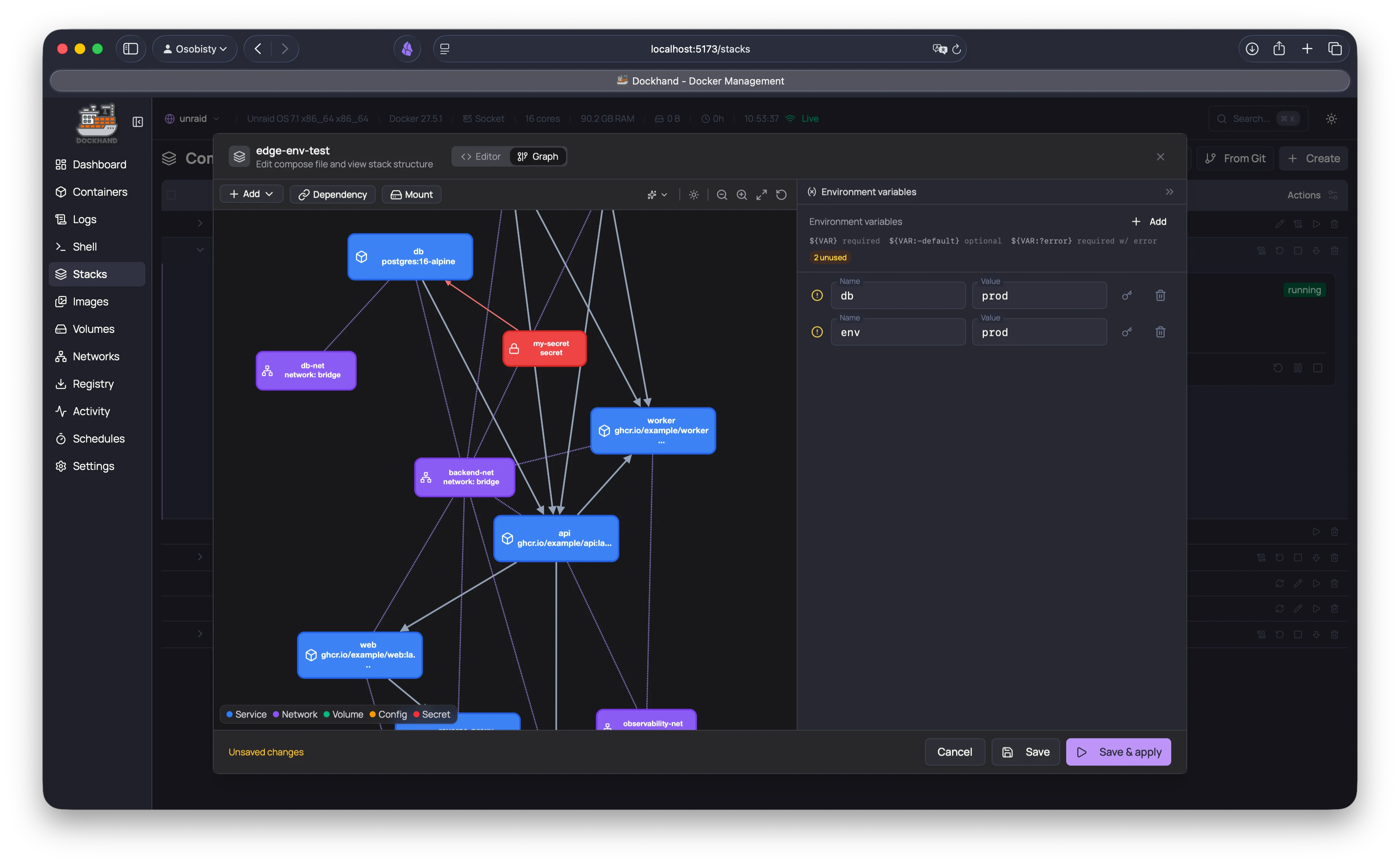
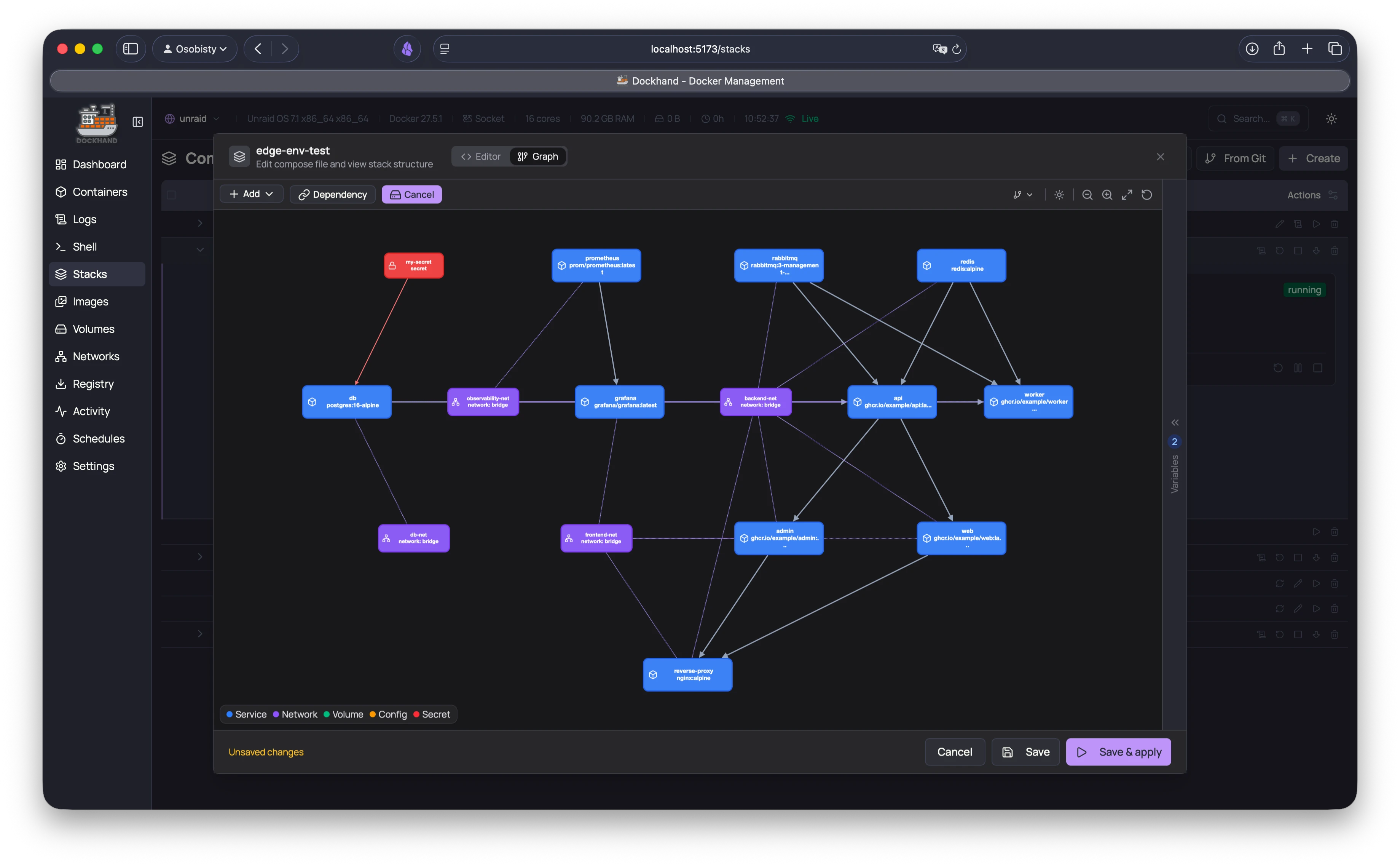
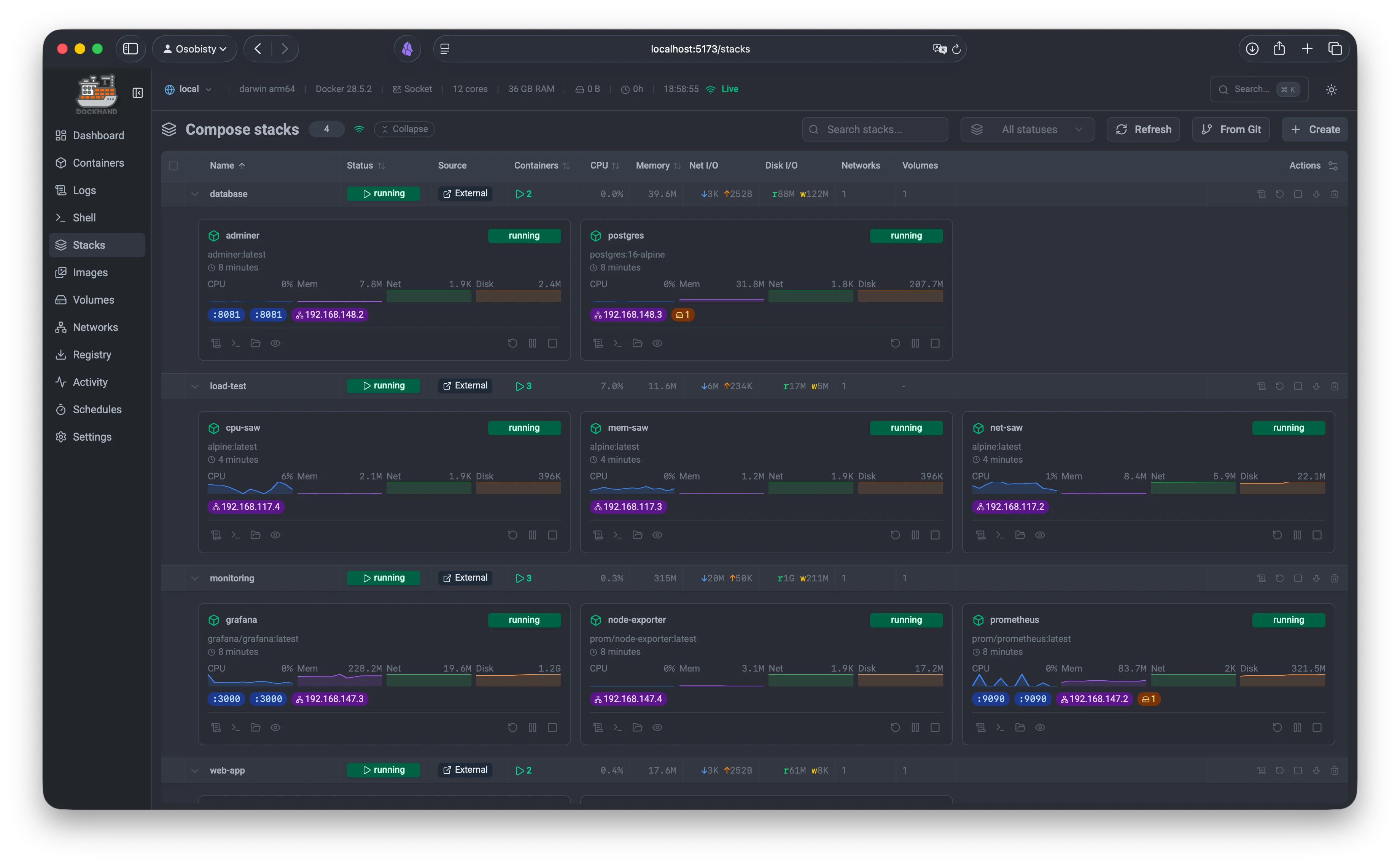
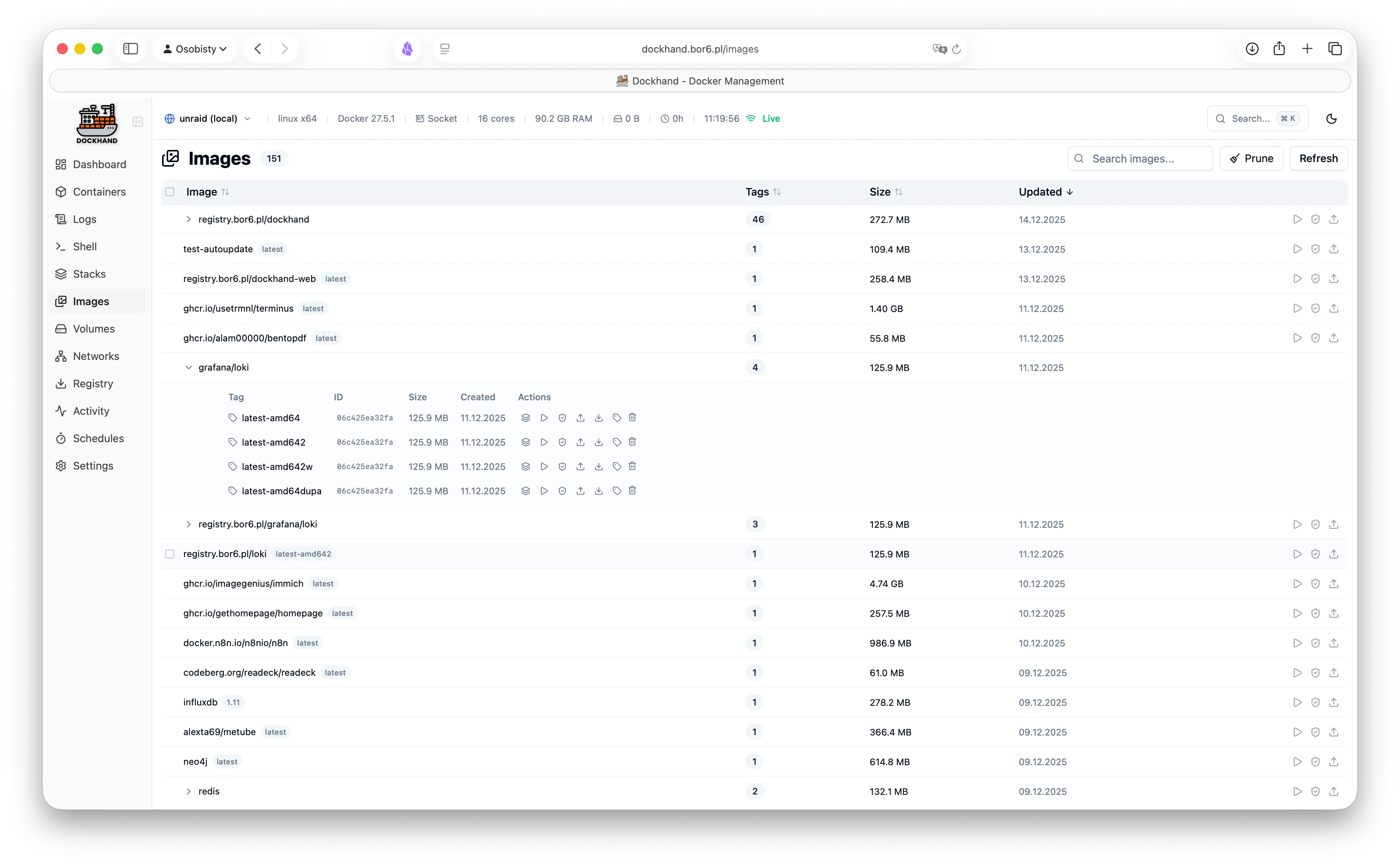
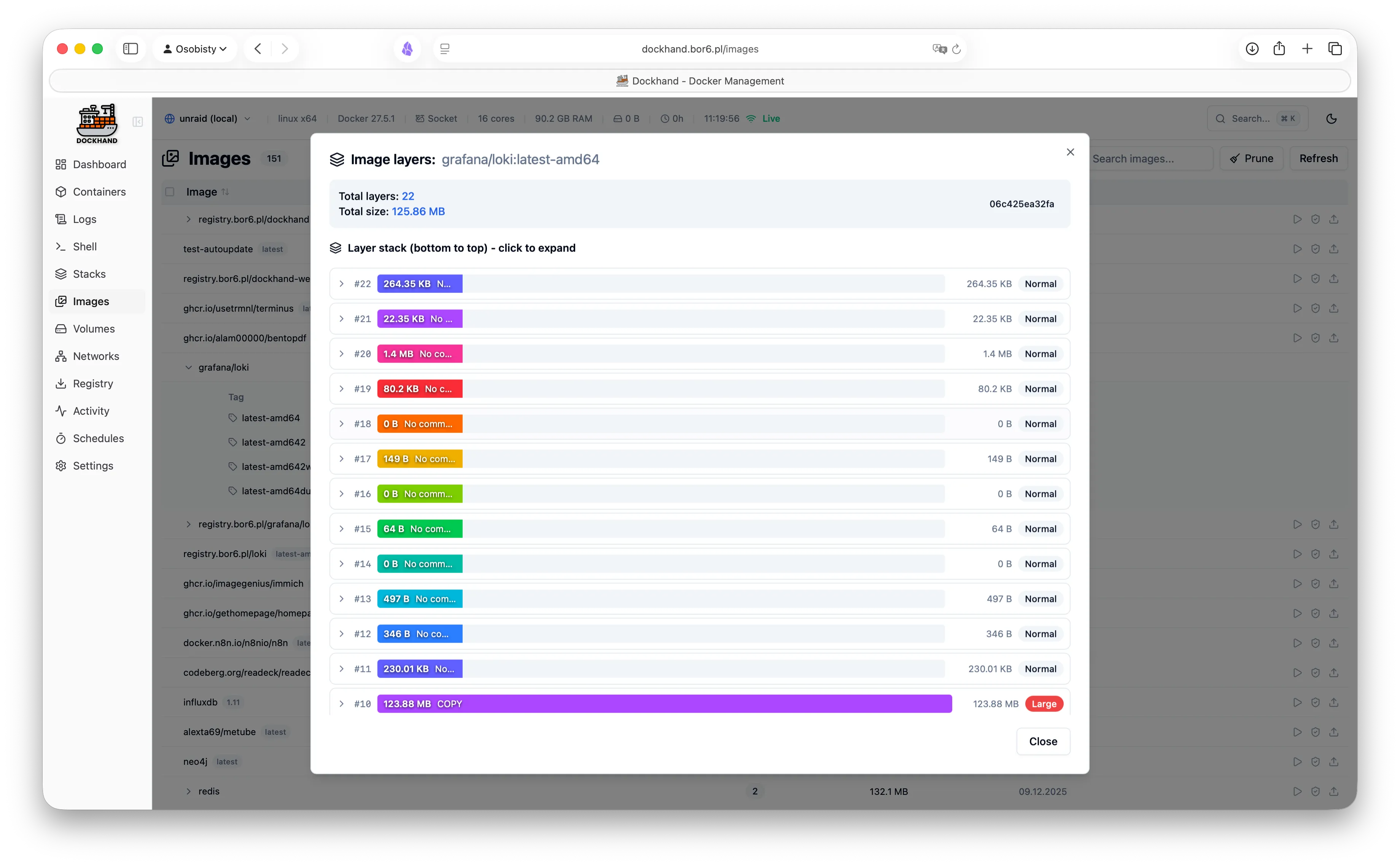
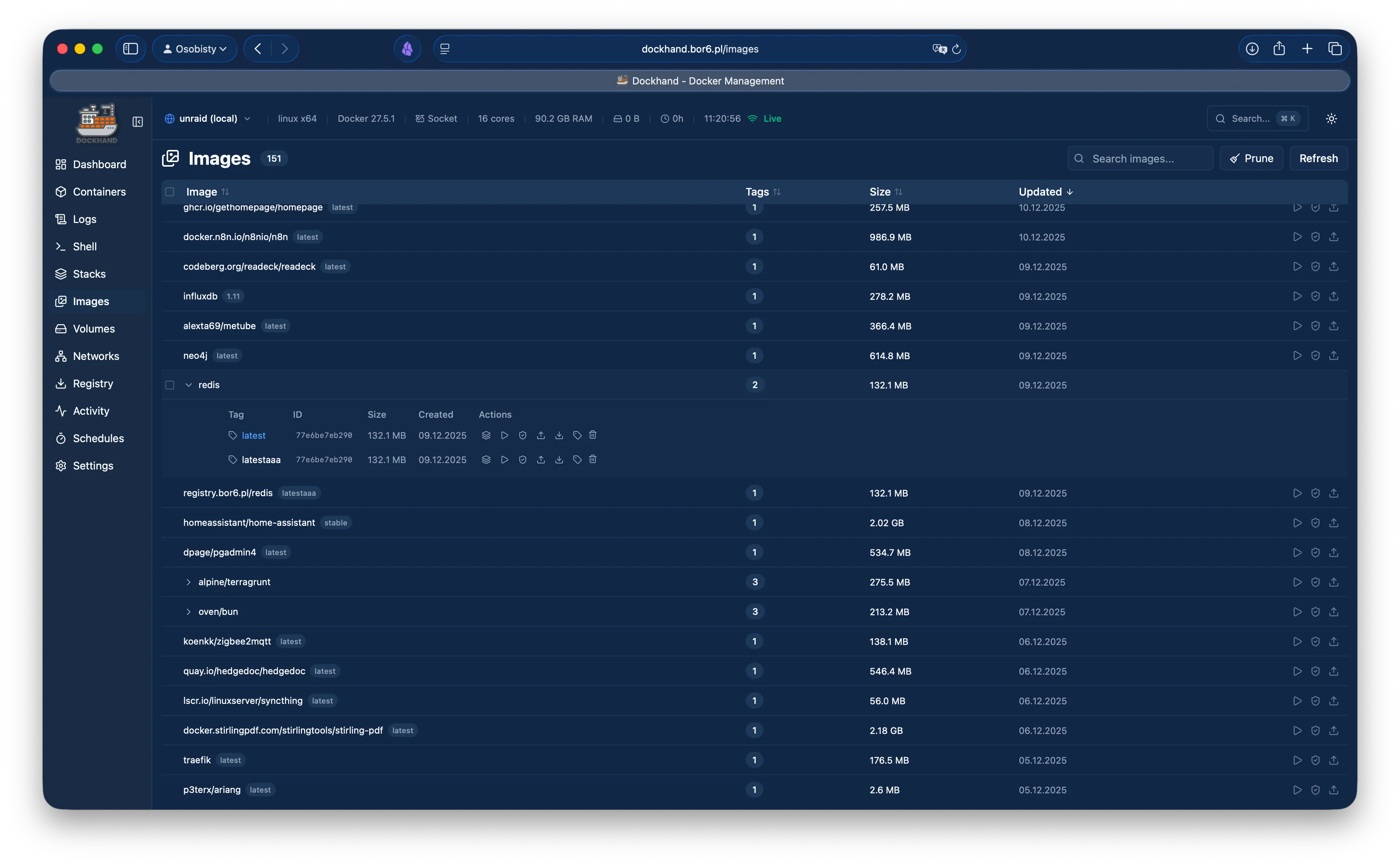
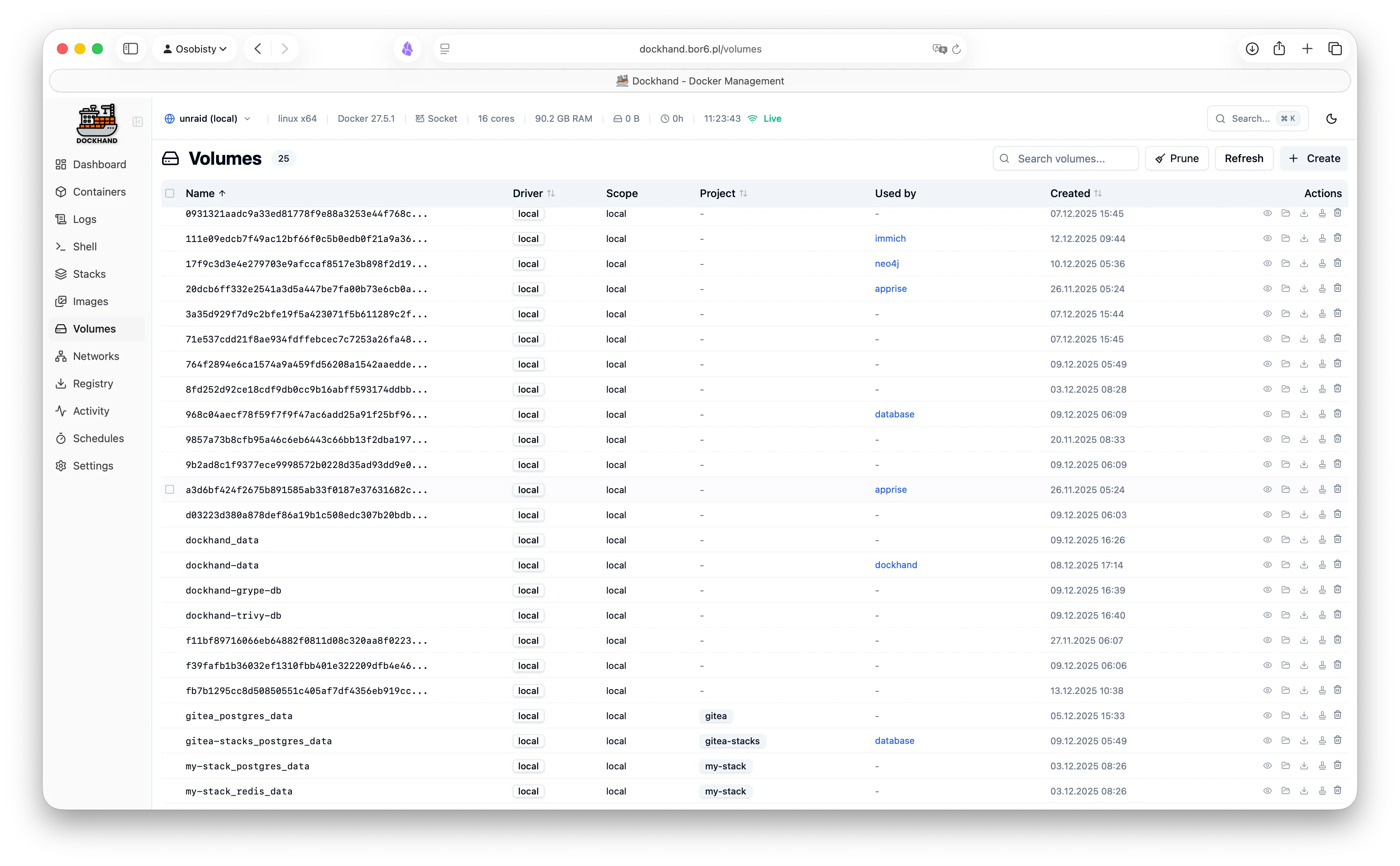
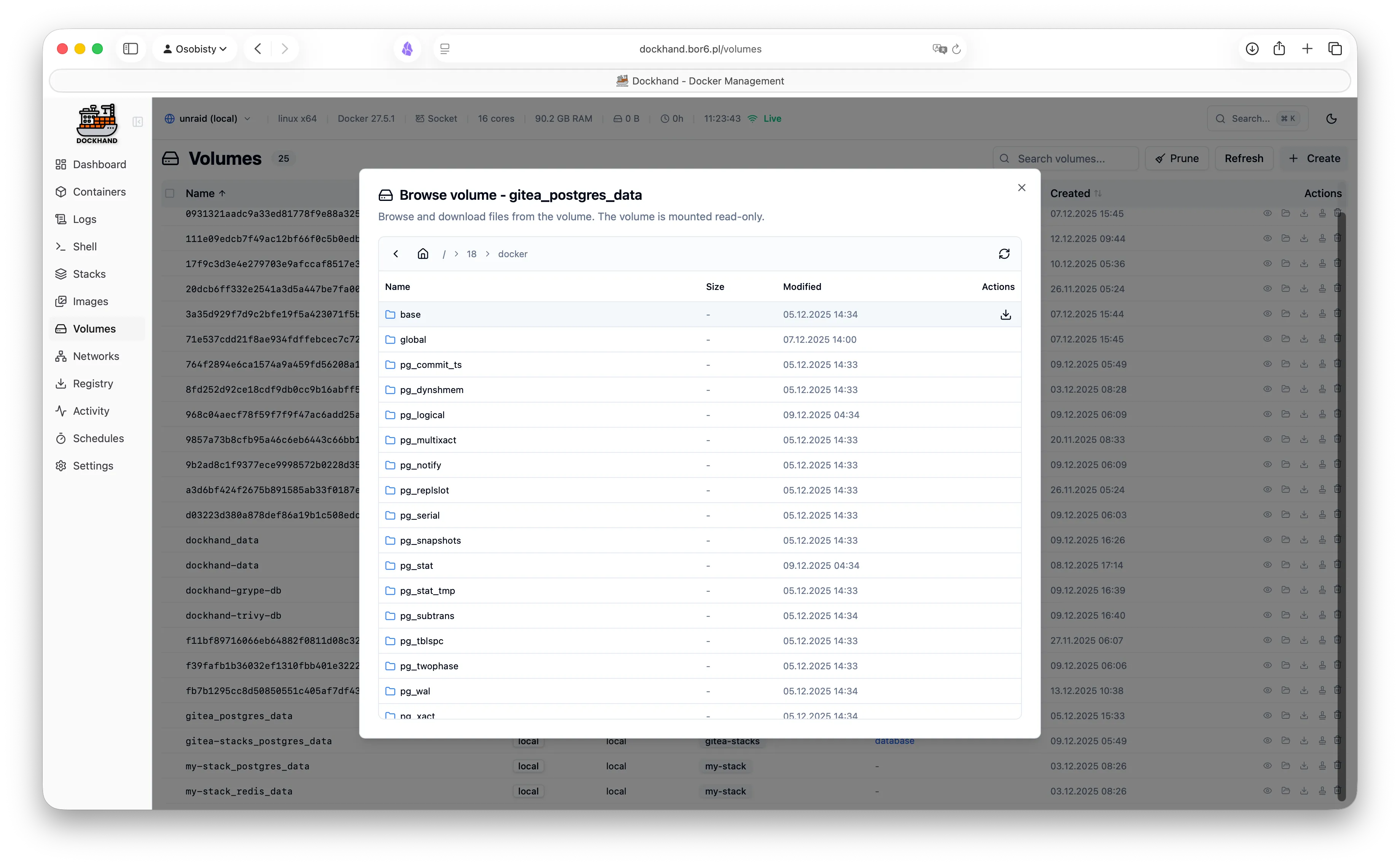
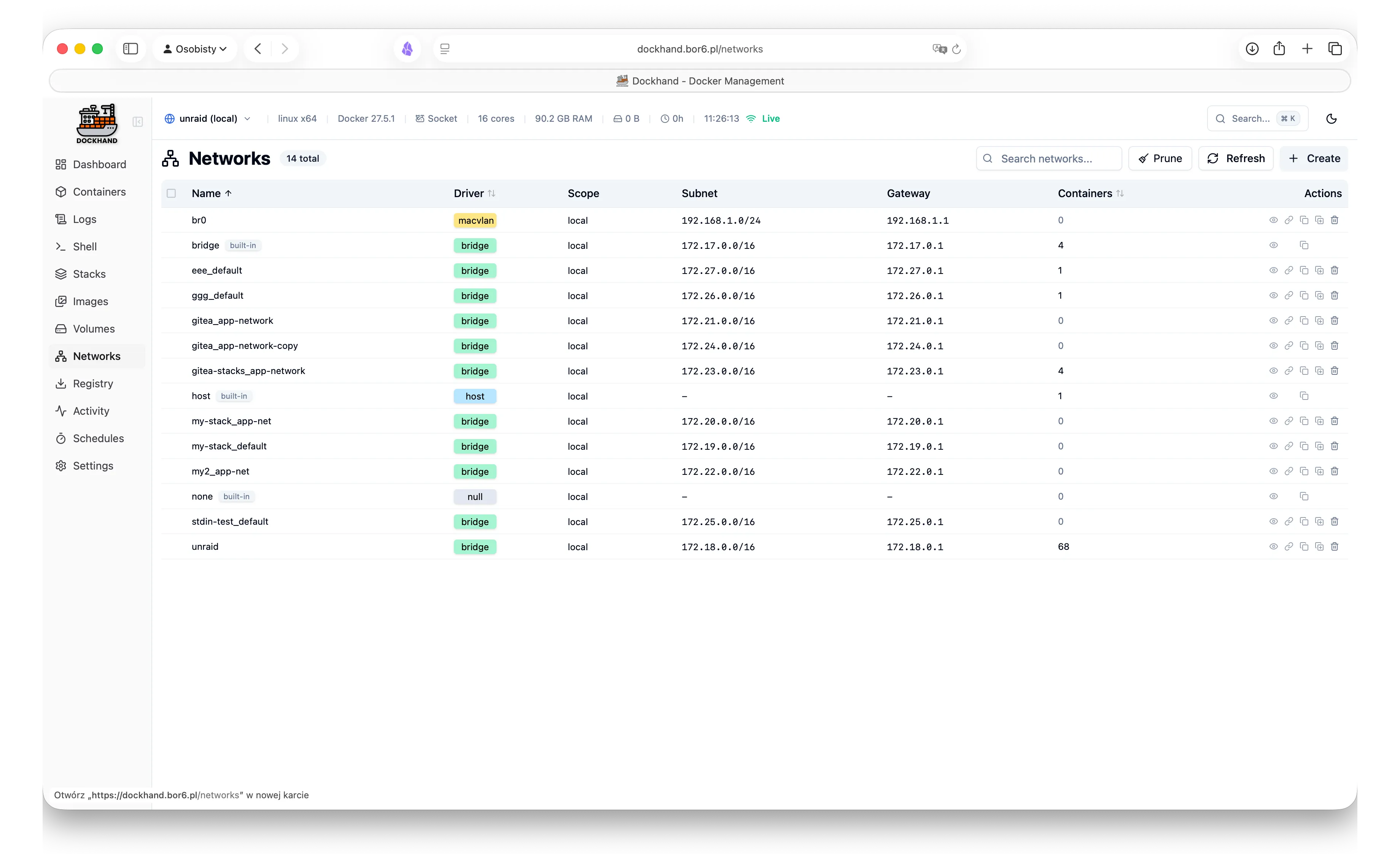
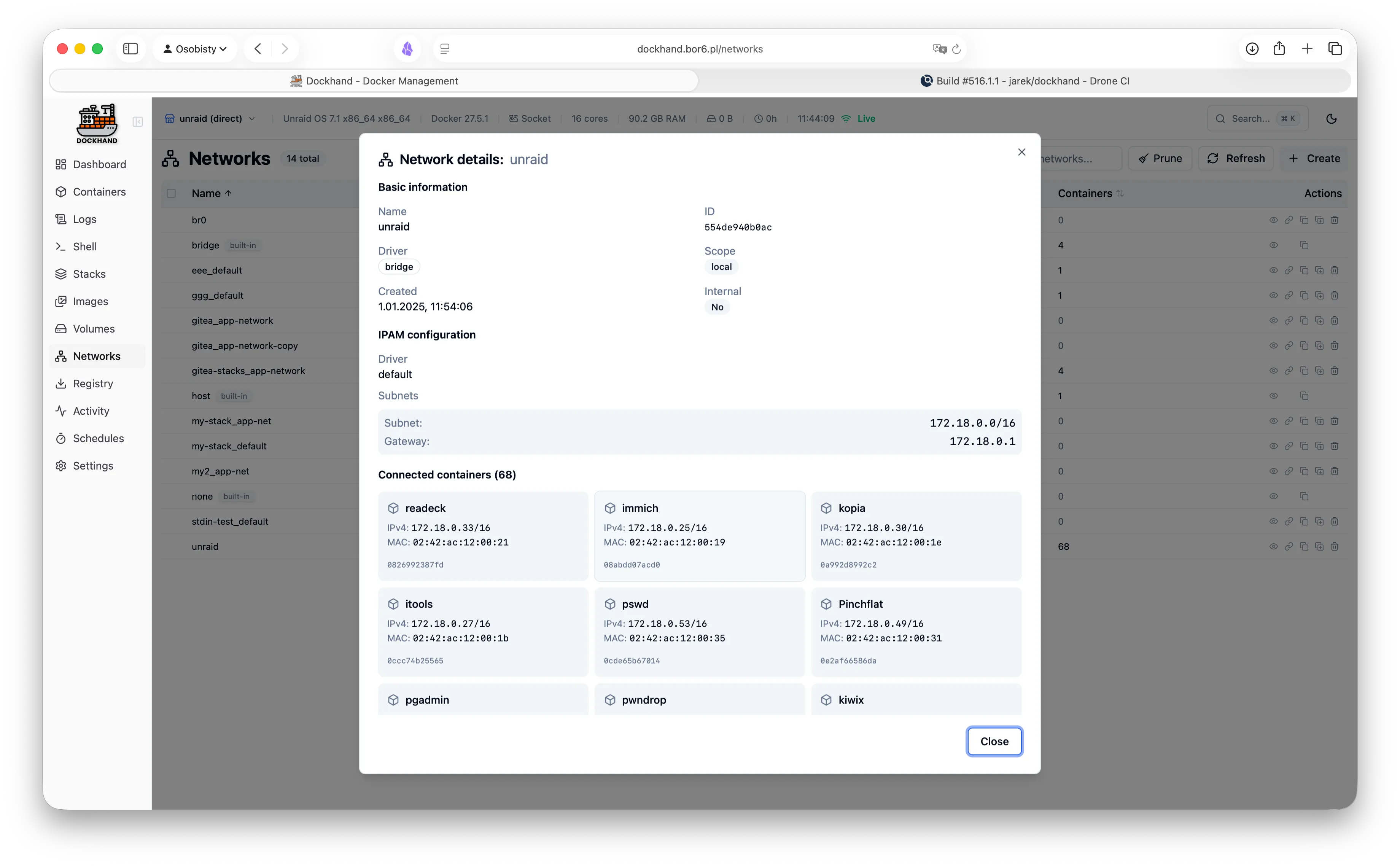
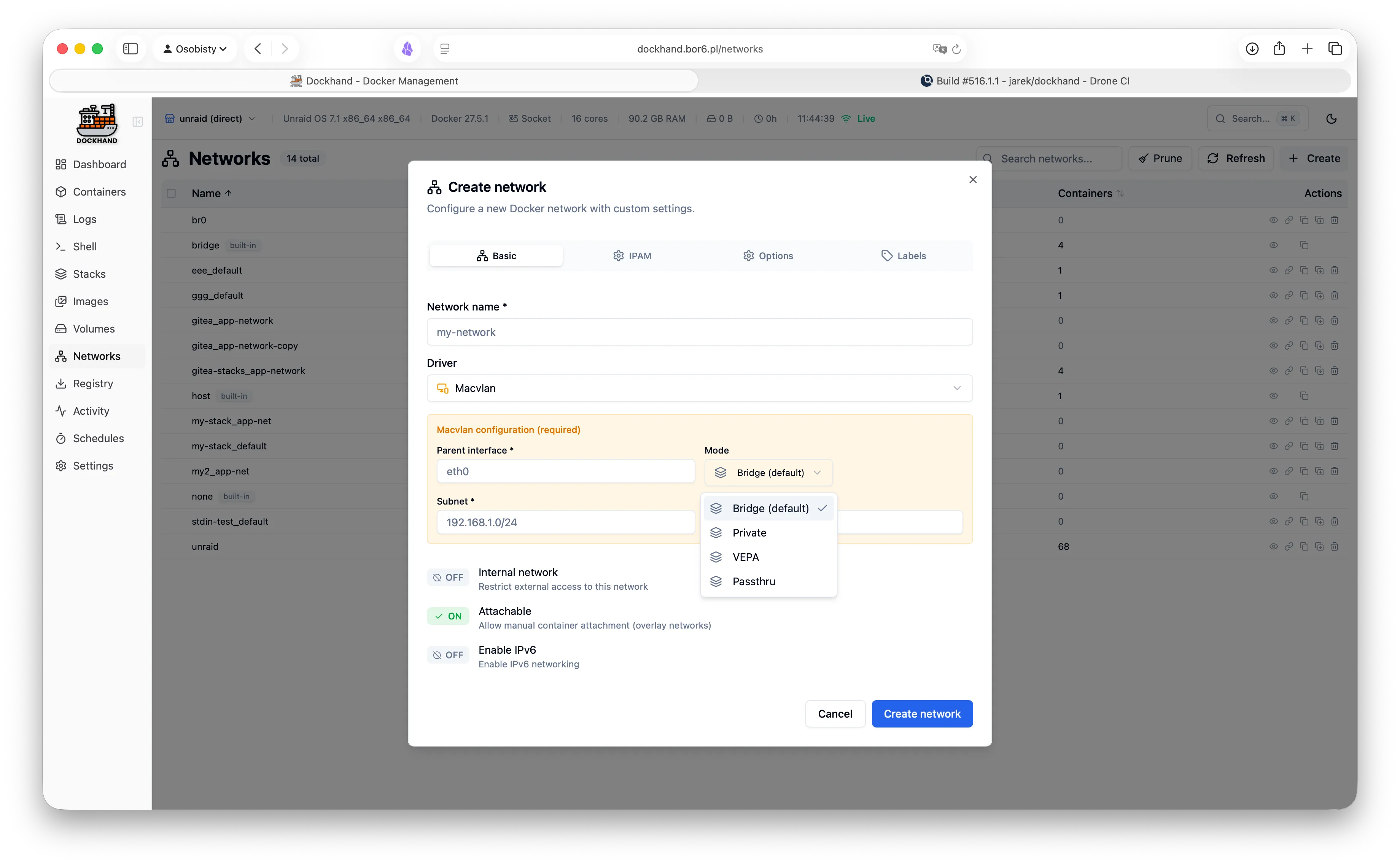
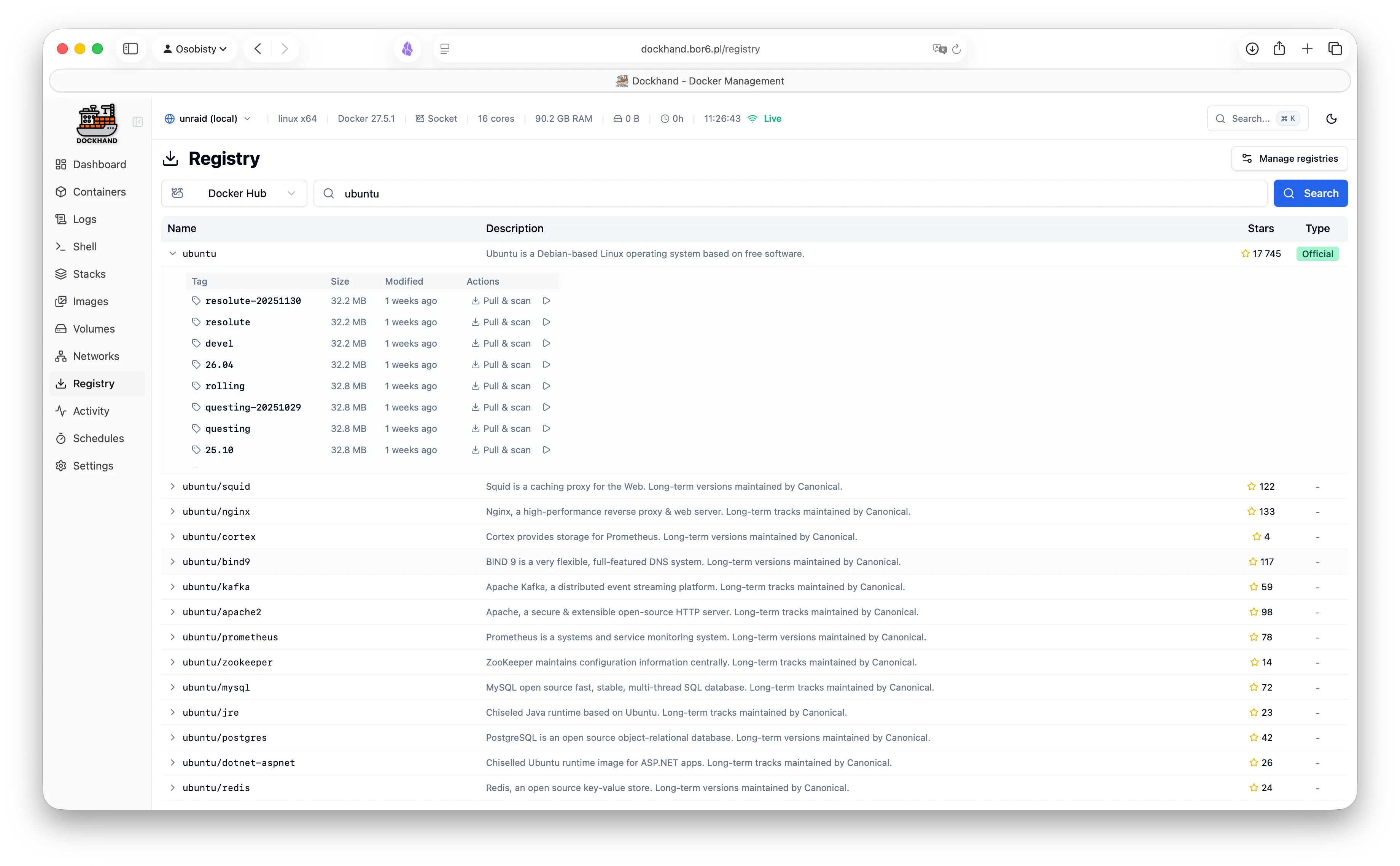
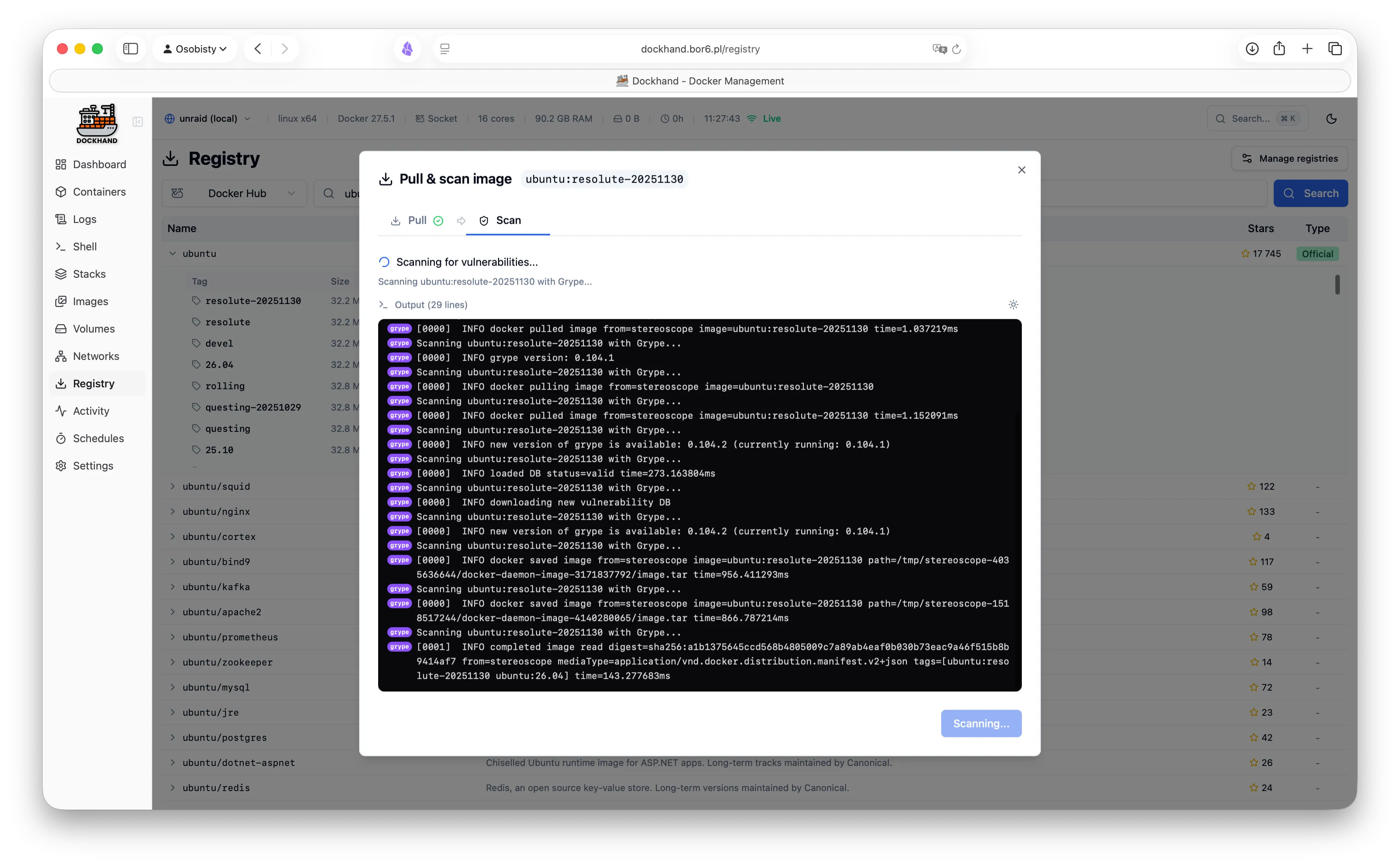
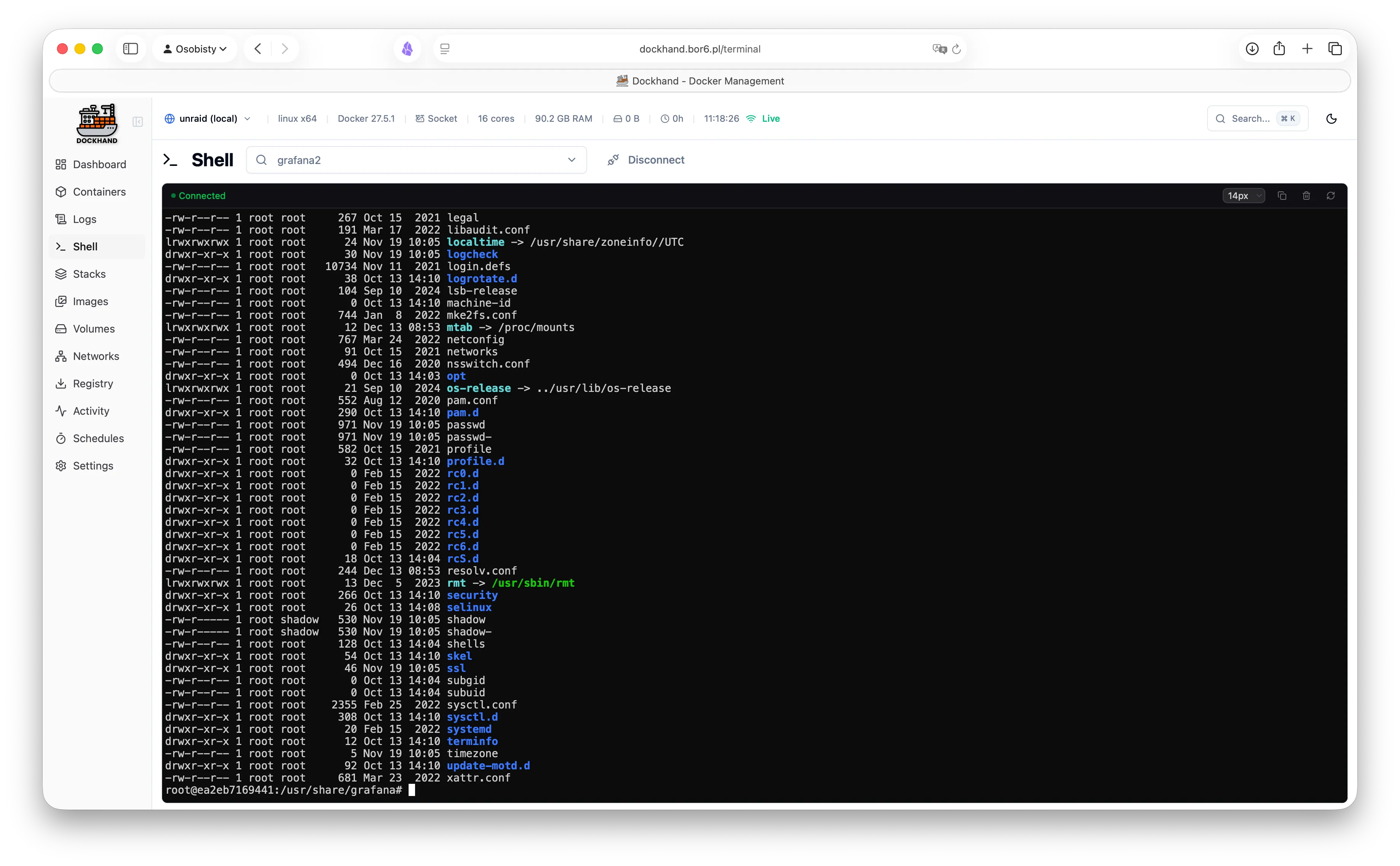
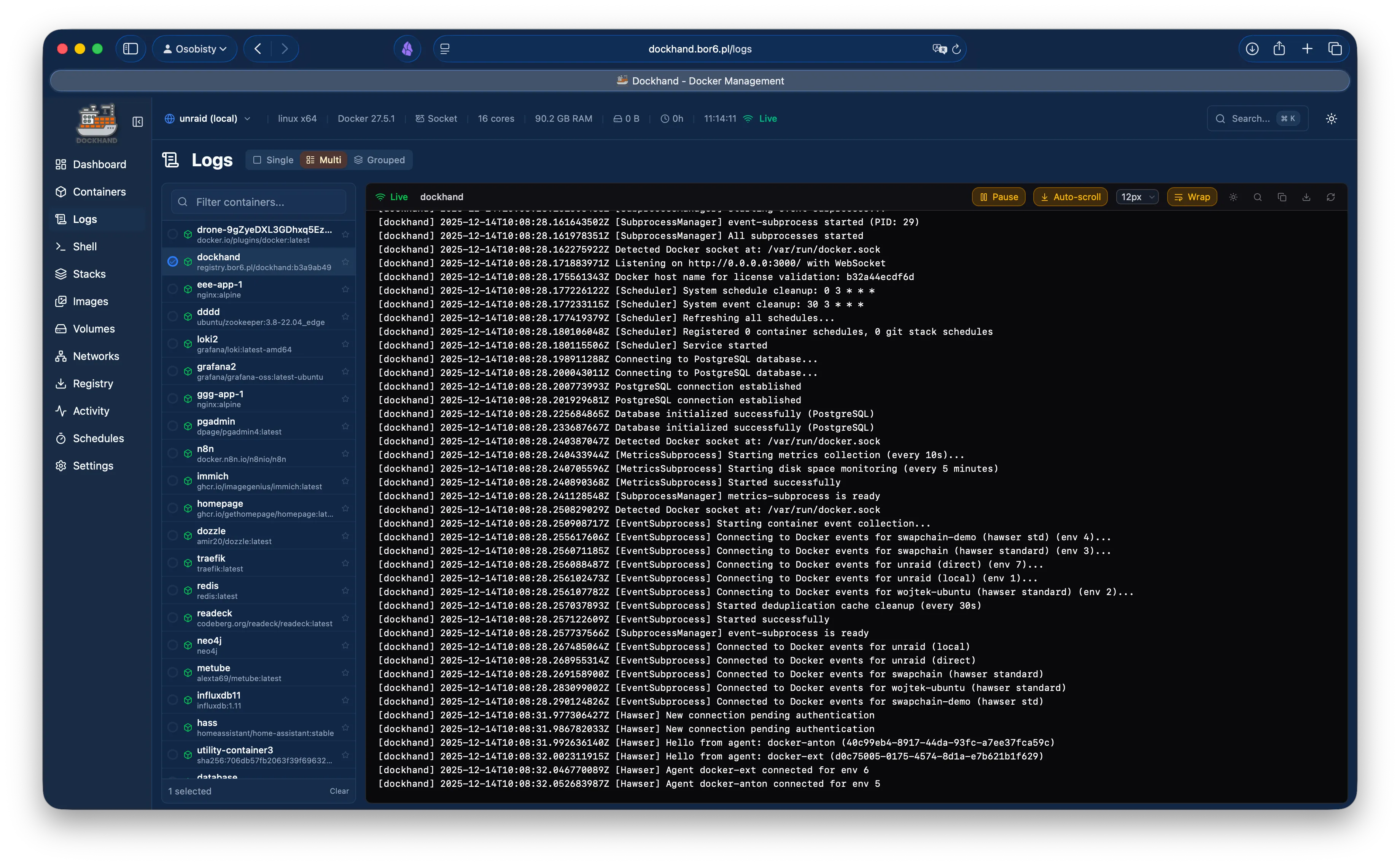
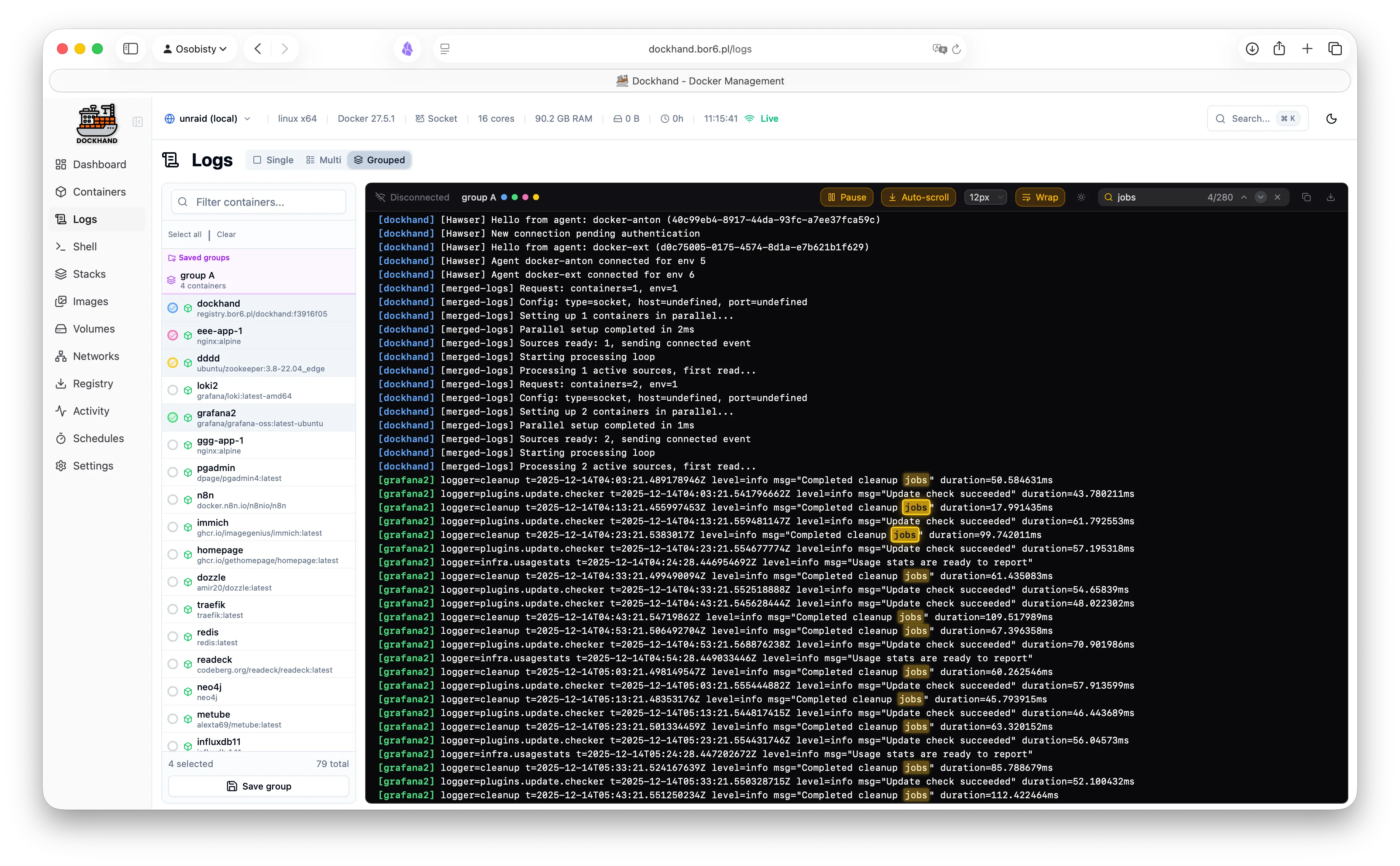
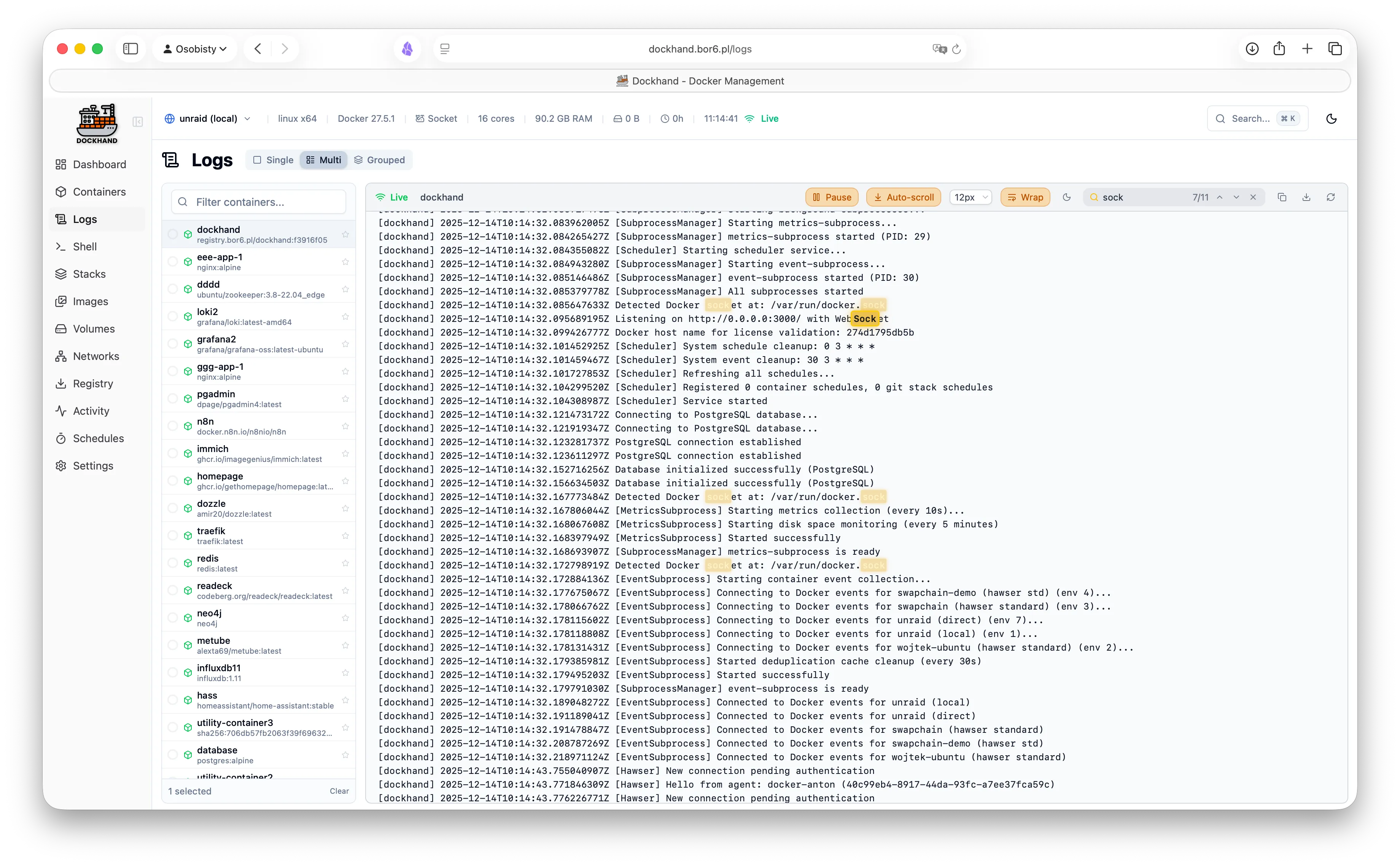
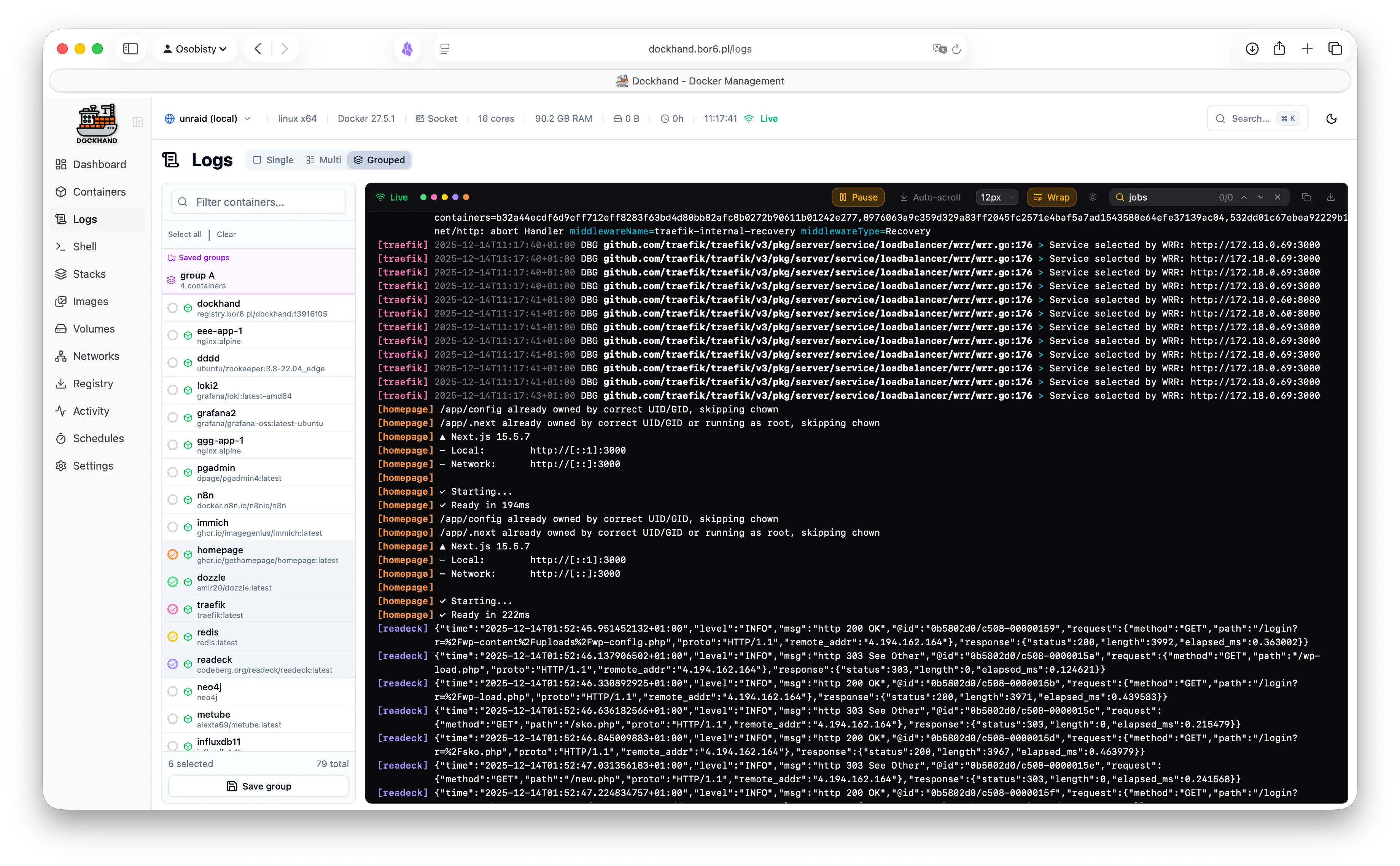
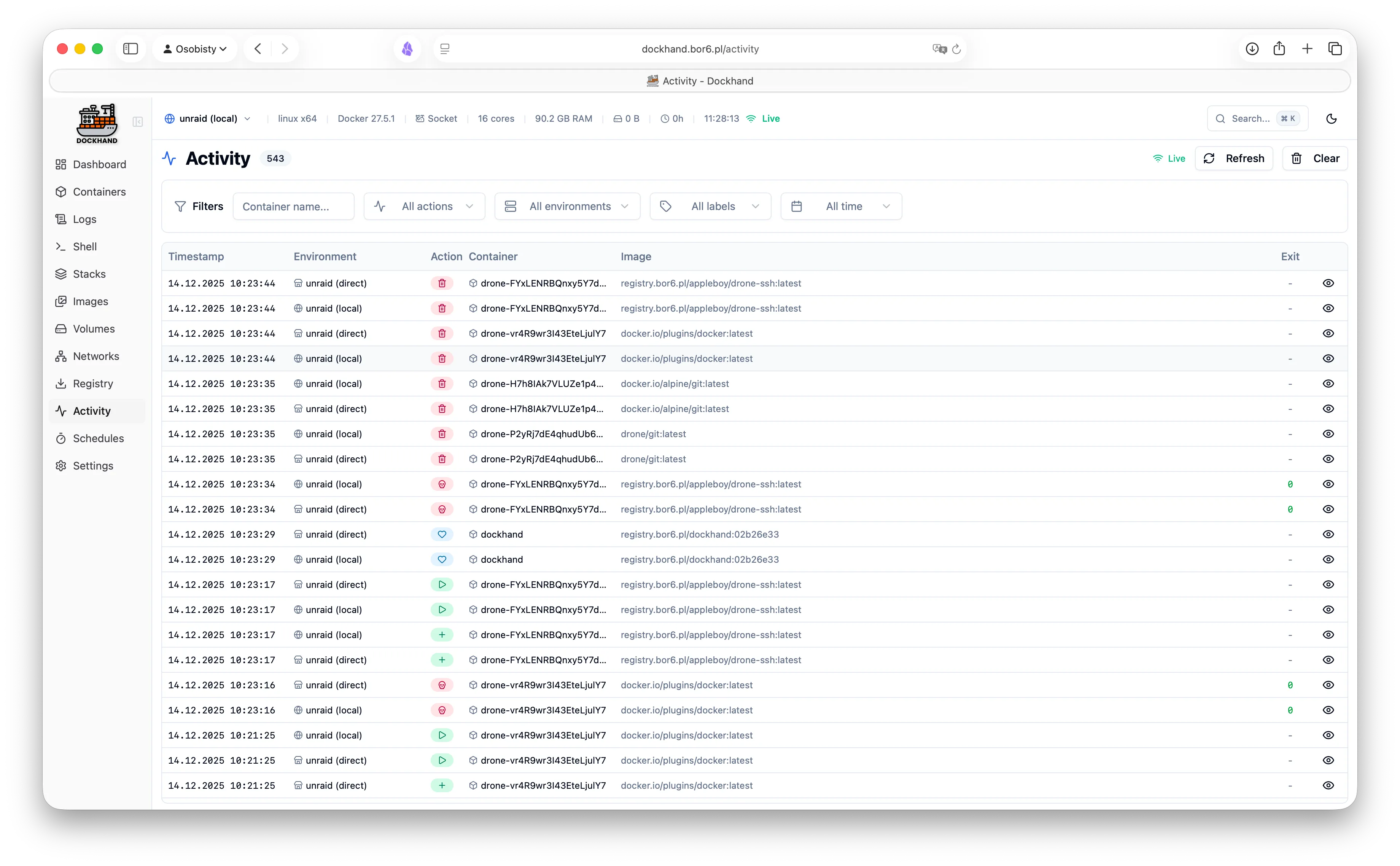
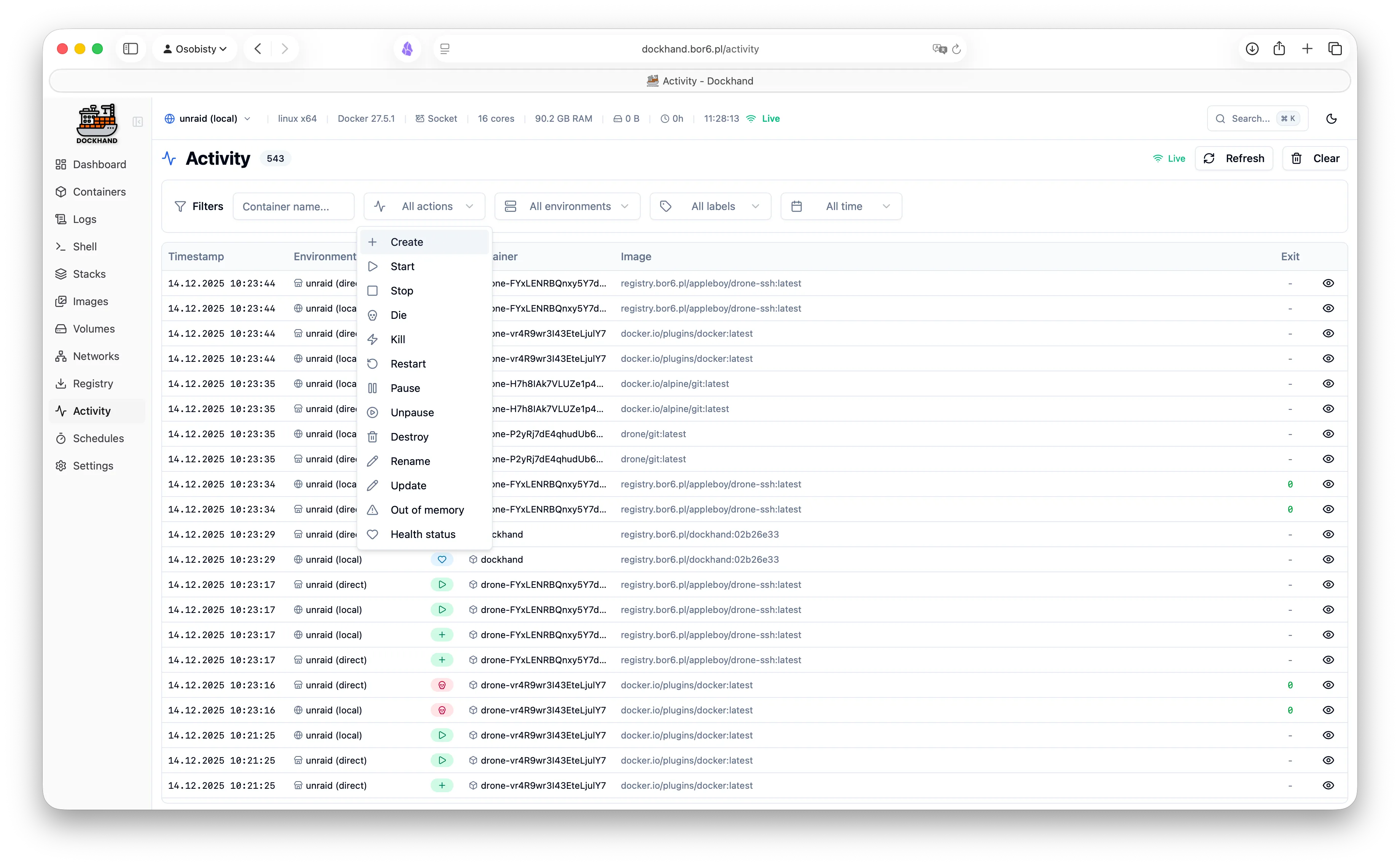
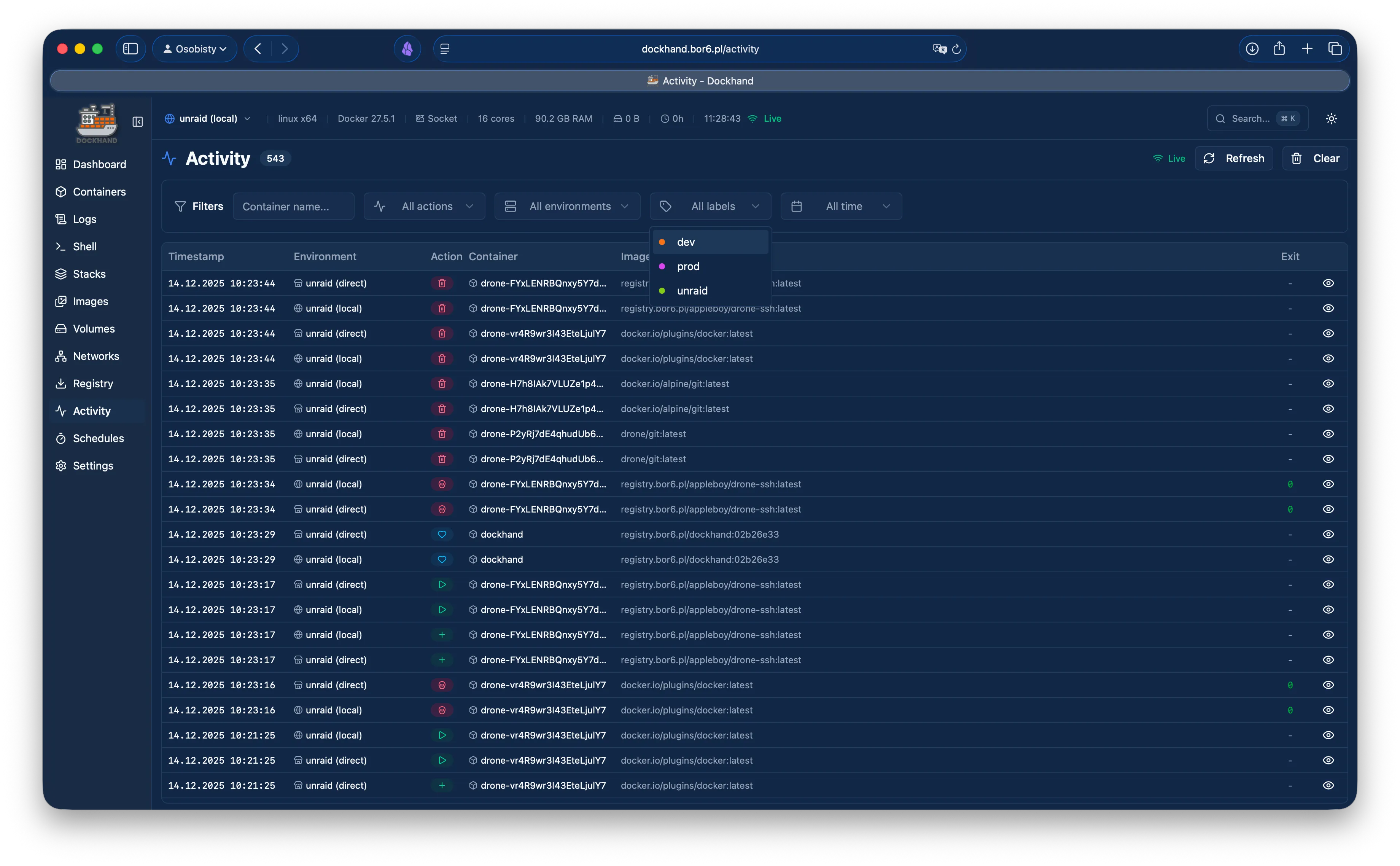
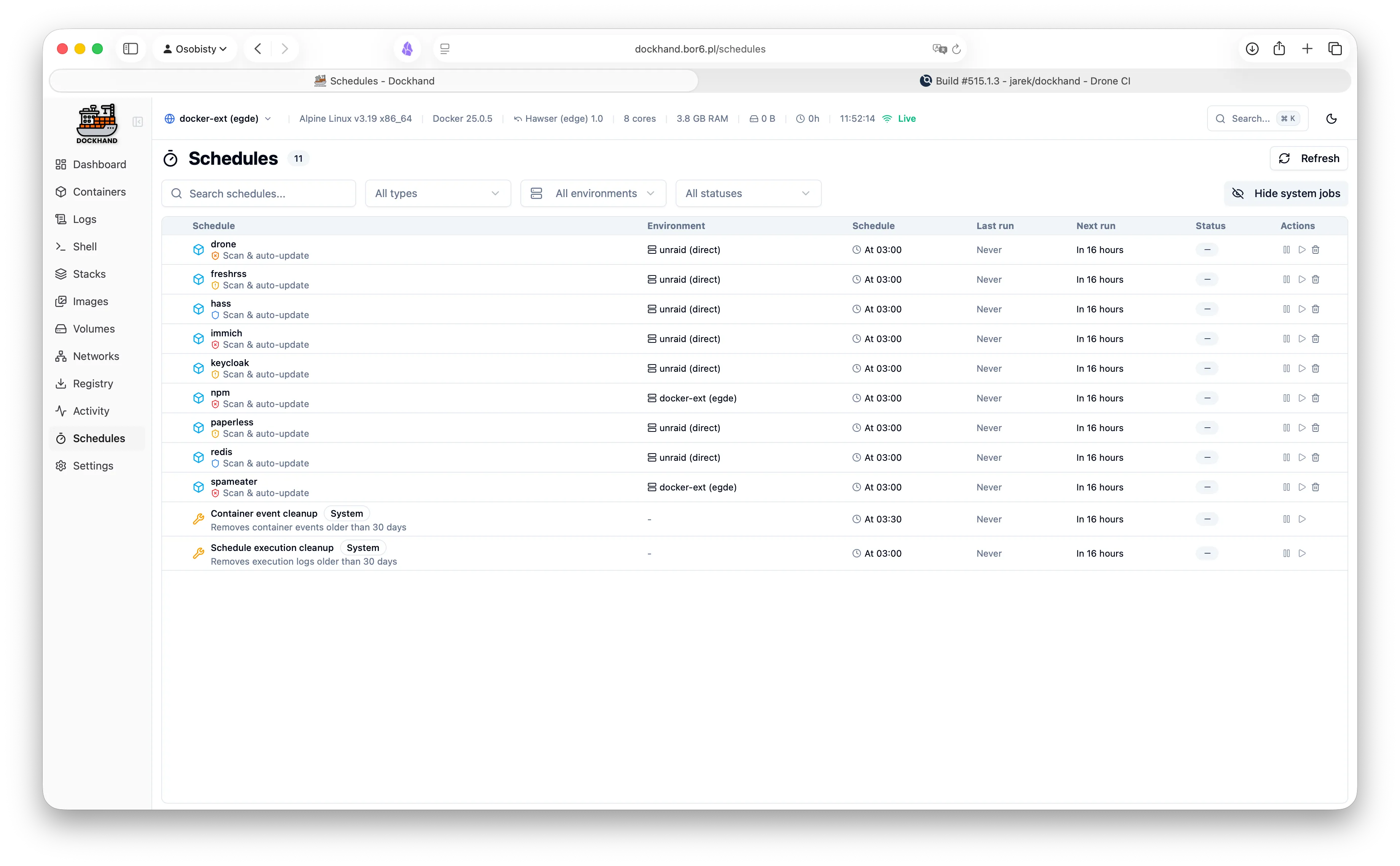
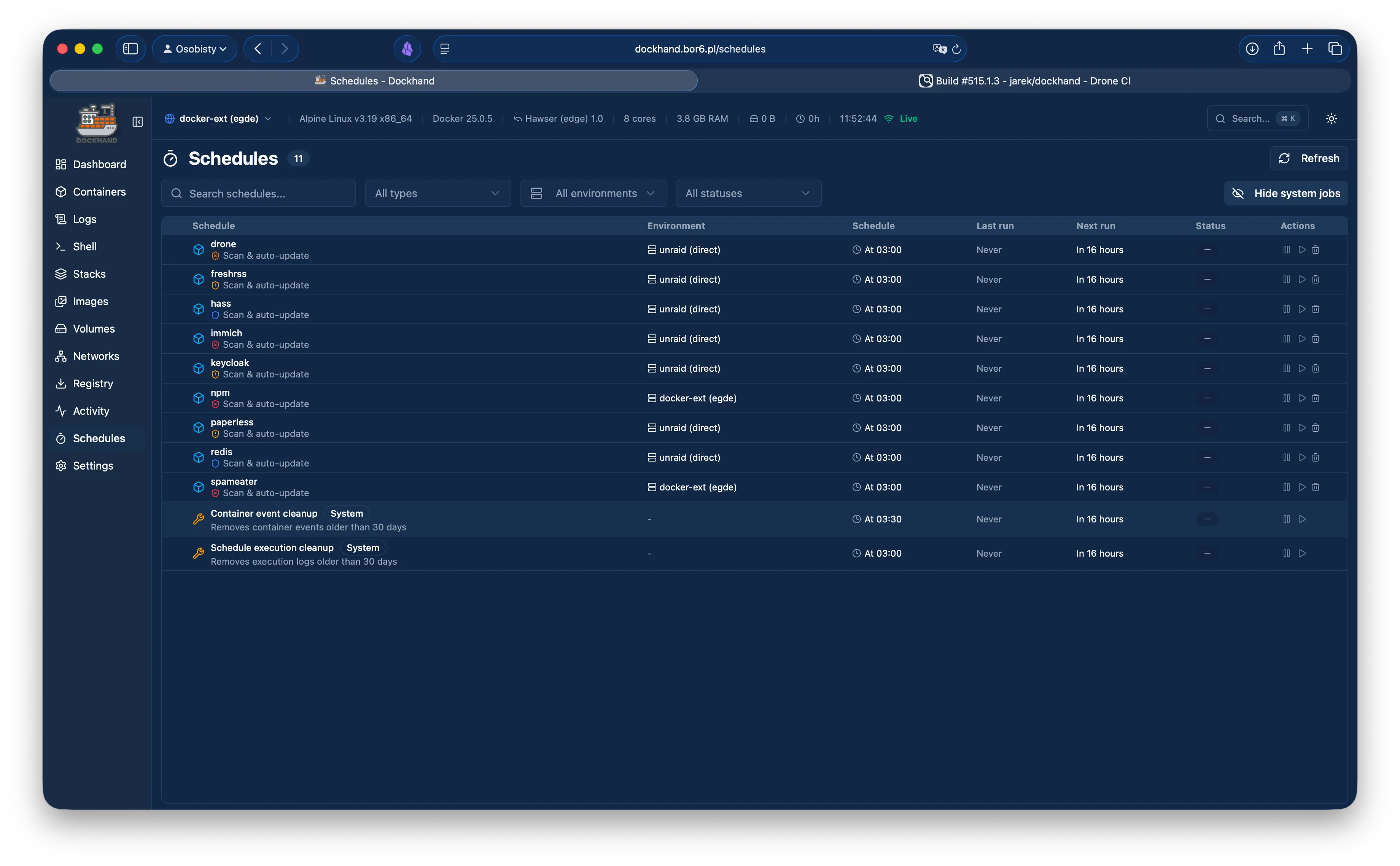
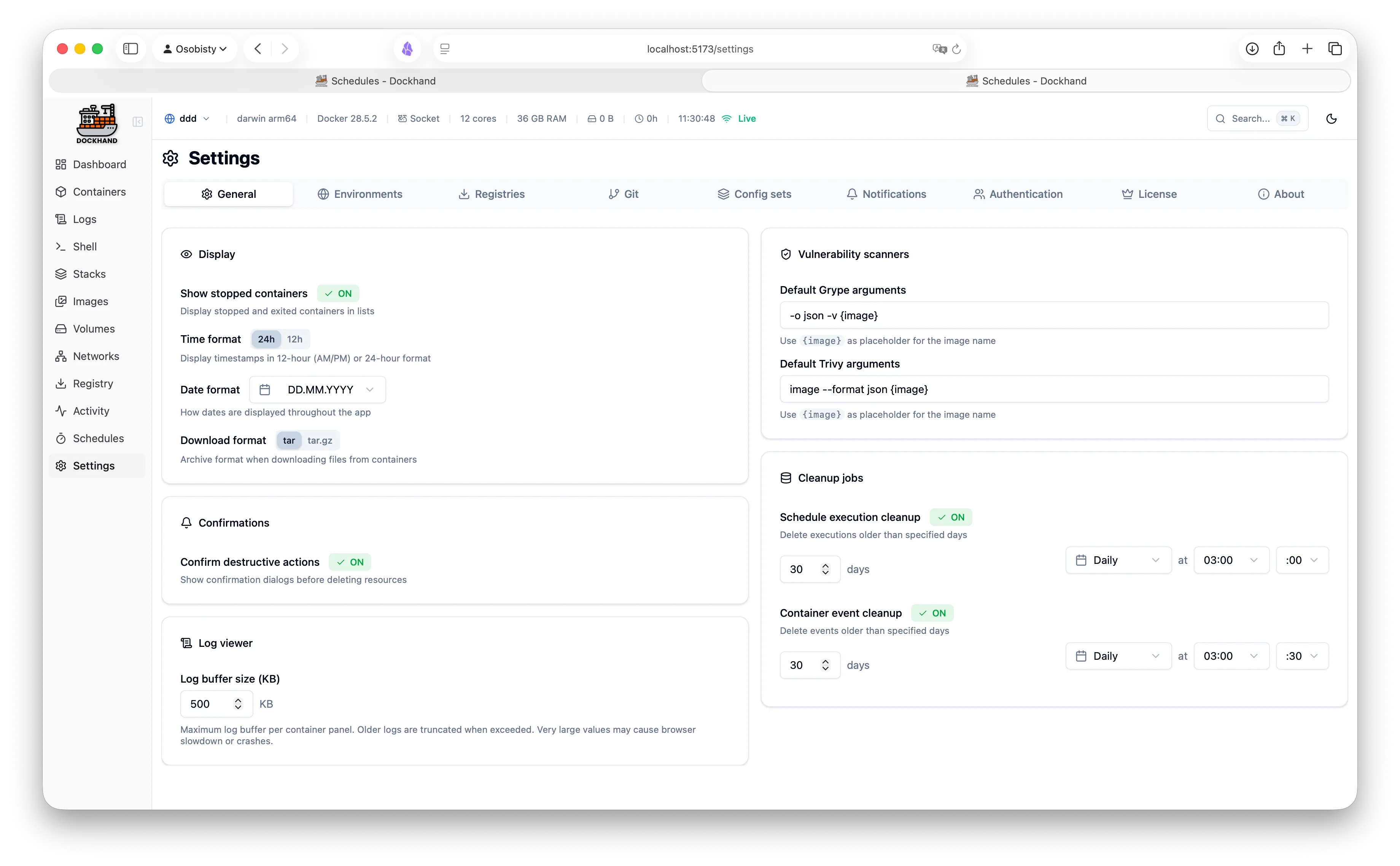
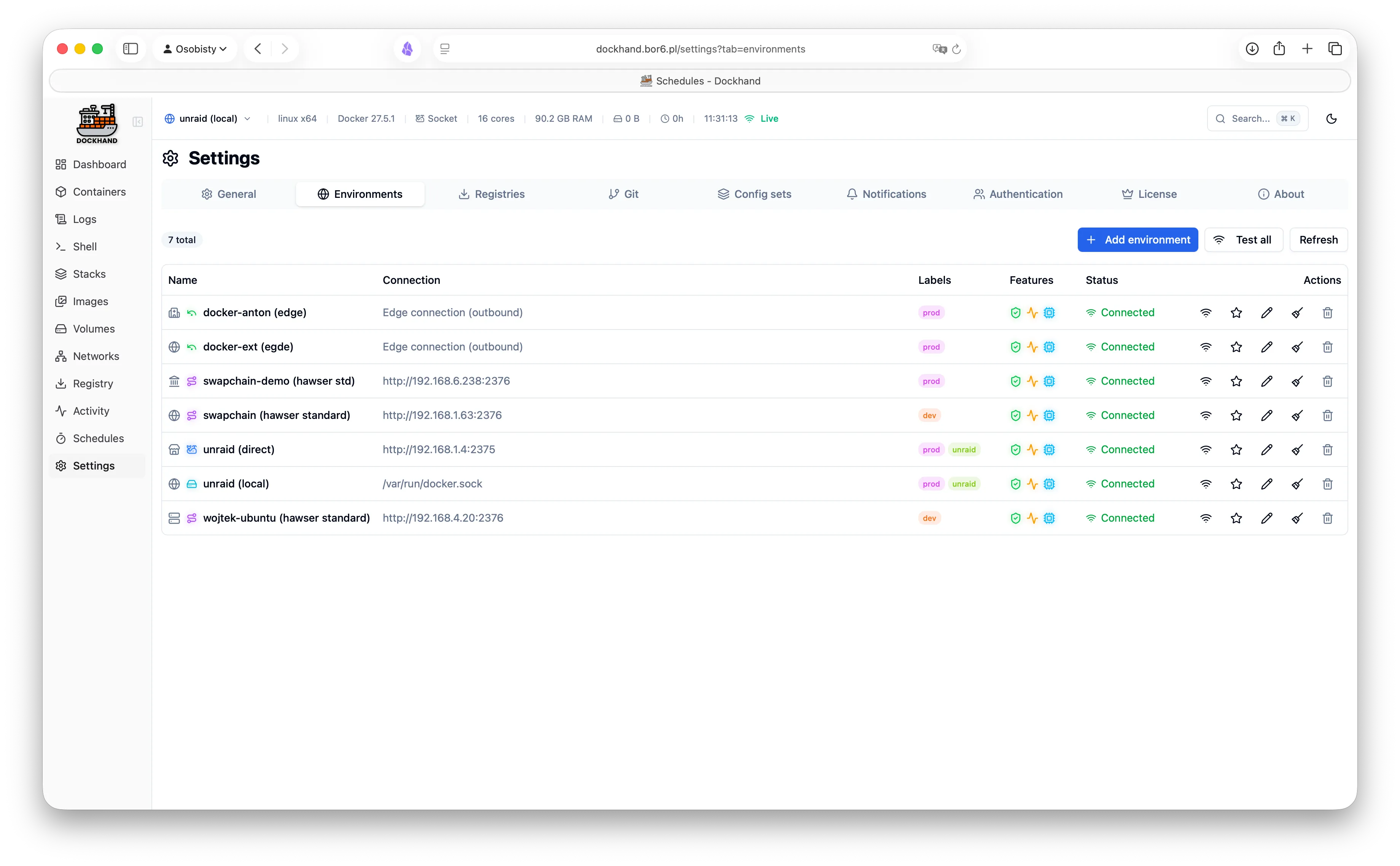
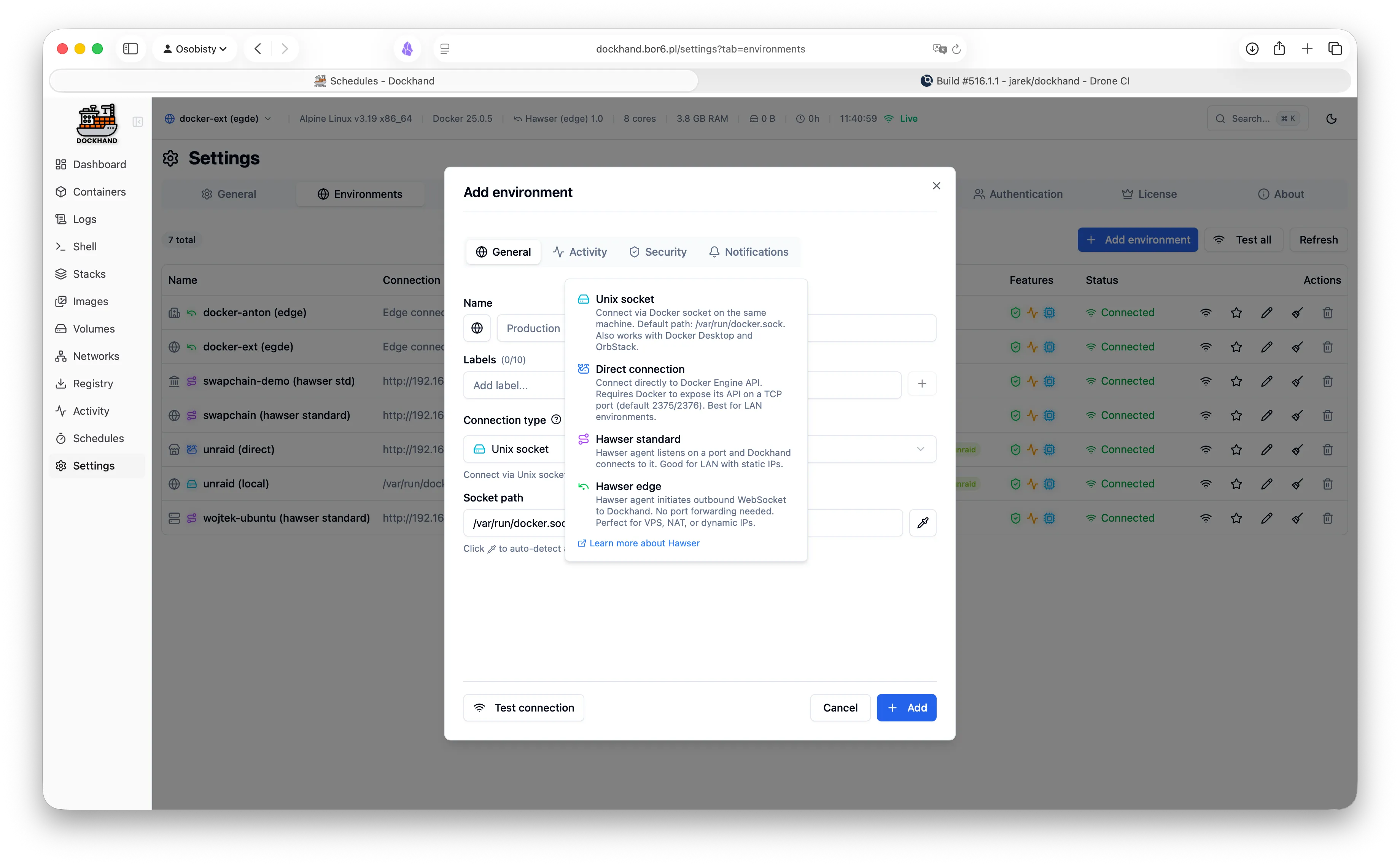
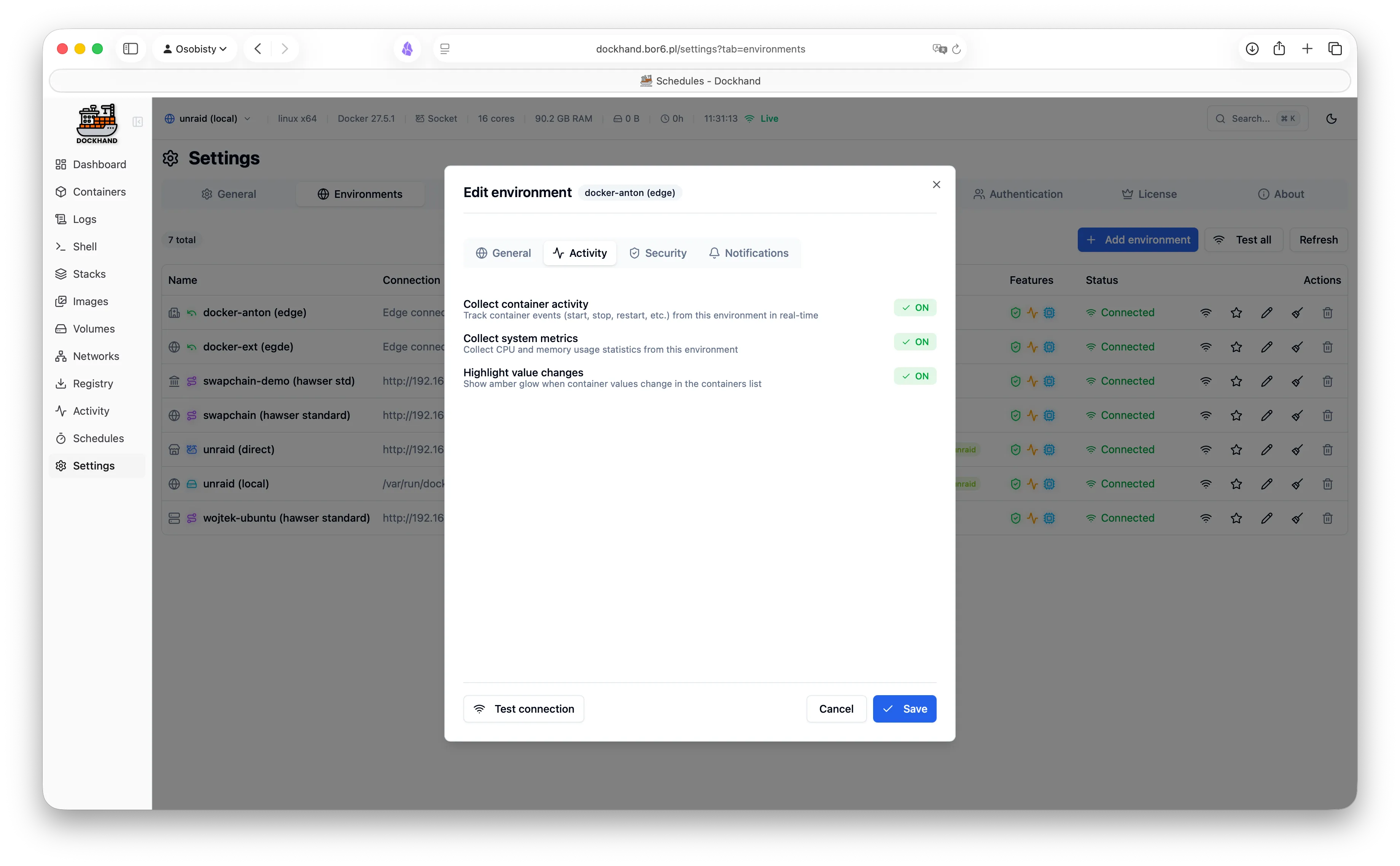
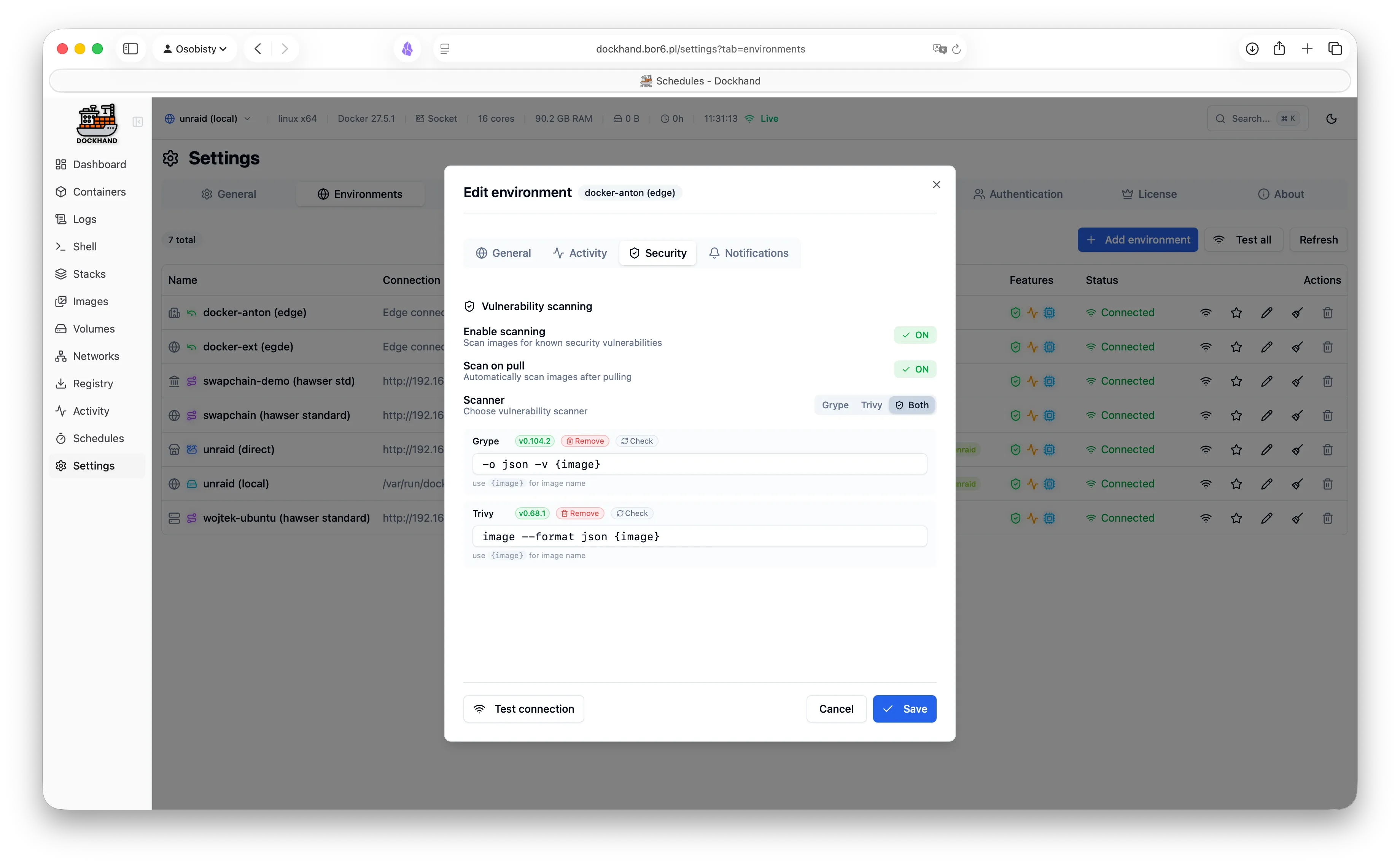
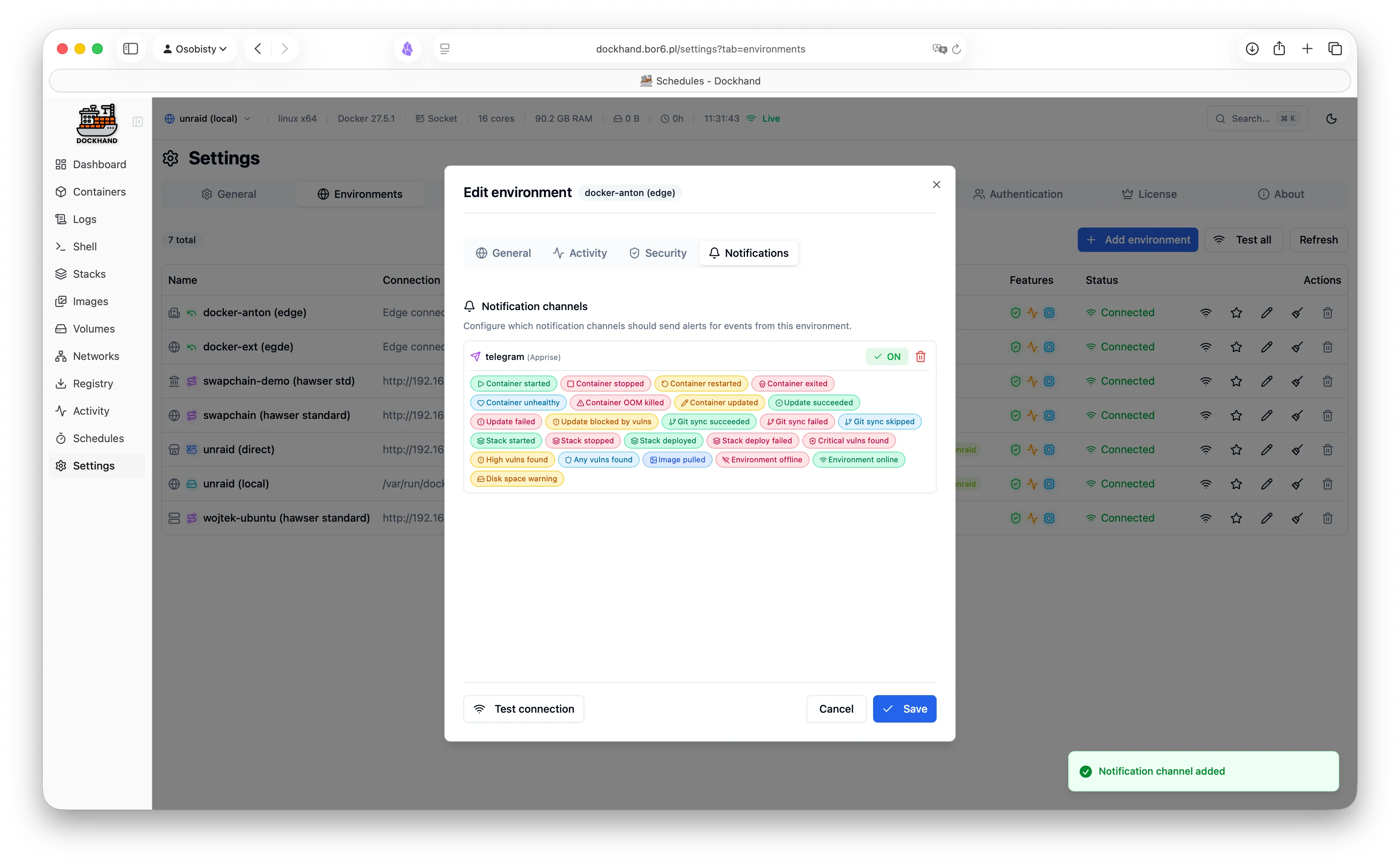
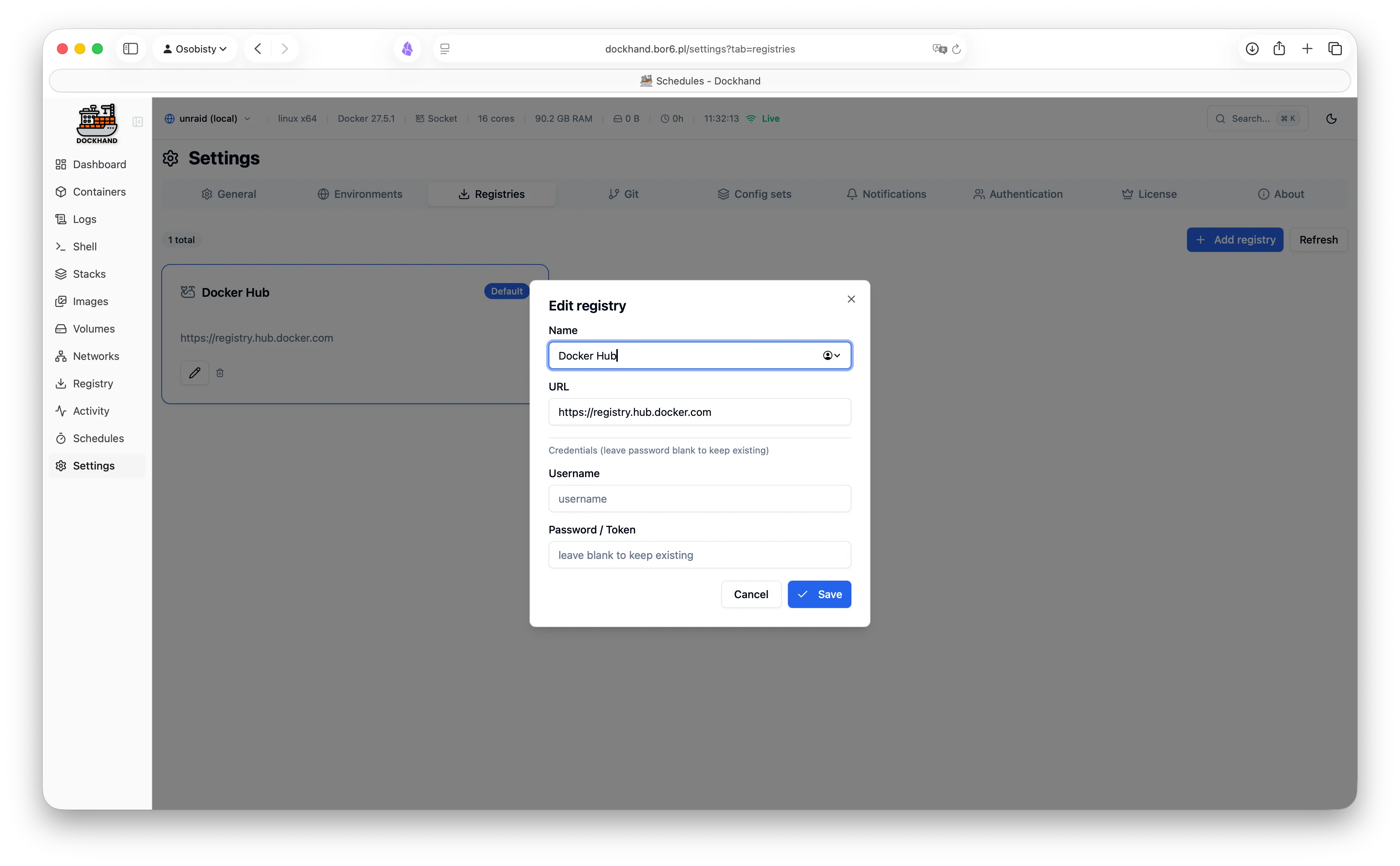
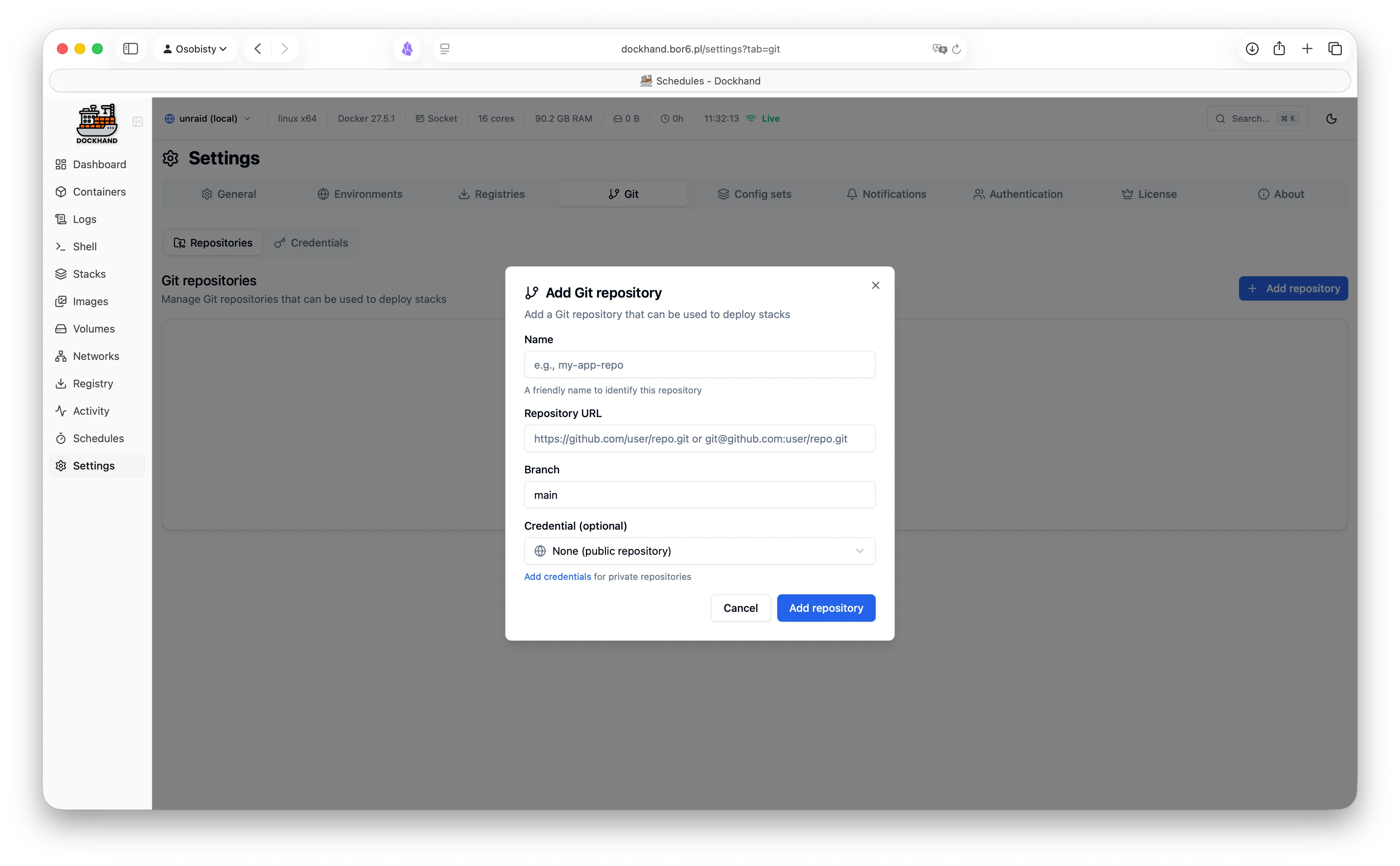
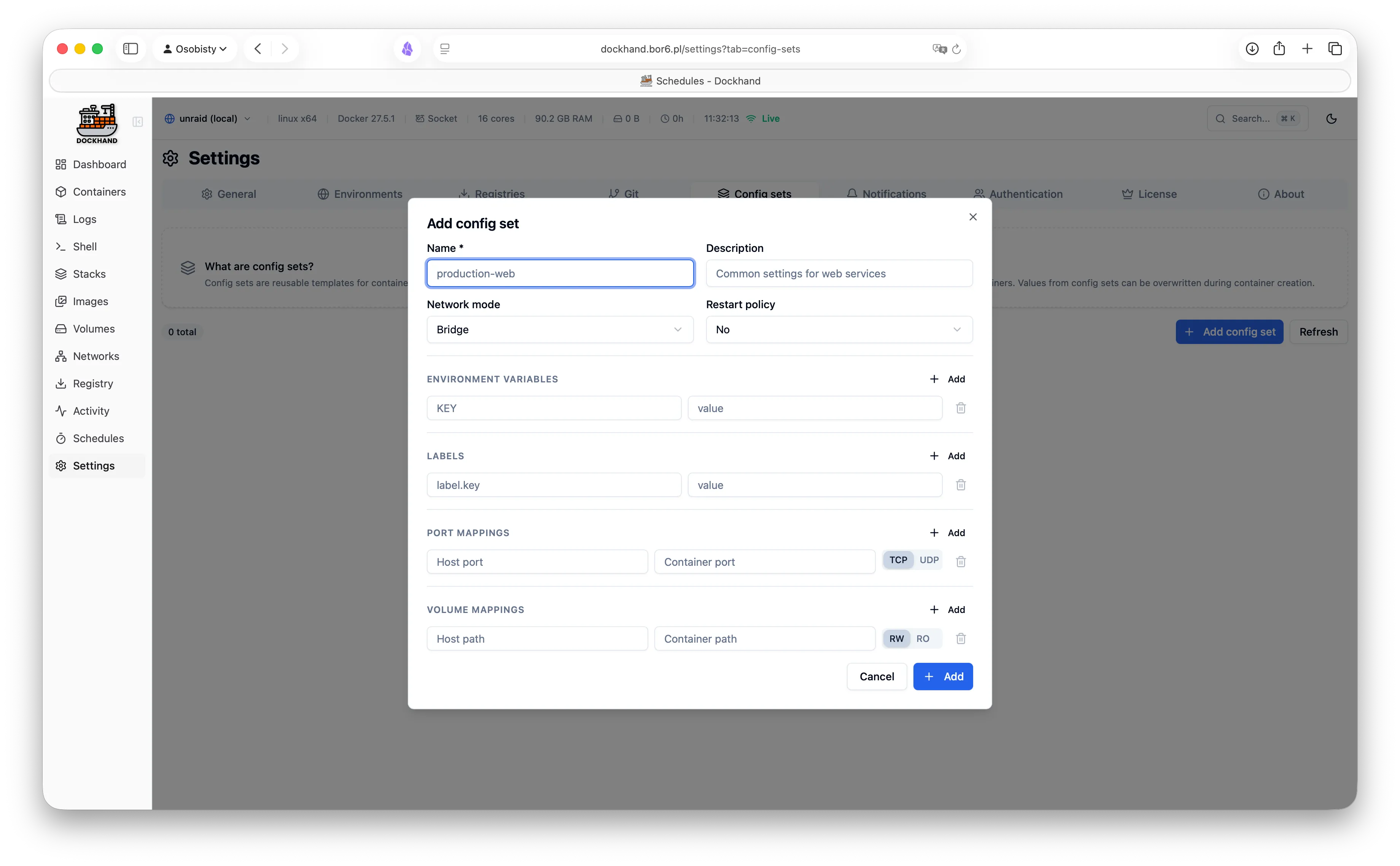
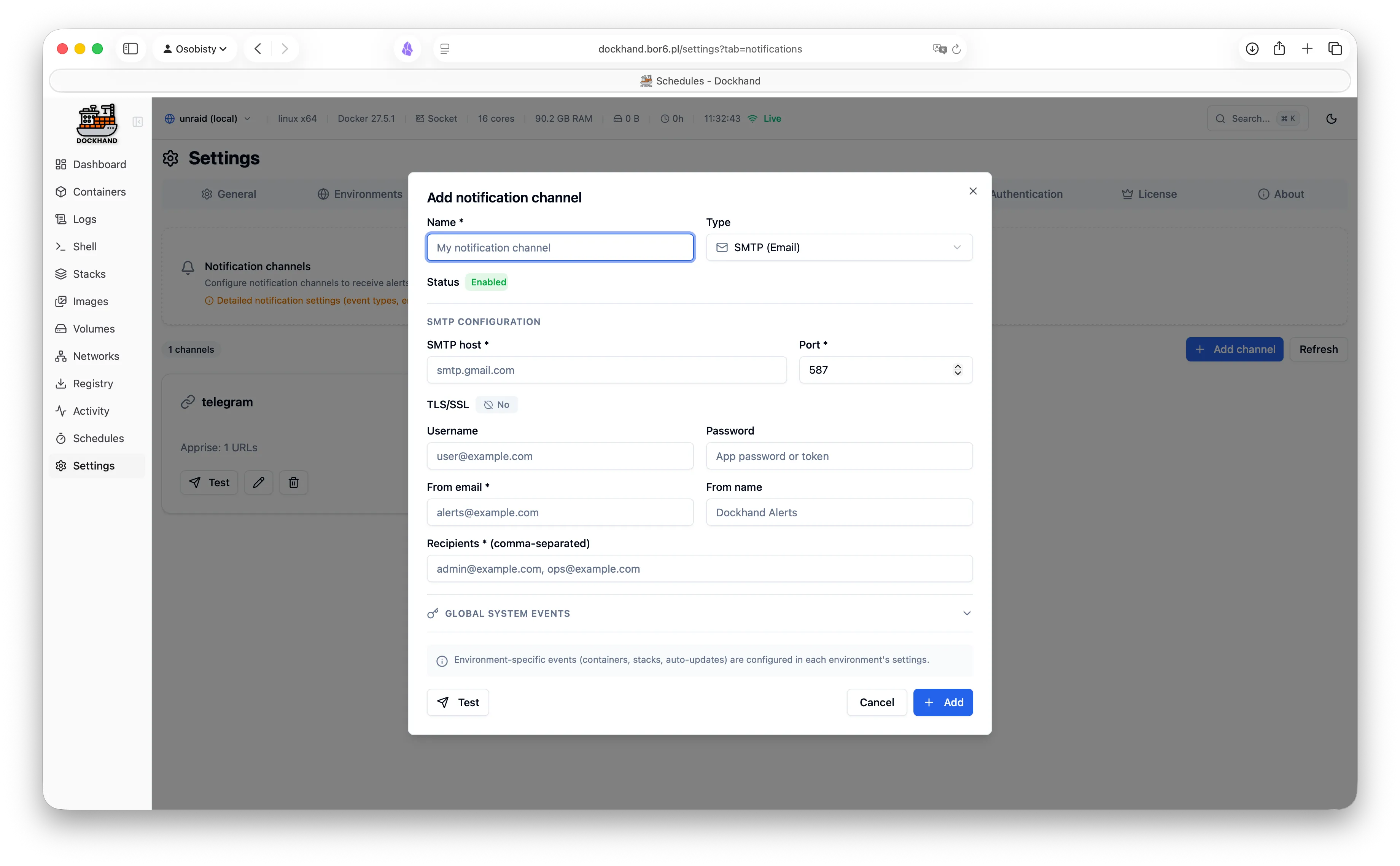
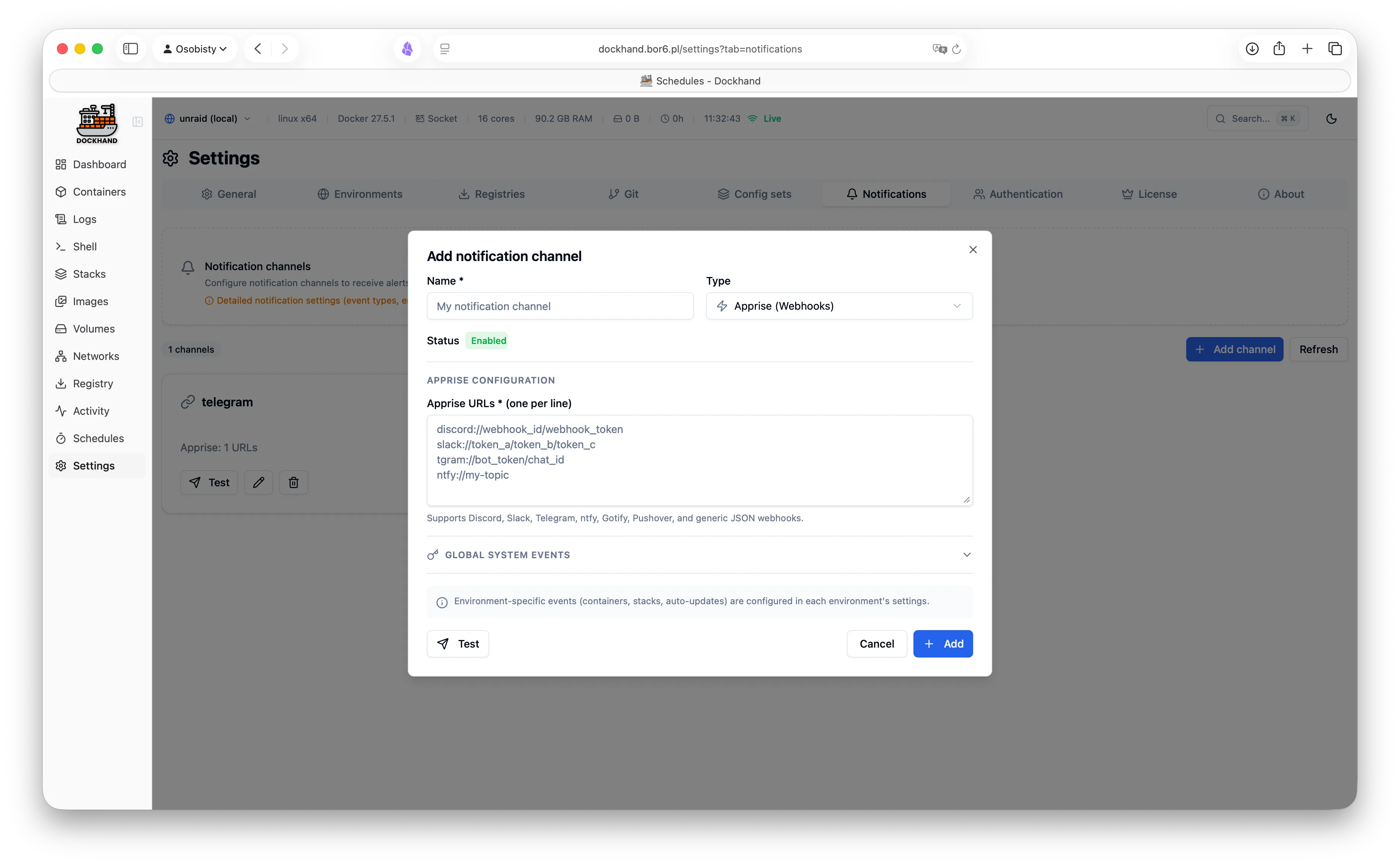
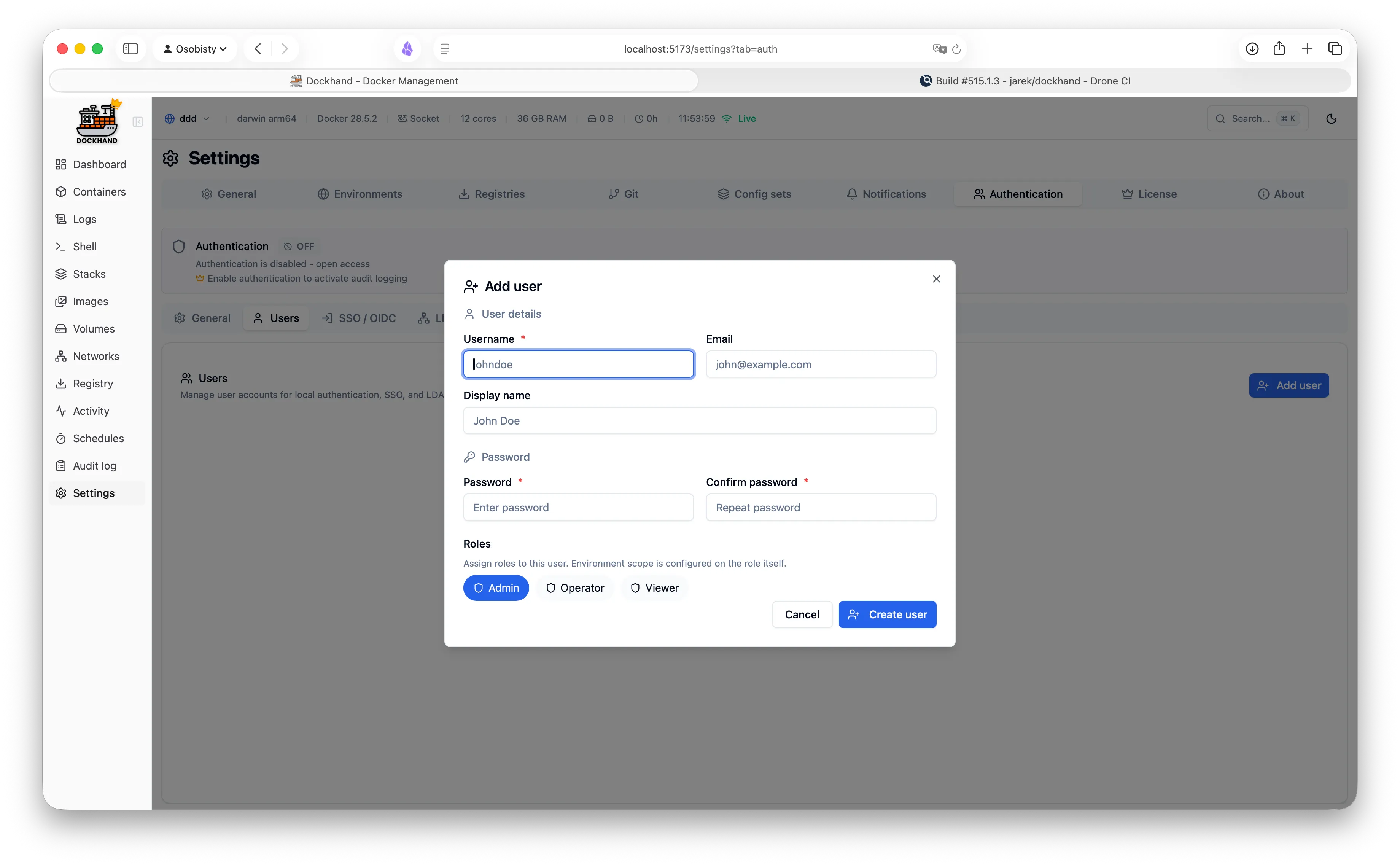
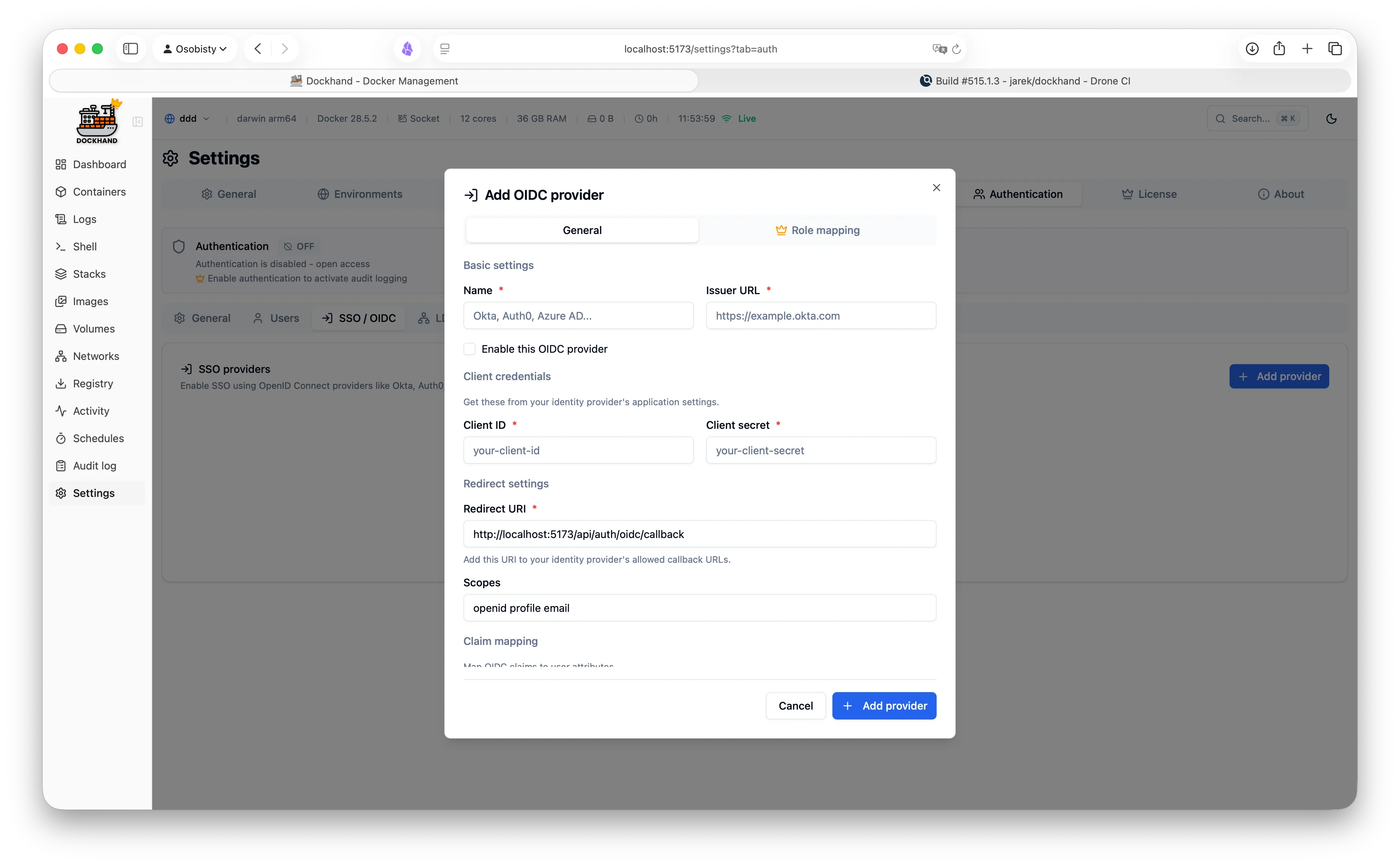
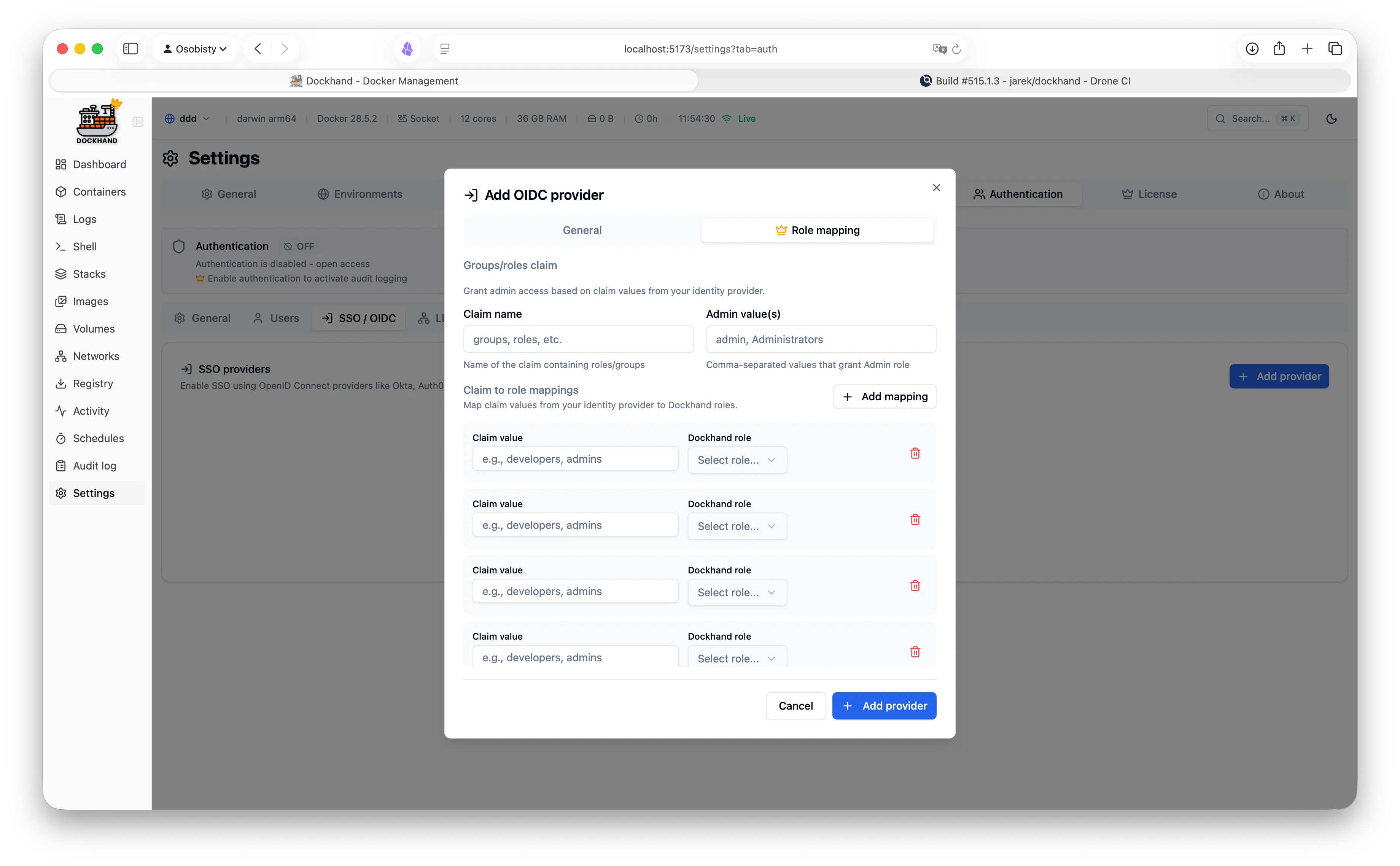
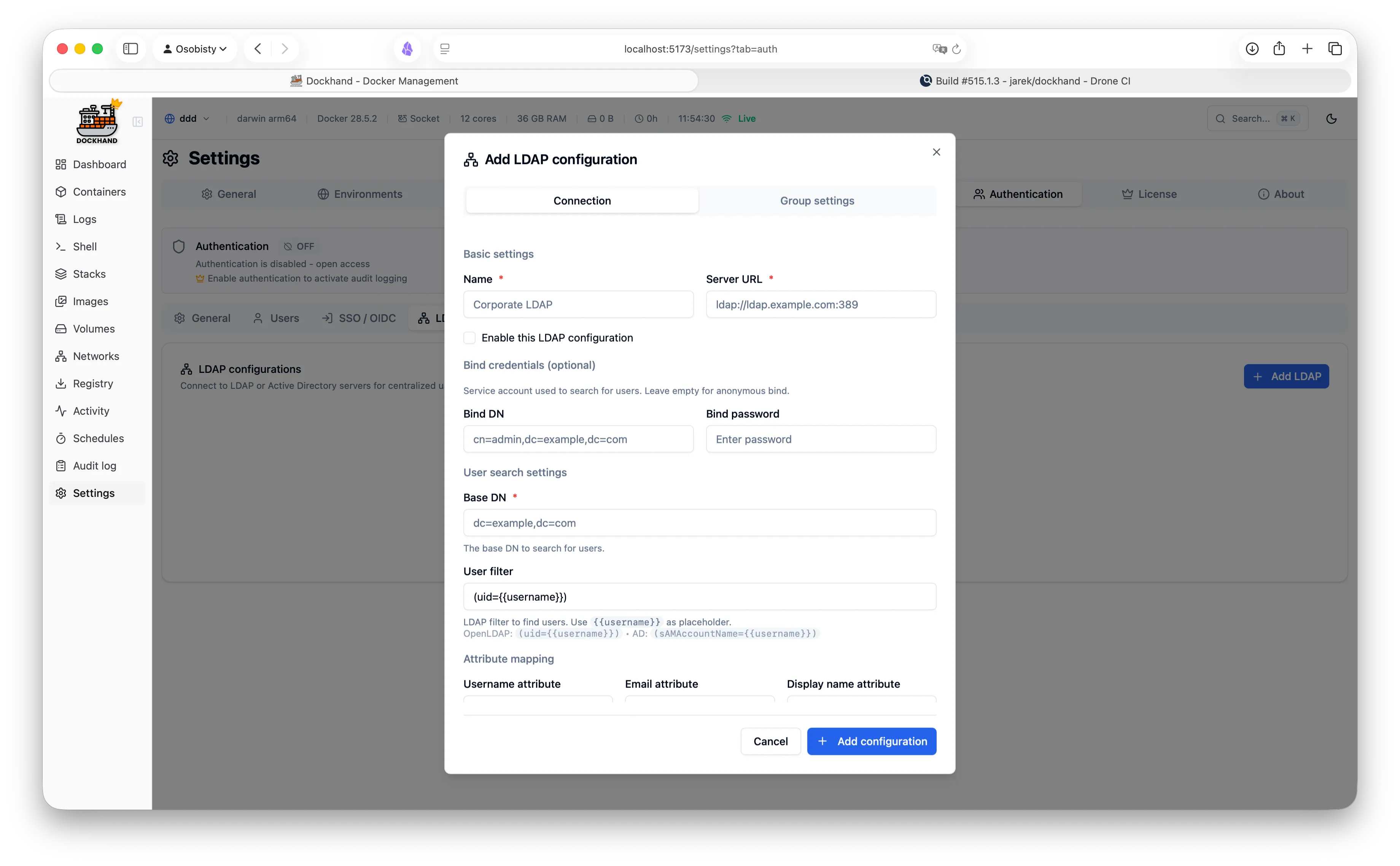
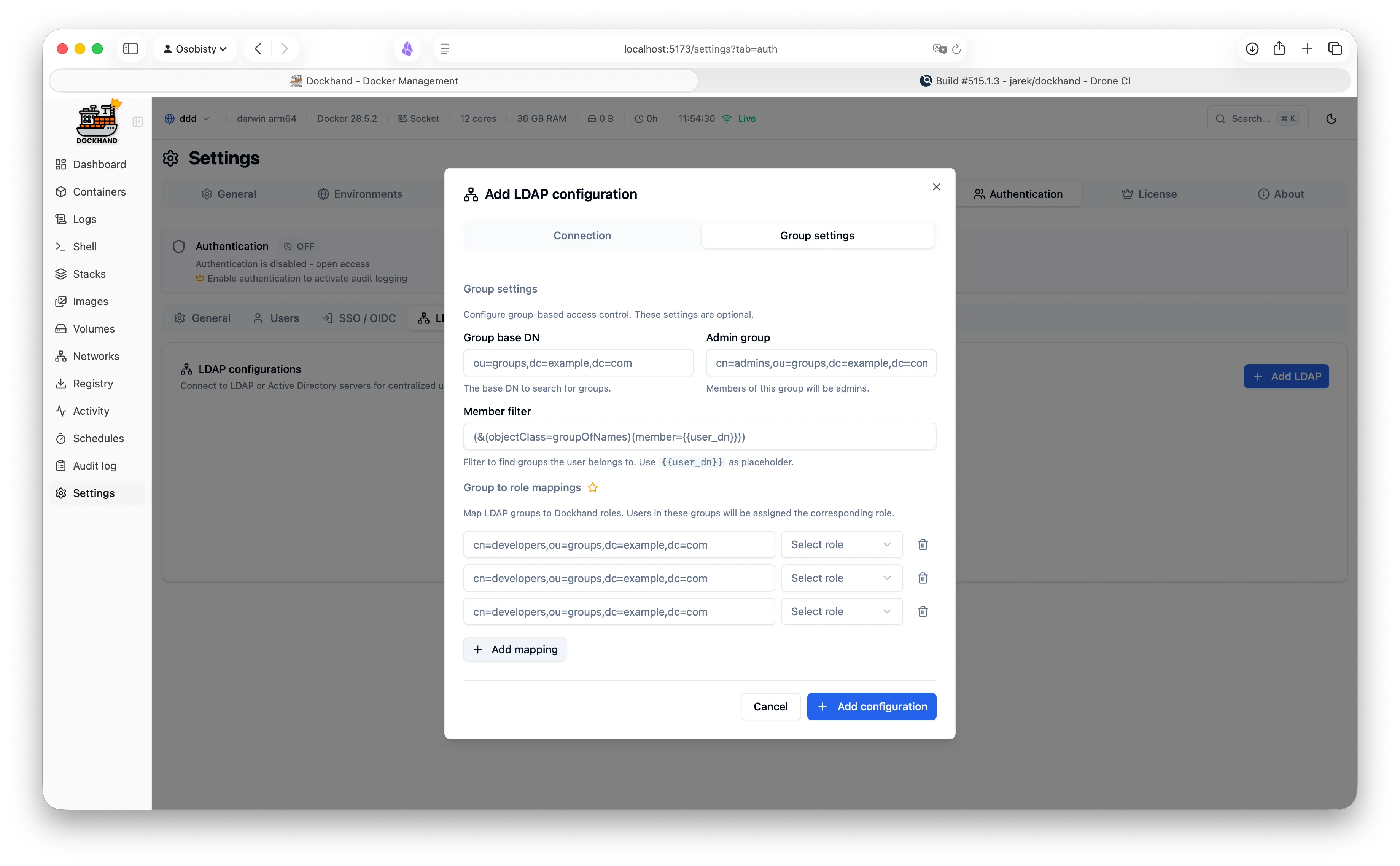
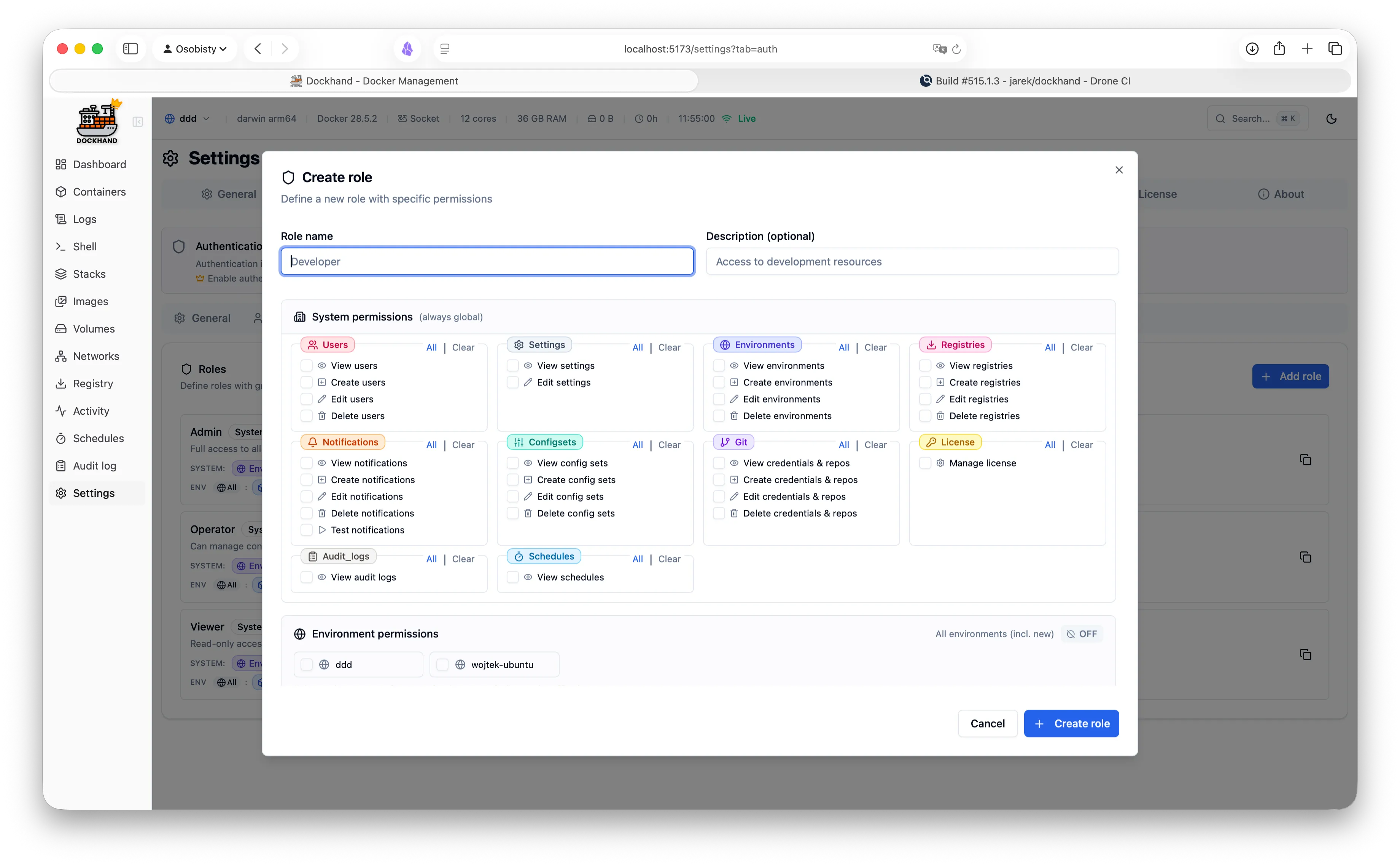
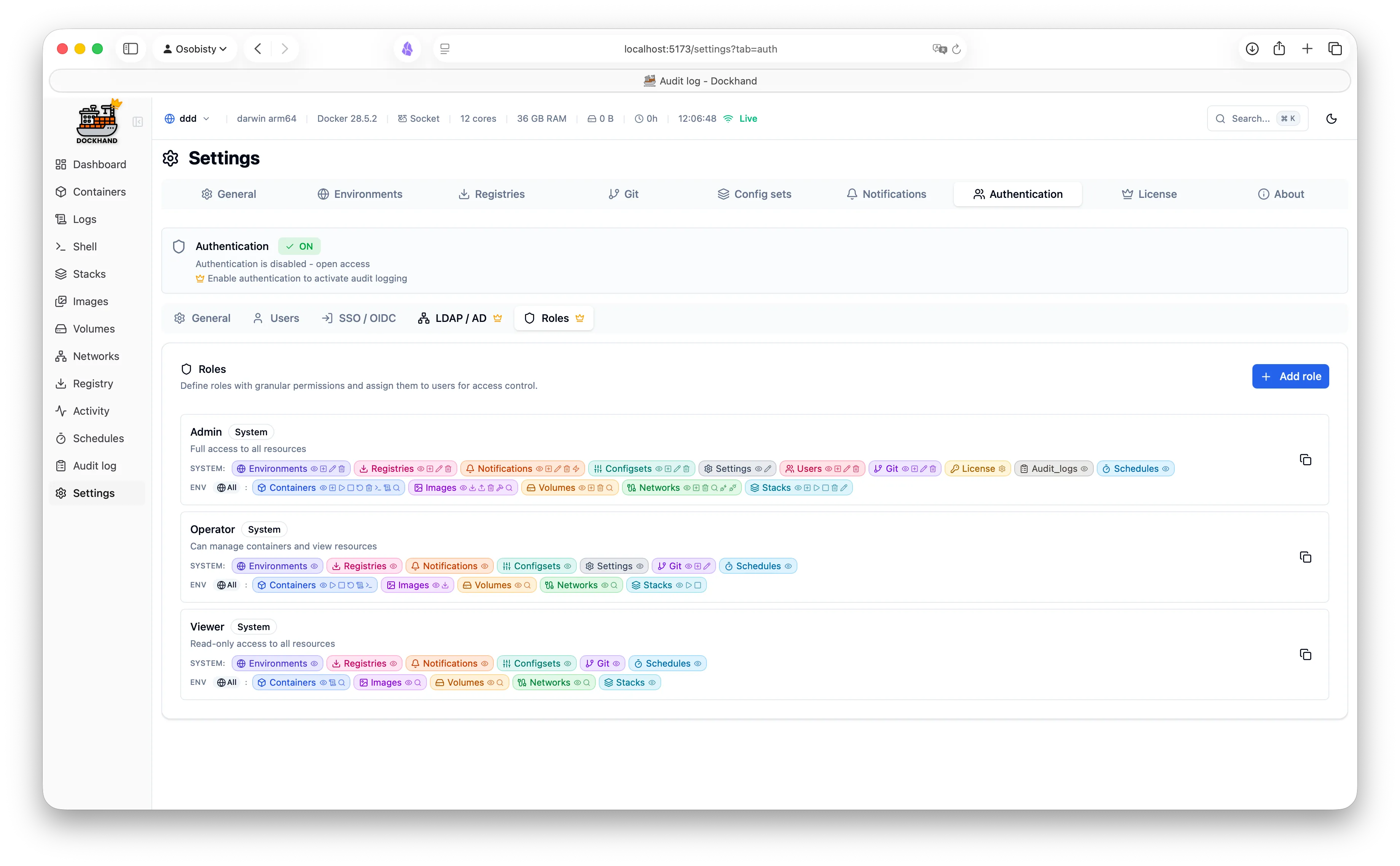
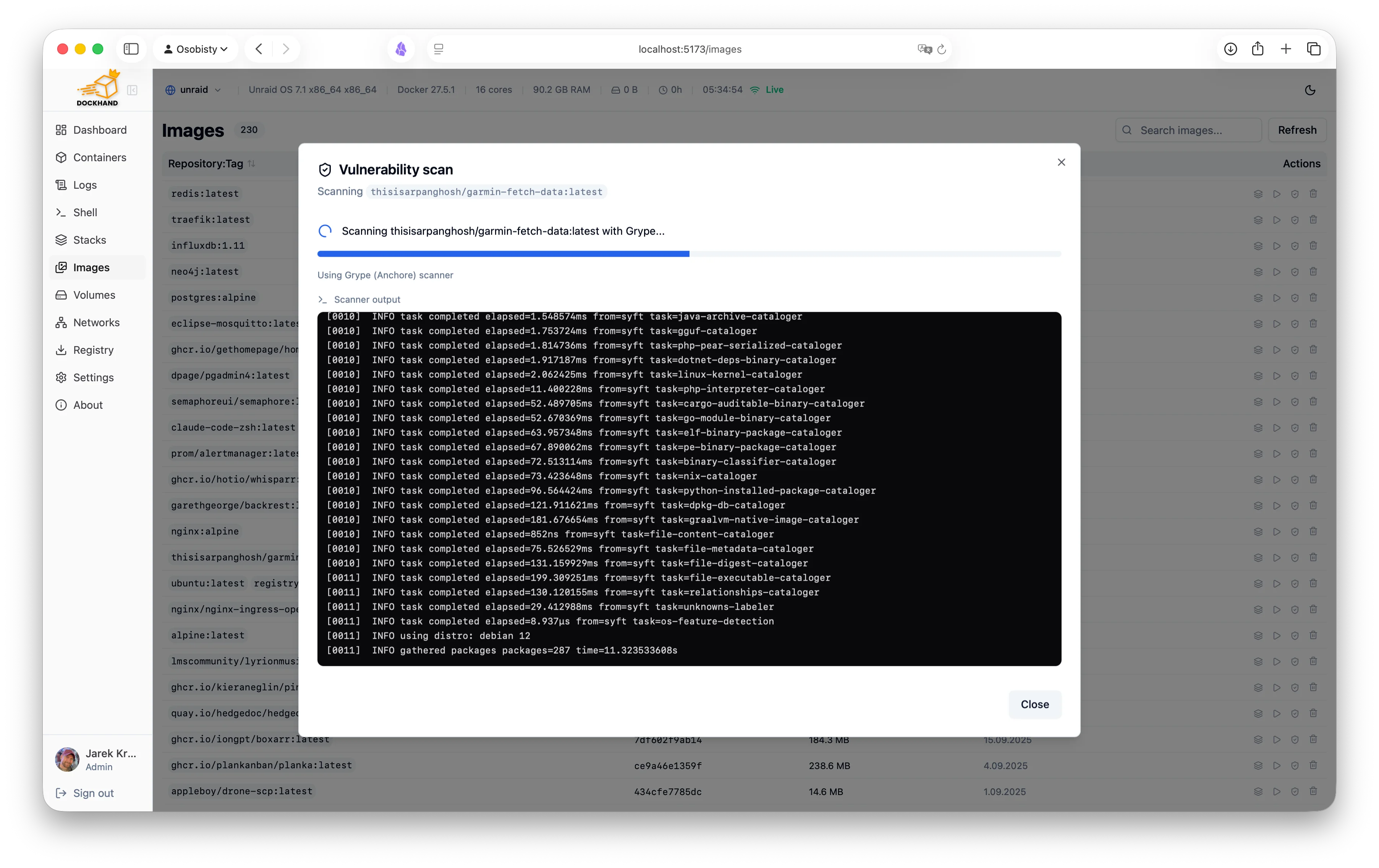
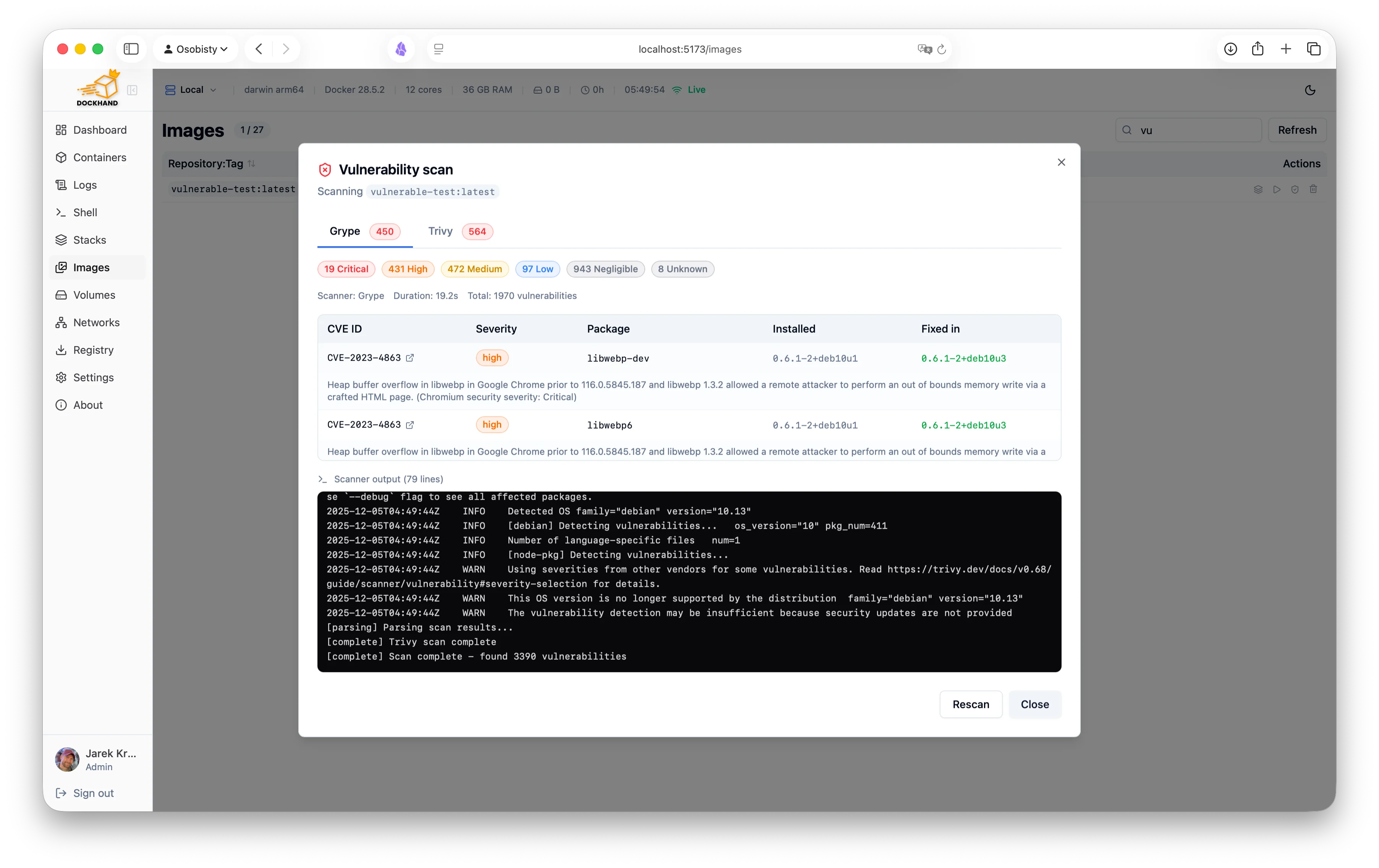
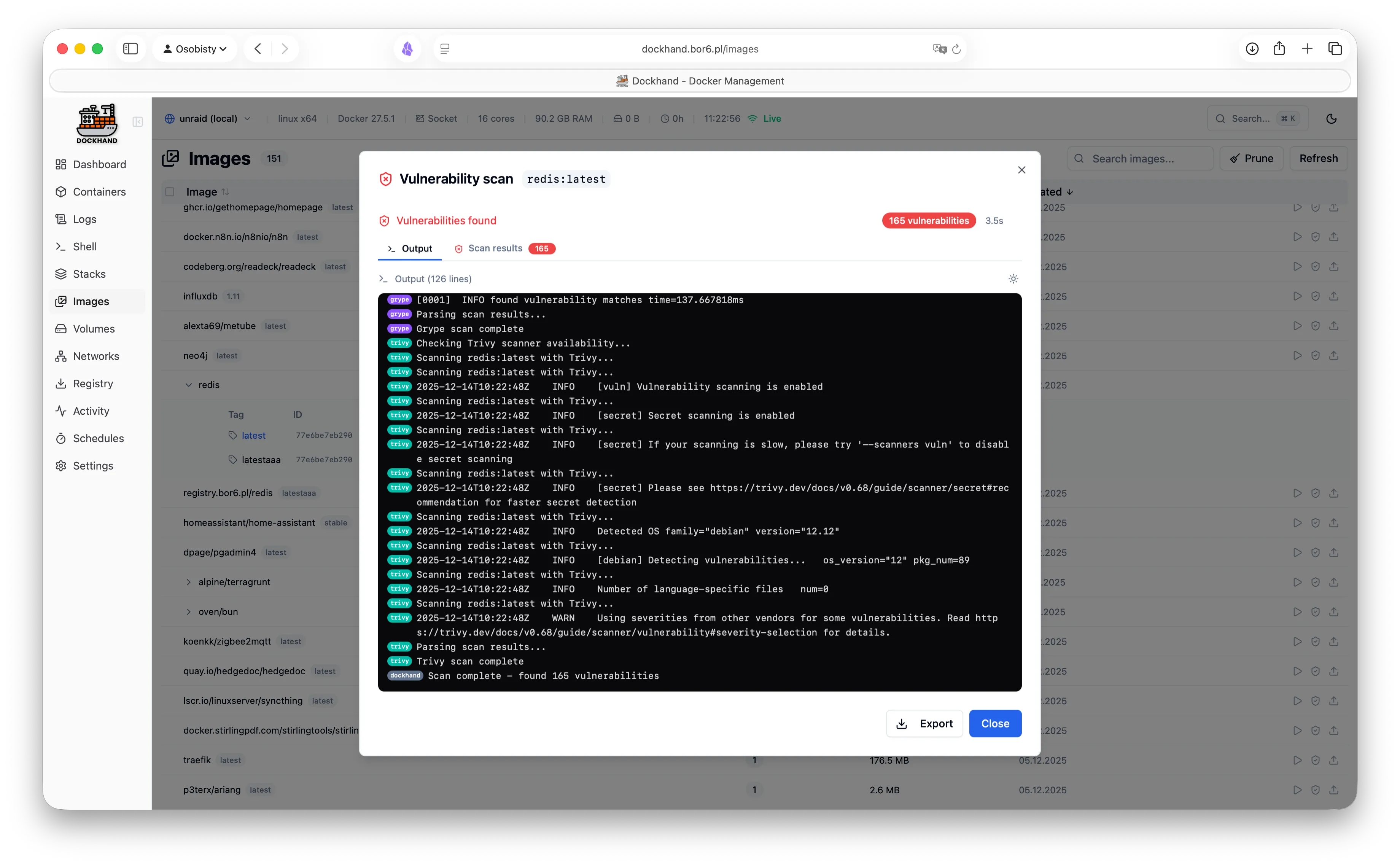
A powerful, intuitive Docker platform. Free for homelabs, ready for enterprise.
We think you'll like it here.
SQLite by default, runs on a Raspberry Pi, zero telemetry, free forever. Self-host everything without the complexity.
OIDC/SSO included free, container activity logging, Git-based deployments, premium support. Everything your team needs without the enterprise price tag.
RBAC, LDAP/AD integration, compliance-grade audit logging, and priority support. Everything you need to satisfy compliance requirements.
One command. No config files. No setup wizards, no 47-page README.
docker run -d \
  --name dockhand \
  --restart unless-stopped \
  -p 3000:3000 \
  -v /var/run/docker.sock:/var/run/docker.sock \
  -v dockhand_data:/app/data \
  fnsys/dockhand:latest
Then open http://localhost:3000. Or put it behind Traefik, Nginx, Caddy, a Kubernetes ingress, three load balancers, and a VPN tunnel. We don't judge.
Prefer Docker Compose?
services:
  dockhand:
    image: fnsys/dockhand:latest
    container_name: dockhand
    restart: unless-stopped
    ports:
      - 3000:3000
    volumes:
      - /var/run/docker.sock:/var/run/docker.sock
      - dockhand_data:/app/data

volumes:
  dockhand_data:
Need PostgreSQL?
services:
  postgres:
    image: postgres:16-alpine
    restart: unless-stopped
    environment:
      POSTGRES_USER: dockhand
      POSTGRES_PASSWORD: changeme
      POSTGRES_DB: dockhand
    volumes:
      - postgres_data:/var/lib/postgresql/data

  dockhand:
    image: fnsys/dockhand:latest
    ports:
      - 3000:3000
    environment:
      DATABASE_URL: postgres://dockhand:changeme@postgres:5432/dockhand
    volumes:
      - /var/run/docker.sock:/var/run/docker.sock
      - dockhand_data:/app/data
    depends_on:
      - postgres
    restart: unless-stopped

volumes:
  postgres_data:
dockhand_data:From simple container operations to complex multi-environment deployments.
Even that one container you forgot about three months ago.
Authentication is free. RBAC is enterprise. No calculator required.
| Feature | Free | SMB | Enterprise |
|---|---|---|---|
| Unlimited environments | ✓ | ✓ | ✓ |
| Container & stack management | ✓ | ✓ | ✓ |
| Git repository integration | ✓ | ✓ | ✓ |
| Vulnerability scanning | ✓ | ✓ | ✓ |
| Local user accounts | ✓ | ✓ | ✓ |
| OIDC/SSO | ✓ | ✓ | ✓ |
| Multi-factor authentication | ✓ | ✓ | ✓ |
| Container activity log | ✓ | ✓ | ✓ |
| Commercial usage license | — | ✓ | ✓ |
| Premium support | — | ✓ | ✓ |
| Priority bug fixes | — | ✓ | ✓ |
| LDAP/Active Directory | — | — | ✓ |
| Role-based access control | — | — | ✓ |
| Environment-scoped permissions | — | — | ✓ |
| Audit logging (compliance) | — | — | ✓ |
| Price | $0 forever | $499/host/year | $1,499/host/year |
| Buy me a coffee |
Host = one machine running Dockhand. Volume discounts available for 5+ hosts.
No cloud dependencies, no telemetry, no data leaving your network. Solid base.
Paranoid? We prefer "security-conscious."
Dockhand runs entirely on your infrastructure. No SaaS, no cloud dependency, no vendor lock-in. Your data never touches our servers.
We don't phone home. No usage tracking, no analytics, no mysterious background connections. Your Docker environment stays private.
SQLite by default, optional PostgreSQL for HA. No Redis, no message queues. Simple deployment, minimal attack surface.
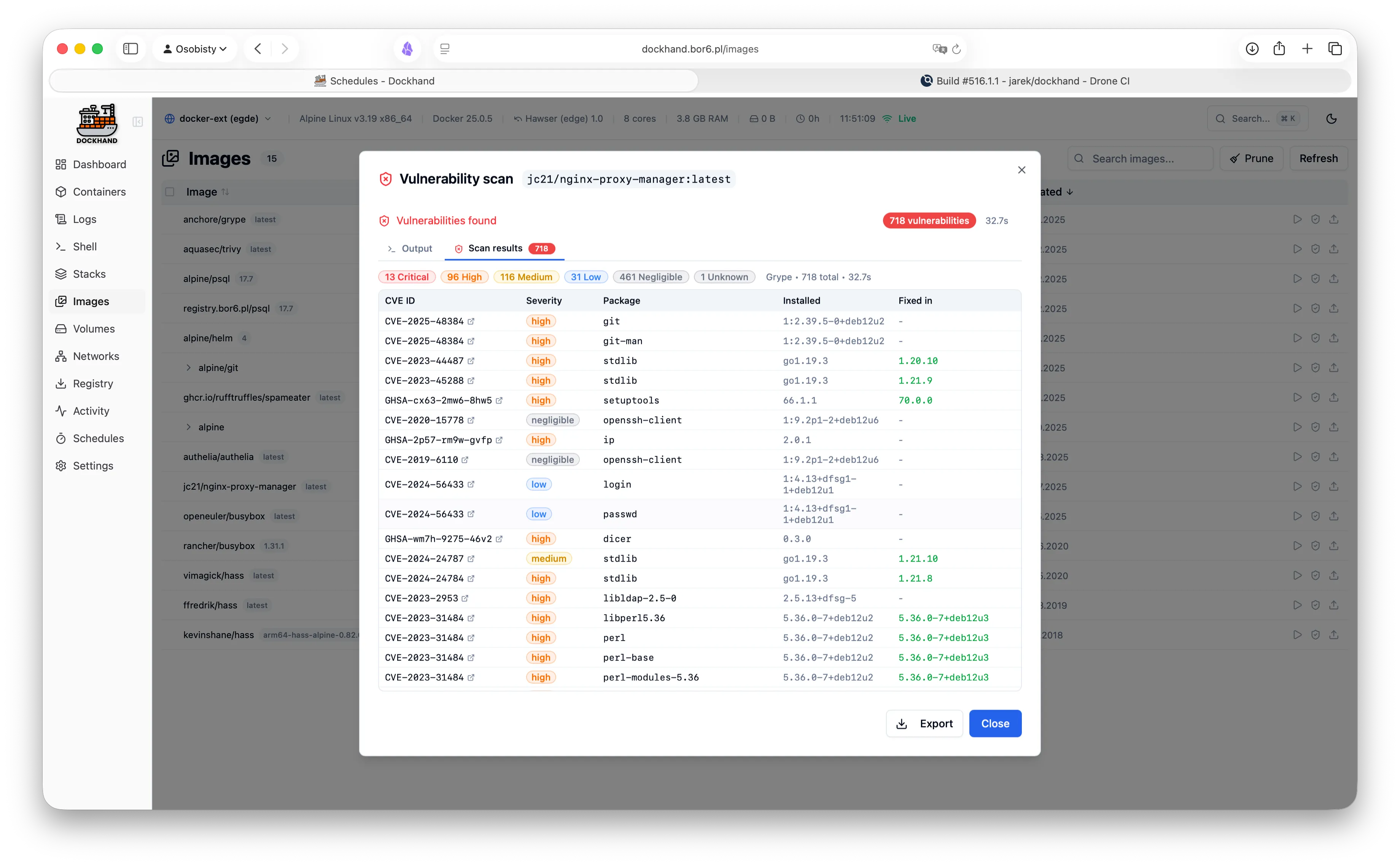
Scan your images for CVEs using Grype and Trivy. Identify security risks before deployment.
Safe-pull protection: During auto-updates, new images are pulled to a temporary tag and scanned before touching your running containers. If vulnerabilities exceed your criteria, the temp image is deleted and your container keeps running safely.
We don't trust pre-built base images. Dockhand builds its own OS layer from scratch using Wolfi packages via apko. Every package is explicitly declared in our Dockerfile - full transparency, zero mystery meat.
While others ship Alpine with 10+ CVEs, we obsess over our own image security. Because a Docker management tool with vulnerabilities is like a locksmith with a broken door. We scan ourselves too.
Our open-source Go agent lets you manage Docker hosts behind NAT, firewalls, or dynamic IPs. The agent initiates outbound connections to Dockhand - no exposed ports, no inbound firewall rules needed.
A modern, intuitive interface designed for productivity.
Warning: May cause sudden urges to containerize everything.
See what our users are saying.
"After trying Dockhand in my lab and comparing features toe to toe with other tools I am currently using, I can honestly say it is one of the best that I have used. It is extremely easy to use, intuitive, and it puts docker management tool security in focus where it should be."
"Perfect for my homelab. It's lightweight, actively maintained, and has all the features I need. Love the terminal access and real-time log streaming!"
"The LDAP integration was a game-changer for our team. Set it up in 10 minutes and now all our developers have proper access control."
"Dockhand wants to be a Portainer replacement, and it might already be there."
"Dockhand is bursting onto the scene with impressive force, bringing a breath of truly fresh air to a world that, let's be honest, had started to feel a bit stagnant."
"Dockhand is incredibly handy to have around."
"The easiest way I've found to manage and update Docker containers."
Free forever. No, really. No bait-and-switch.
Like it? Fuel the dev with caffeine.
For commercial use. Growing teams, happy CFOs.
When compliance asks "is it enterprise-ready?" and you want to say yes.
In the 2004 animated series The Batman, the episode "The Laughing Bat" (Season 2, Episode 4) presents a twisted role reversal where the Joker decides that if he cannot defeat Batman, he will simply be him . This episode is often cited as a conceptual predecessor to the popular modern comic book villain, The Batman Who Laughs . The Twisted Role Reversal
The plot follows the Joker as he dons a homemade Batman costume and begins a "crime-fighting" spree . However, his version of justice is a nightmare of disproportionate retribution:
Minor Offenses: He targets citizens for trivial acts like jaywalking, littering, or using an express checkout lane with too many items .
Punishment: His "sentences" are always the same—a dose of a new, lethal Joker Venom that leaves victims paralyzed with a permanent grin .
The Swap: Seeking a true arch-rival for his new persona, Joker injects the real Batman with a toxin designed to strip away his seriousness and turn him into a "Joker" . Batman’s Descent into Madness
As the toxin takes hold, Bruce Wayne experiences a behavioral transformation . He begins making inappropriate puns, laughing uncontrollably during serious moments (such as a hospital visit with the Mayor), and even starts calling Alfred "Al" . Bruce discovers he has only one hour to live unless he can secure a sample of the Joker's specific venom to create an antidote . Key Highlights & Impact
The Laughing Bat " is the fourth episode of Season 2 of the 2004 animated series The Batman, and it is widely considered a high-concept standout that predates the modern DC Comics character "The Batman Who Laughs" by over a decade. The "Switcheroo" Concept
The episode follows a chaotic role reversal: The Joker decides to take over the mantle of Batman, patrolling Gotham and brutally "punishing" citizens for minor infractions like jaywalking or graffiti using his deadly Joker Venom. To complete his twisted game, he injects the real Batman with a slow-acting toxin that will eventually drive him insane and kill him unless he finds a cure. Review Highlights The Batman Review: The Laughing Bat (S2E12)
The "Laughing Bat" or more commonly referred to as "The Joker's Playing Card" or simply "Laughing Gas" plot device from Christopher Nolan's 2008 film "The Dark Knight" (not 2004) where the Joker uses a toxin that induces a paralyzing fear and a comically exaggerated, uncontrollable laughter in those affected, shares some thematic elements and visuals with the concept you might be referring to. However, focusing on a supposed 2004 film related to Batman and a laughing bat:
The resolution is surprisingly simple but emotionally resonant. Batgirl (the breakout star of this arc) deduces that the Joker’s own blood contains the antidote—because even he has limits on how long he can laugh. After a frantic chase through a chemical plant, she injects Batman. The cure is violent: he convulses, screams, and finally spits out a last, strangled laugh before collapsing into silence.
When he wakes, Bruce is ashamed. He remembers everything—the jokes, the vandalism, the mockery of his parents’ memory. The episode doesn’t gloss over that trauma. In the final scene, he sits alone in the Batcave, staring at the spare Joker costume. The audience holds its breath. Then, for the first time all episode, he gives a real smile—small, sad, and human. “Not funny,” he mutters. And he burns the costume.
Upon entering the Joker’s mind, Batman’s costume begins to warp. The black and grey are replaced by purples and neon greens. His cowl grows elongated, his gloves become spidery, and his cape frays into jagged tatters. Most horrifyingly, his stoic, clenched jaw is pried open into a rictus grin—sharp, white, and ear-to-ear.
The Batman 2004 Laughing Bat is a fusion of the World’s Greatest Detective and the Clown Prince of Crime. He moves with Batman’s martial arts precision, but he laughs with the Joker’s abandon. He isn't trying to save anyone inside the mindscape; he is hunting. The animation shifts into a fever dream: the background melts into circus stripes, light poles bend like balloon animals, and the air is thick with laughing gas.
What makes this version of the Laughing Bat distinct from other "insane Batman" tropes (like the Batman Who Laughs from the comics) is the intentional vulnerability. This is not an alternate universe version; this is our Batman being puppeteered by the Joker’s id. He says things like, "Why so serious?" before cackling wildly. He beats up police officers (in the mindscape) with glee. He becomes the very thing he swore to destroy.
The Batman 2004 Laughing Bat is a real image, but not a real episode. It is a 1.5-second Easter egg in Strange Minds that exploded into an internet urban legend due to a combination of a creepy fan-fiction story, a misremembered movie, and a working title for the series finale. the batman 2004 laughing bat
If you want to experience the myth, watch the actual episode. The truth is more artistic than any creepypasta: For one frame, in the heart of the Joker’s insanity, the Bat stops being a symbol of fear and becomes a joke. And that is the scariest thing of all.
Have you spotted the Laughing Bat? Share your timestamp and screenshot in the comments below. And remember: In Gotham, if you see a bat laughing… run. You’re already in the punchline.
Keywords used: the batman 2004 laughing bat, The Batman 2004, Strange Minds, Joker fear toxin, lost episode, Laughing Bat legend.
"The Laughing Bat" is the fourth episode of the second season of The Batman
(2004), originally airing on June 4, 2005, and featuring a role-reversal where the Joker adopts a twisted Batman persona. The plot centers on the Joker injecting Batman with a toxin that forces him to become a "Jokerized" version of himself, prompting a race to find a cure. For more details, visit The Batman (2004) Wiki The Batman (2004) Wiki | Fandom The Laughing Bat | The Batman (2004) Wiki | Fandom
"The Laughing Bat" is the twelfth episode of the second season of The Batman and the twenty-fifth episode overall. The Batman (2004) Wiki | Fandom "The Batman" The Laughing Bat (TV Episode 2005) - IMDb
This report examines the narrative and production details of The Laughing Bat
the fourth episode of the second season of the animated series The Batman Episode Overview Original Air Date: June 4, 2005. Production Number:
Seeking a worthy arch-rival, the Joker decides to "become" Batman, terrorizing Gotham by punishing citizens for minor or imagined offenses. He simultaneously infects the real Batman with a lethal toxin to transform him into a new version of the Joker. Narrative Summary
In this episode, the Joker dons a crude Batsuit and begins "protecting" Gotham in a twisted fashion—for instance, gassing a woman for forgetting her turn signal or threatening the Mayor over a minor grocery checkout error.
When the real Batman intervenes, the Joker injects him with a lethal, liquid version of Joker Venom. This toxin affects the nervous system, causing escalating fits of uncontrollable laughter that eventually lead to death within hours. To develop a cure, Batman determines he needs a pure sample of the Joker's venom. The Laughing Bat | Batman Wiki | Fandom
The episode "The Laughing Bat" (Season 2, Episode 4) of the 2004 animated series The Batman stands as one of the show’s most conceptually daring entries. Years before the comics introduced the Multiversal nightmare known as "The Batman Who Laughs," this episode explored the terrifying psychological threshold where the Dark Knight and the Clown Prince of Crime began to bleed into one another. The Plot: A Dark Reflection
The episode begins with a jarring role reversal: the Joker decides he’s bored with being a criminal and opts to become Gotham’s new "protector". Donning a crude, makeshift Batsuit—complete with a white chin and his signature manic grin—he terrorises the city by enforcing "justice" for the most trivial offences.
Joker’s "Justice": He targets misdemeanours like jaywalking, littering, and even an elderly lady for leaving her turn signal on too long, "punishing" them with doses of his lethal Joker Venom. In the 2004 animated series The Batman ,
The Transformation: During a confrontation, the Joker injects the real Batman with a new, slow-acting strain of his toxin. Unlike standard versions that cause instant paralysis or death, this concoction systematically rewrites Bruce Wayne’s nervous system, causing him to gradually lose control and descend into fits of inappropriate, hysterical laughter. The Struggle for Control
As the toxin takes hold, the episode shifts from a dark comedy to a psychological thriller. Bruce Wayne must battle his own biology to find a cure while his mental state deteriorates.
Sanity Slippage: In one of the show's most unsettling scenes, a "Jokerised" Bruce Wayne visits a hospital where he begins laughing uncontrollably at the Mayor’s paralysed wife and other patients.
The Clock is Ticking: Bruce determines he has only one hour to live unless he can obtain a pure sample of the Joker's venom to synthesize an antidote. This leads to a frantic three-way battle at the Gotham Museum of Art involving a confused Penguin, who is also accidentally dosed with the toxin. The Legacy: Precursor to "The Batman Who Laughs"
While The Batman (2004) was often criticised by fans of the 90s Batman: The Animated Series for its radical redesigns, "The Laughing Bat" is now viewed as a visionary precursor to modern DC lore.
Early "Jokerised" Batman: The visual of a Batman-inspired Joker fighting a Joker-inspired Batman has been noted by fans on sites like Reddit as an early exploration of the concept that would eventually become the Batman Who Laughs in the Dark Nights: Metal comic series.
The Final Joke: The episode concludes with a subtle homage to The Killing Joke. After curing himself and defeating the Joker, Batman tells a simple "man walks into a bar" joke that makes the Joker laugh hysterically. It’s a rare, haunting moment where Batman seems to briefly acknowledge the dark absurdity they both share. The Batman (TV Series 2004–2008) - IMDb
The Batman (2004) Laughing Bat: A Review of the Iconic Symbolism and Its Impact
The 2004 film "The Batman" directed by Christopher Nolan brought a fresh and darker take on the iconic DC Comics character. One of the most intriguing and symbolic elements in the movie is the Laughing Bat, a concept that plays a significant role in the narrative. In this review, we'll delve into the significance of the Laughing Bat, its connection to the Batman universe, and its lasting impact on the franchise.
The Concept of the Laughing Bat
In the movie, the Laughing Bat is a symbol used by the Joker (Heath Ledger) to taunt Batman (Christian Bale) and the citizens of Gotham City. The Joker's plan involves using the fear and chaos he inspires to create a sense of anarchy, which he refers to as "the laughing bat." The concept is rooted in the idea that the Joker's actions will make the people of Gotham City question their own morality and the morality of their hero, Batman.
The Significance of the Laughing Bat
The Laughing Bat serves as a metaphor for the Joker's anarchic ideology and his desire to disrupt the social order of Gotham City. By using this symbol, the Joker aims to create a sense of uncertainty and fear among the citizens, making them question their trust in Batman and the justice system. The Laughing Bat also represents the Joker's fascination with Batman and his need to push the Dark Knight to his limits.
The Connection to Batman's Character
The Laughing Bat is also a reflection of Batman's own psyche and his struggles with the Joker. Batman's obsession with stopping the Joker and saving Gotham City is rooted in his own fear of chaos and anarchy. The Laughing Bat represents the Joker's attempt to break Batman's spirit and push him to confront his own darkness. Throughout the movie, Batman grapples with the idea of being a symbol of hope and justice, and the Laughing Bat serves as a constant reminder of the Joker's efforts to undermine that symbol.
The Impact on the Franchise
The Laughing Bat has become an iconic symbol in the Batman franchise, representing the eternal struggle between Batman and the Joker. The concept has been referenced and reinterpreted in various forms of media, including comics, video games, and movies. The Laughing Bat has also become a fan favorite, symbolizing the complexity and depth of the Batman universe.
Conclusion
In conclusion, the Laughing Bat in "The Batman" (2004) is a thought-provoking and symbolic element that adds depth to the narrative. Its significance extends beyond the movie itself, representing the eternal struggle between Batman and the Joker. The Laughing Bat has become an integral part of the Batman franchise, inspiring new interpretations and reinterpretations of the iconic symbol. As a symbol of chaos and anarchy, the Laughing Bat continues to fascinate fans and inspire new stories in the Batman universe.
Rating: 5/5
Recommendation: If you're a fan of the Batman franchise or interested in exploring the complexities of the character, "The Batman" (2004) is a must-watch. The movie's thought-provoking themes, coupled with its intense action sequences, make it a thrilling ride.
In "The Laughing Bat" (2004), the The Batman animated series presents a twisted, psychological role-reversal that deconstructs the symbiotic relationship between Batman and the Joker. This episode isn't just a gimmick about "The Joker as Batman"; it is a dark exploration of how identity is defined by the "Other." The Parody of Justice
The Joker’s decision to become "The Batman" is driven by a chaotic logic: he believes Batman’s life is more "fun" because of the gadgets and the theatricality. When Joker stalks the streets in his DIY Bat-suit, he doesn't fight crime; he punishes "crimes" that are absurd or non-existent, like a man forgetting to tip or someone wearing a clashing outfit.
This highlights a fundamental terror: the Joker mimics Batman’s methodology (vigilante intimidation) while stripping away the morality. It suggests that without a rigid code, a man in a mask is indistinguishable from a lunatic. The Infection of Chaos
The episode’s stakes become visceral when Joker infects Batman with a lethal dose of Joker Venom. For the first time, Bruce Wayne is forced to experience the Joker’s internal world—a chemical-induced euphoria that threatens to break his legendary self-control.
As Batman begins to succumb to the toxin, the visual language of the show shifts. His silhouette becomes more jagged, his movements more erratic, and his iconic scowl falters into a pained, uncontrollable grin. This creates a ticking-clock tension where Batman must solve the case before he physically and mentally "becomes" his greatest enemy. It’s a literalization of the Nietzschean warning: “If thou gaze long into an abyss, the abyss will also gaze into thee.” The "Mirror" Dynamic
The climax in the "Bat-Cave" (a dilapidated, funhouse version of the real thing) serves as the ultimate confrontation of identities. Joker wants Batman to die laughing because, in his eyes, that is the only "honest" way to live.
By the end, the episode reinforces that Batman and Joker are two sides of the same coin. Batman’s "seriousness" is a mask for his trauma, just as Joker’s "laughter" is a mask for his nihilism. "The Laughing Bat" succeeds because it shows us a Batman who is terrifyingly close to the edge, proving that the only thing separating the hero from the monster is a single, fragile choice to remain grim in the face of the absurd. Keywords used: the batman 2004 laughing bat, The
Here’s a deep guide to “The Laughing Bat” (Season 2, Episode 9) from The Batman (2004), focusing on its unique take on the Joker, the psychological stakes, and why it stands out in Batman animation.
Get started in 30 seconds. No credit card required.
Finally, a UI that sparks joy.